


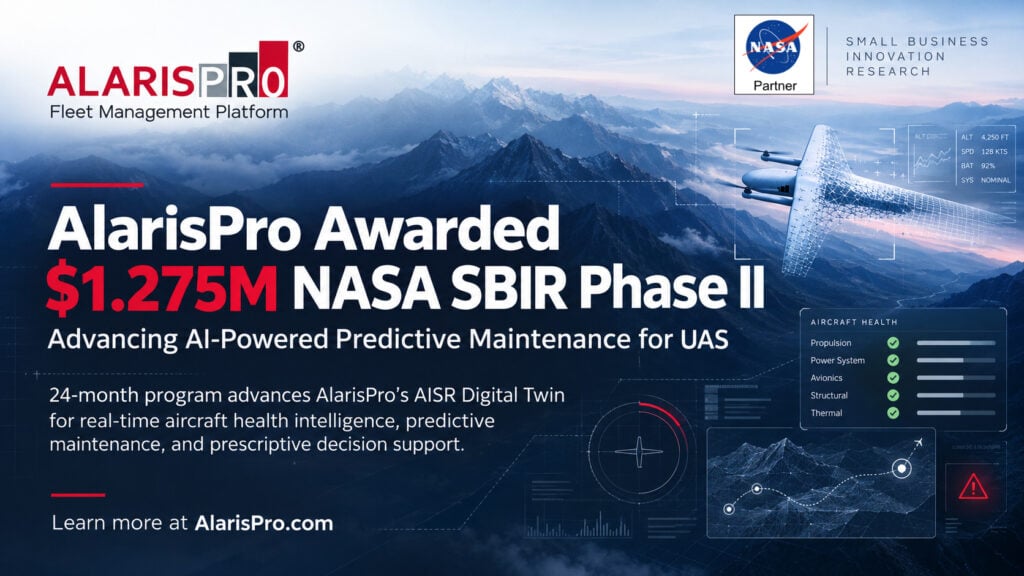
AlarisPro has secured $1.275M in Phase II funding through NASA’s Small Business Innovation Research (SBIR) program to advance its AI-Enhanced Safety and Reliability (AISR) Digital Twin framework for Uncrewed Aircraft Systems (UAS).
The 24-month initiative will advance validated Phase I feasibility work toward an operational demonstrator designed to convert UAS telemetry and historical reliability data into predictive, actionable safety intelligence.
While most existing fleet and asset management systems report past events or current operating conditions, the UAS industry has yet to demonstrate a consistently reliable capability to predict potential failures at the aircraft, subsystem, and component levels. Addressing this limitation represents an important opportunity for advancing predictive maintenance, reliability, and aviation safety software.
Anthony Pucciarella, Founder and CEO of AlarisPro, said, “That is the problem we are solving,” adding, “As UAS operations move toward routine BVLOS and fleets scale, regulators, operators, and OEMs need reliable, component-level insight into what is likely to happen next – and what action to take before aircraft availability or safety is affected.”
Advancing Predictive UAS Maintenance
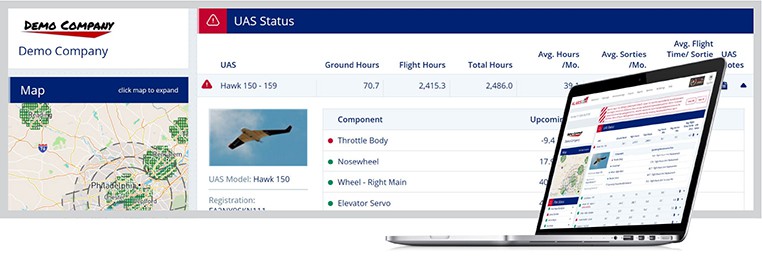
AlarisPro aims to extend its existing component reliability and continued-airworthiness platform into a predictive maintenance intelligence system capable of identifying potential aircraft health issues before they result in operational disruptions or safety events.
The NASA SBIR Phase II funding supports the development and operational validation of the AISR Digital Twin, live telemetry processing, Prognostics and Health Management (PHM), and an AI/ML engine designed to detect anomalies, model degradation, and predict potential failures before they occur.
Earlier in 2026, AlarisPro’s Phase I work validated the architecture using real flight data from two UAS platforms and demonstrated cross-platform modularity across different aircraft and subsystems.
Phase II will advance these prototypes toward an operational system spanning three primary layers: onboard real-time health estimation and PHM, operator-facing alerts and maintenance recommendations, and a global intelligence layer designed to mine the AlarisPro Data Lake for cross-fleet patterns and model improvements.
This architecture directly supports NASA’s In-Time Aviation Safety Management Systems (IASMS) vision, which emphasizes continuous monitoring, predictive awareness of potential failures, and decision support for proactive risk mitigation.
The system is intended to help operators identify reliability concerns earlier, focus maintenance on genuine degradation risks, improve aircraft readiness, and strengthen the evidence supporting continued airworthiness.
Pucciarella commented, “The opportunity is to turn operational data into intelligence that operators can use before a discrepancy becomes an interruption or a safety event. That is the shift to true predictive maintenance.”
Pucciarella continued, “Phase I demonstrated that our approach has the potential to work across very different aircraft and operating environments. Phase II gives us the opportunity to advance that foundation much further,” adding, “Our goal is to help operators move beyond understanding what has already happened and toward understanding what may happen next. That shift has enormous implications for aircraft availability, maintenance planning, operational safety, and the future of advanced UAS operations.”
Supporting Aircraft Reliability and BVLOS Operations
As UAS operations move toward routine Beyond Visual Line of Sight (BVLOS) missions, aircraft reliability and continued airworthiness become increasingly important to safe, scalable operations. Scheduled inspections, disconnected records, and post-flight analysis alone cannot provide the continuous aircraft-health awareness these missions require.
The AISR Digital Twin is designed to address this challenge through onboard PHM, severity-ranked alerts, and structured continuing-airworthiness evidence, providing operators, Original Equipment Manufacturers (OEMs), and regulators with objective, traceable information about emerging component degradation.
Earlier identification of potential failures could allow operators and OEMs to move from reactive maintenance toward more proactive decision-making. Intended benefits include improved maintenance planning, increased aircraft availability, fewer unplanned disruptions, and greater confidence that aircraft can continue operating within a reliable safety envelope as fleet utilization and mission complexity increase.
AlarisPro also brings a decade-built foundation of aviation reliability knowledge and data, component performance insights, maintenance intelligence, and operational experience to the program.
Combined with live telemetry, this historical data is intended to provide the Global AI/ML Intelligence Engine with the context needed to improve model fidelity, identify potential failure precursors earlier, and generate increasingly precise maintenance recommendations.
The Phase II program will also support the development and validation of the core modeling techniques, data infrastructure strategy, and predict-and-prescribe architecture that AlarisPro intends to extend across its broader system-of-systems customer base.
These developments form part of the company’s goal of delivering what it describes as the first validated, platform-agnostic predictive maintenance solution for UAS.
Moving Toward Operational Demonstration
Over the 24-month Phase II program, AlarisPro will expand onboard subsystem coverage, advance hybrid AI/ML and PHM models, integrate operator-facing decision support, and operationalize cross-fleet pattern intelligence.
The program is intended to culminate in an IASMS-aligned operational demonstration and NASA transition package, advancing the technology toward potential operational deployment.
Beyond NASA, the same technical foundation offers a potential commercial pathway for UAS operators, OEMs, Maintenance, Repair, and Overhaul (MRO) providers, insurers, regulators, and other stakeholders.
By combining historical reliability information with real-time aircraft health monitoring, the technology aims to support earlier identification of component degradation, more proactive maintenance decisions, and stronger reliability evidence as UAS operations scale.
Pucciarella said, “NASA’s continued investment is significant for AlarisPro and the broader UAS industry. It helps move predictive safety intelligence toward operational use as fleets grow and routine BVLOS operations emerge. We believe this capability can become a critical part of how advanced UAS are operated and maintained safely.”