Unmanned Surface Vehicles (USV)
Discover cutting-edge solutions from 8 leading global suppliers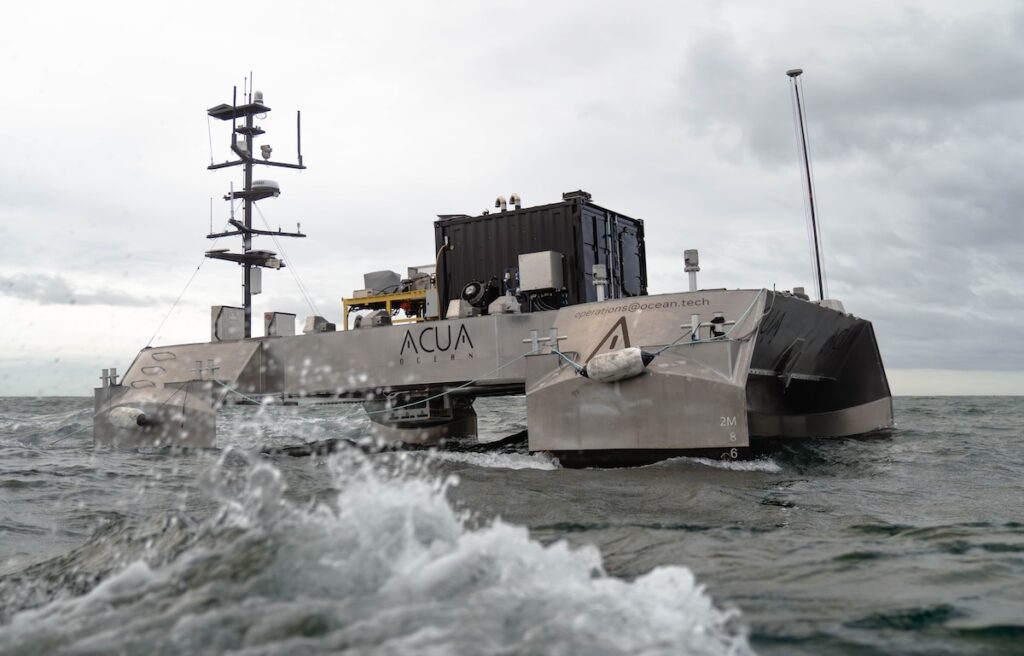
ACUA Ocean and Forssea Robotics have completed three weeks of integration trials off Plymouth, demonstrating fully remote subsea inspection and light intervention from an uncrewed surface vessel.
Conducted under a contract with the European Space Agency, the campaign paired Forssea’s 170kg ARGOS remotely operated vehicle (ROV) with ACUA Ocean’s USV Pioneer. Every launch, dive, and recovery sequence during the trials was commanded entirely from shore, targeting a persistent gap in the offshore inspection and survey market by enabling high-quality subsea operations from a vessel capable of remaining safely on station in adverse weather conditions.
Over six days of active at-sea testing, the integrated platform completed more than 40 ROV deployments, including eight launch-and-recovery cycles in a single day. Operations were conducted in wave heights reaching two meters south of the Plymouth breakwater, as well as in winds averaging 18 knots and gusting between 20 and 30 knots, with no impact on ROV performance. Deploying up to 35 meters of tether, the ARGOS ROV inspected seabed targets deeper than 20 meters, including test inspections on The Poulmic wreck and a concrete target block in Cawsand Bay.
The operational capability relies on complementary technical strengths. USV Pioneer provides a stable surface platform that enables operations in higher sea states than equivalent crewed vessels, extending workable operational windows and reducing weather-related downtime. Forssea’s all-electric ARGOS ROV is equipped with a bespoke “plug & play” USV integration kit, delivering high-maneuverability inspection, survey, and light-intervention performance.
Undersea positioning was supported by Sonardyne, utilizing a pole-mounted Mini-Ranger 2 ultra-short baseline system on USV Pioneer to track a WSM6+ transponder on ARGOS. The setup supported both manual and dynamic-positioning station keeping, holding the ROV accurately on task in degraded ocean conditions.
Control was executed as a unified, remotely supervised package from the ACUA Ocean Remote Operations Centre at Turnchapel Wharf, with simultaneous supervision from Forssea’s headquarters in Sète, France. A demonstration dive was also live-streamed to the Cyber Innovation Hub of the Bundeswehr in Eckenforde, Germany.
The integrated solution targets offshore energy operators, subsea inspection, repair, and maintenance providers, critical national infrastructure security stakeholders, and survey companies. By eliminating reliance on large crewed support vessels, the technology lowers operational costs, reduces carbon emissions, and minimizes personnel risk across wind farms, pipelines, and subsea infrastructure.
“These trials prove we can open a weather window that conventional crewed vessels cannot work in, giving operators a wider weather window for inspection campaigns. Just as importantly, running inspection campaigns from an uncrewed surface vessel takes significant cost out of the work – fewer support vessels, fewer people offshore and far less weather-related downtime,” commented Neil Tinmouth, CEO ACUA Ocean.
“All of us at Forssea are hugely proud of this milestone and impressed by Pioneer’s sea-state capabilities. Seeing how smoothly the ROV integration and the multiple launch-and-recovery sequences went over the past few weeks was hugely satisfying. My congratulations to the ACUA engineering teams – we are excited to see what comes next,” added Gautier Dreyfus, CEO Forssea Robotics.
Following the successful completion of trials, the integrated ROV–USV solution is commercially available for offshore campaigns.