Unmanned Helicopters
Discover cutting-edge solutions from 5 leading global suppliers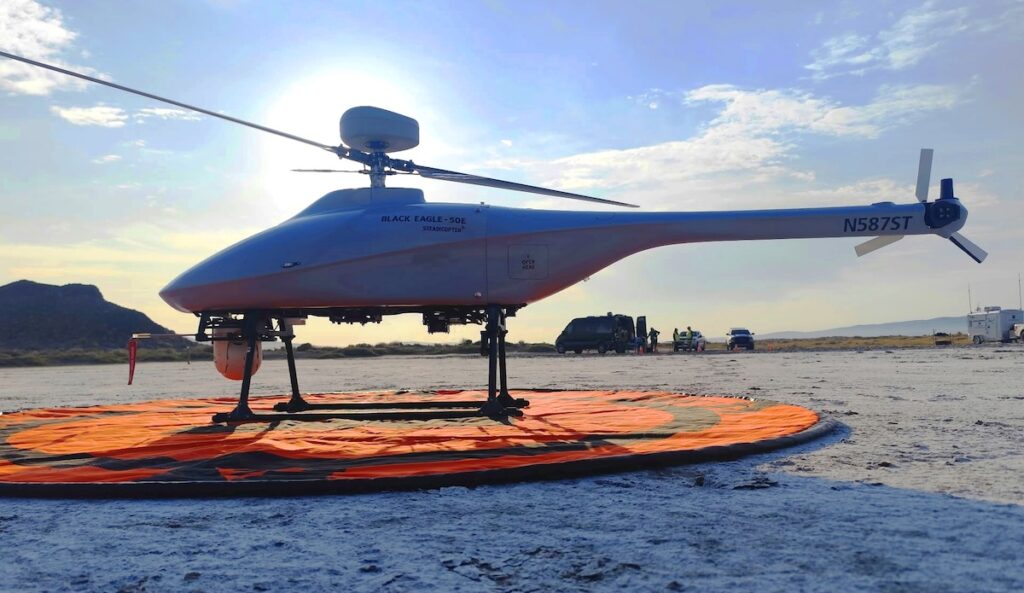
Steadicopter Ltd. has reached a key milestone toward expanding U.S. operations for its Black Eagle 50E uncrewed helicopter following airworthiness validation and Federal Aviation Administration (FAA) operational authorizations.
The electric Black Eagle 50E aircraft completed an airworthiness validation process conducted through the Nevada Unmanned Aircraft Systems Test Site (Nevada UASTS), operated by the University of Nevada, Reno. Following the assessment, Nevada UASTS issued an Airworthiness Statement covering all Black Eagle 50E aircraft in the U.S. operated by Steadicopter’s U.S. Demonstration and Operational Readiness Partner, Alchemy Analytics (flyAlchemy).
The validation complements FAA Certificates of Waiver or Authorization (COAs) supporting flight operations across designated areas totaling more than 8,100 square miles. Together, the operating authorizations and airworthiness validation provide a foundation for continued Black Eagle 50E flights, customer demonstrations, training, mission evaluations and the development of operational use cases in the United States.
Combining vertical takeoff and landing capability with endurance and payload capacity, the electric Black Eagle 50E can operate without conventional runway infrastructure. The U.S. program will support mission development for defense and security, Intelligence, Surveillance and Reconnaissance (ISR), public safety, critical infrastructure, remote sensing and emergency response.
Noam Lidor, CEO of Steadicopter, commented, “This milestone represents an important step in establishing a sustained U.S. operational capability for the Black Eagle 50E. The Nevada UASTS process and FAA operational authorizations provide the foundation to move beyond initial demonstrations and evaluate the platform against real customer and mission requirements, while reinforcing our long-term commitment to the U.S. market.”
From its Reno-Stead Airport base in Nevada, flyAlchemy has coordinated U.S. flight operations and supported airworthiness activities, regulatory and operational planning, aircraft staging, mission development and preparation for customer demonstrations and evaluations.
Conrad Wright, Founder of Alchemy Analytics / flyAlchemy, added, “Completing the Nevada UASTS airworthiness process, together with the FAA operating areas already established, provides a strong operational foundation for the Black Eagle 50E in the United States. This work allows us to move beyond simply demonstrating the aircraft and begin evaluating complete mission capabilities against real U.S. customer requirements—from payload selection and integration through training, mission-specific demonstrations and operational evaluations.”
The companies will now expand U.S. customer and partner engagement, conduct mission-specific demonstrations and evaluations, integrate additional payloads, and pursue additional operating areas and authorizations as customer requirements develop.