


The future of air power demands cost-effective, autonomous aircraft that can operate in tandem with human-crewed fighters like the F-35 Lightning II and Next-Generation Air Dominance (NGAD) systems. These aircraft must extend surveillance, engage threats, relay intelligence, and operate independently or in coordination with the rest of the force.
The Gambit Series embodies this shift—a family of unmanned collaborative aircraft designed for highly specialized roles in modern warfare. Unlike single-purpose collaborative platforms, Gambit features four distinct variants, each engineered for specific mission sets:
A defining feature of the Gambit Series is its modular common core architecture, which standardizes major subsystems across all variants to enhance affordability, interoperability, and scalability.
Gambit Core: A Modular Foundation
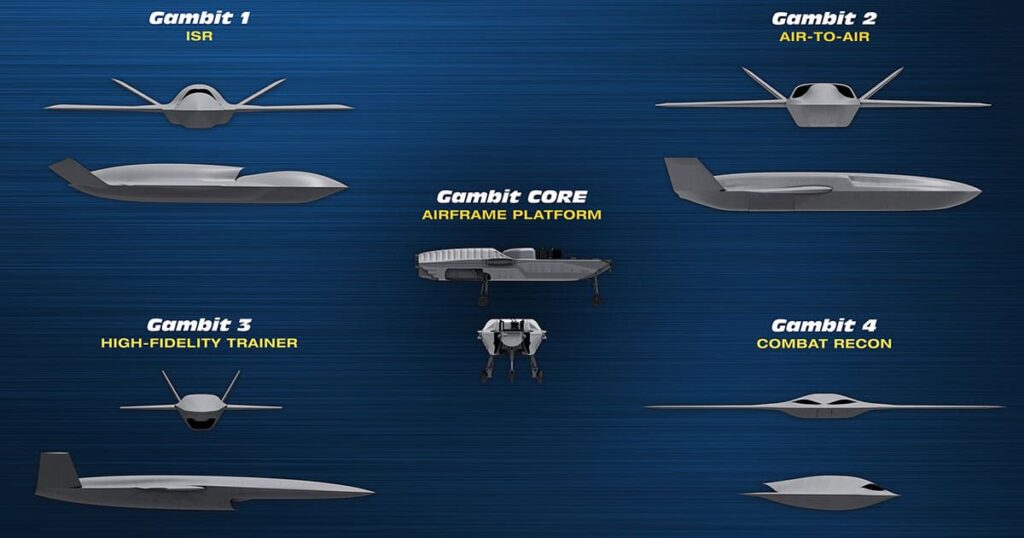
At the heart of the Gambit Series is Gambit Core, a shared platform that comprises approximately 70% of the total system cost across all variants. This core includes:
- Landing gear
- Baseline avionics
- Chassis
- Essential onboard systems
By leveraging a common hardware foundation, Gambit Core significantly reduces costs while maintaining flexibility for mission-specific adaptations. Each variant builds upon this core by incorporating different engines, fuselage designs, wings, and mission systems to optimize performance for its designated role.
Gambit Variants and Their Roles
Gambit 1 – Long-Endurance ISR
Gambit 1 is a high-endurance intelligence, surveillance, and reconnaissance (ISR) platform optimized for persistent operations. Designed to function as the eyes and ears of a combat force, it can accompany other unmanned aircraft or operate alongside human-crewed fighters at the forefront of a strike package.
By prioritizing fuel efficiency and aerodynamic design, Gambit 1 is ideal for early warning and extended surveillance missions over contested airspace.
Gambit 2 – Air-to-Air Combat

Gambit 2 introduces air-to-air combat capabilities, equipping the aircraft with weapon systems to engage enemy aircraft. While it sacrifices some of the endurance of Gambit 1, this variant compensates with firepower, allowing it to hold even advanced aerial threats at risk.
Its optimized outer mold line enhances combat performance, making Gambit 2 a formidable force in contested airspace operations.
Gambit 3 – Advanced Trainer

Gambit 3 is designed for complex adversary training, serving as an autonomous aggressor aircraft for U.S. and allied fighter pilots. While it shares design similarities with Gambit 2, this variant is specifically tailored to simulate high-end threats for advanced pilot training exercises.
By integrating with U.S. integrated air defense systems and other fifth-generation tactical assets, Gambit 3 enhances realistic combat training while reducing the operational and sustainment costs of traditional adversary aircraft.
Gambit 4 – Stealth Combat Recon

Gambit 4 is a stealth-optimized combat reconnaissance aircraft built for high-risk intelligence gathering in contested environments. Featuring a tailless, swept-wing design, it prioritizes low observability, enabling it to operate undetected while conducting long-endurance missions.
This variant is engineered for specialized reconnaissance tasks, leveraging stealth technology and advanced mission systems to penetrate hostile airspace without detection.