


In a new whitepaper, Meshmerize examines how predictable radio-link behavior can support drone networks as they grow from individual connections into larger multi-hop systems. Read more >>
The paper focuses first on the link between two nodes, where range, interference, asymmetric conditions, and mixed traffic can introduce instability before mesh routing becomes the main challenge. It also looks at WFB-ng as a single-link approach before explaining how Meshmerize extends link control across a broader networking system.
Meshmerize outlines control over transmission-rate behavior, spatial streams, acknowledgment behavior, and link operation under traffic pressure. These capabilities are combined with traffic-aware Quality of Service, end-to-end reliability above link-level acknowledgments, and multi-hop scaling.
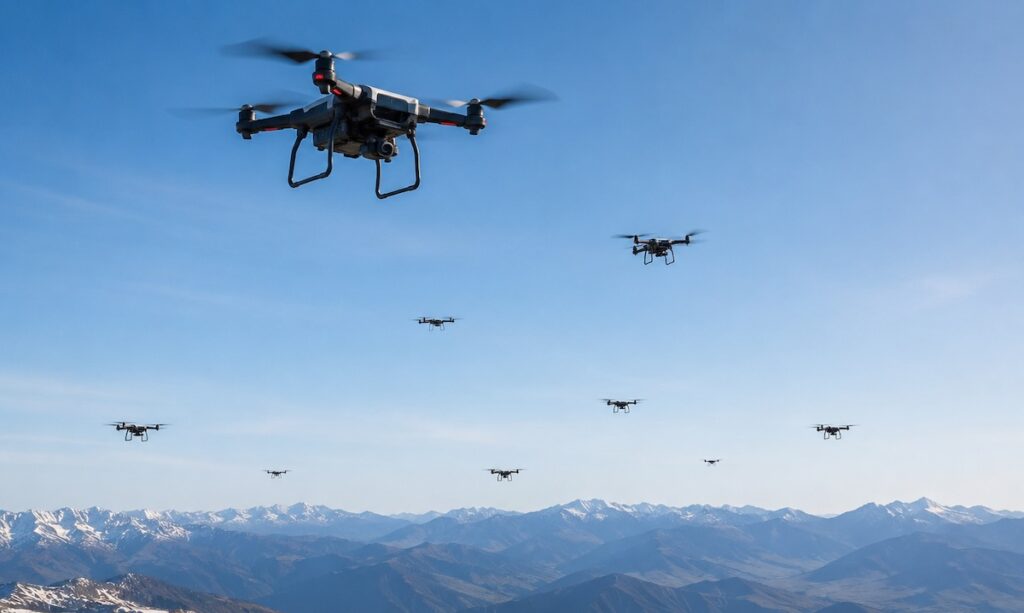
The whitepaper also references a Meshmerize swarm deployment involving more than 50 drones operating up to 50 km from ground control. According to Meshmerize, each drone broadcast 3D geolocation data five times per second at approximately 200 kbps per drone. The deployment also included five simultaneous video streams at 2.5 Mbps each and five drones carrying long-range relay radios.
For teams evaluating the technology, Meshmerize describes a deployment path that starts with two nodes and measures round-trip time, packet delivery, and control-traffic behavior under payload load before additional relay or air nodes are introduced.