Making aviation history doesn’t happen overnight.
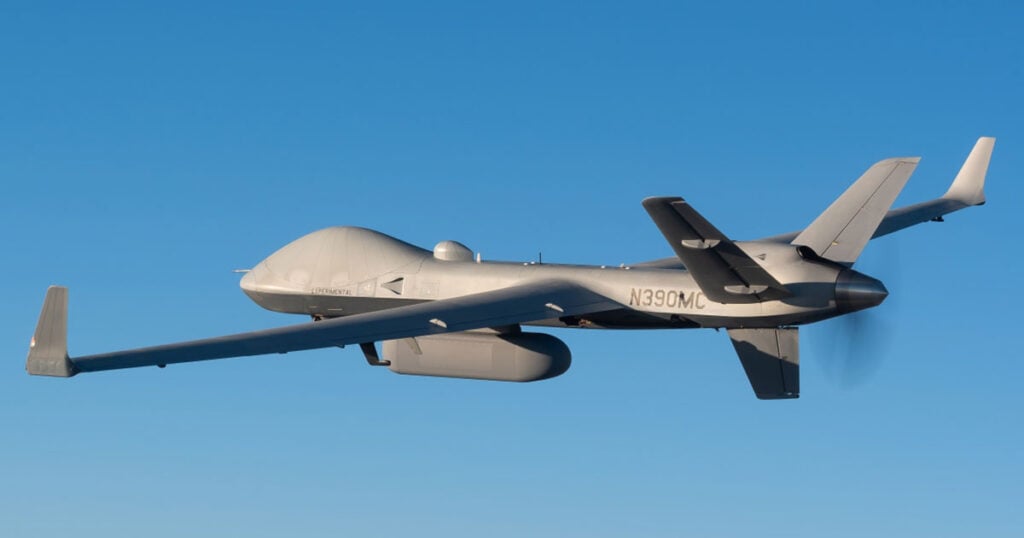
Engineers and executives at General Atomics Aeronautical Systems, Inc., were confident the short takeoff and landing demonstrator Mojave could, and would, launch from an aircraft carrier and then land back aboard the first time.
They just hadn’t ever done it before.
“It’s sort of like when you take your 4×4 sport utility vehicle out onto a backcountry trail for the first time,” said one engineer involved with the project. “You know it was built for that. You know it’s got a mode for that, it’s got the right tires, high clearance, everything. You just need to go out and prove it.”
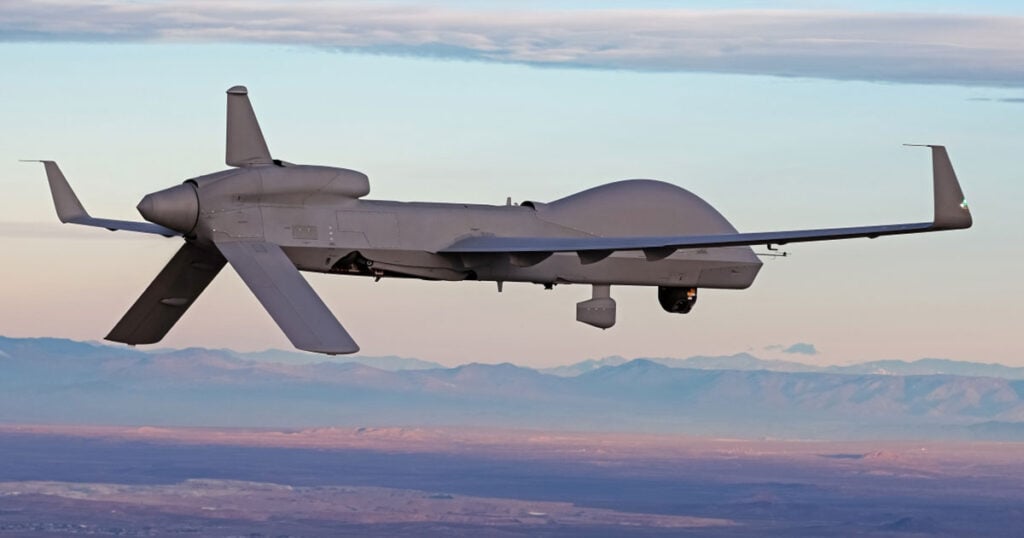
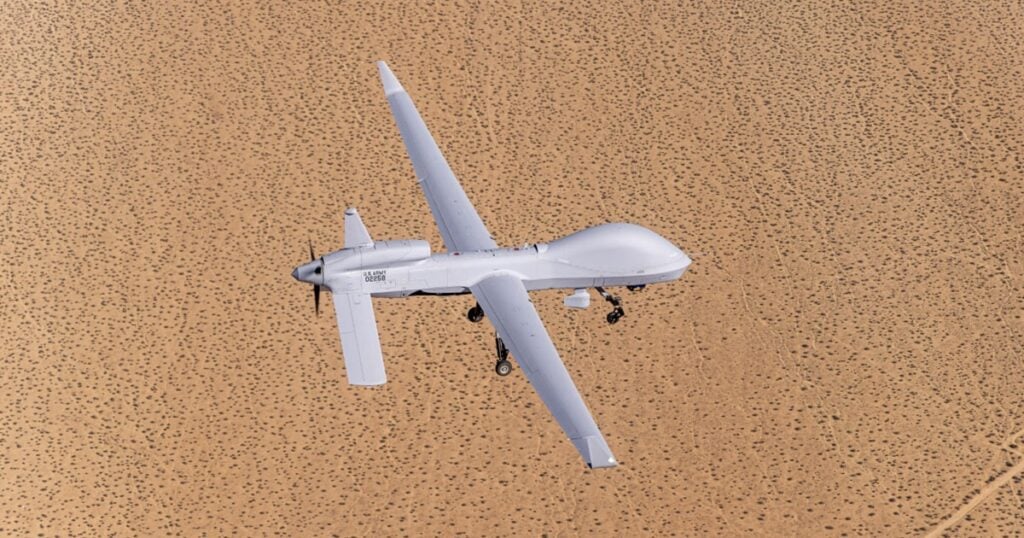
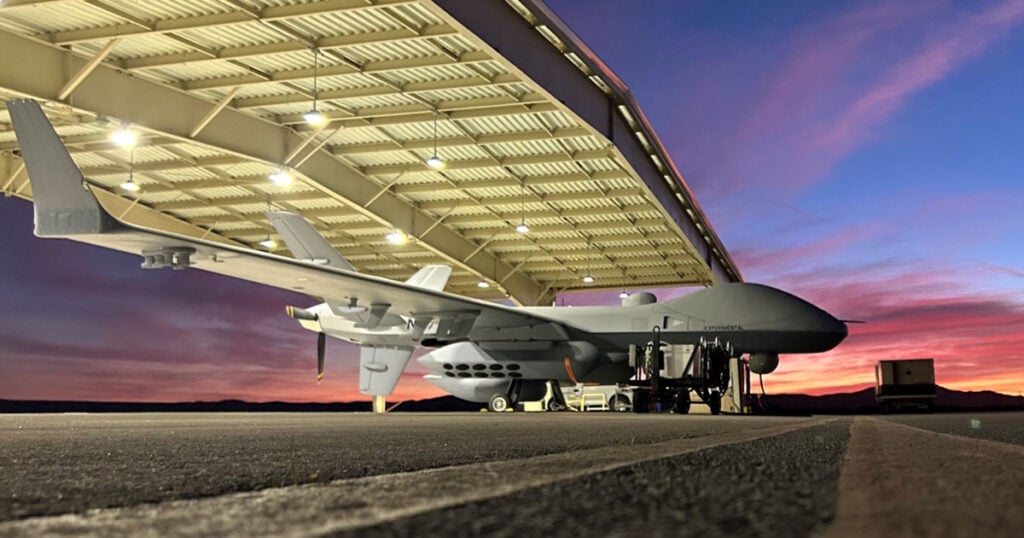
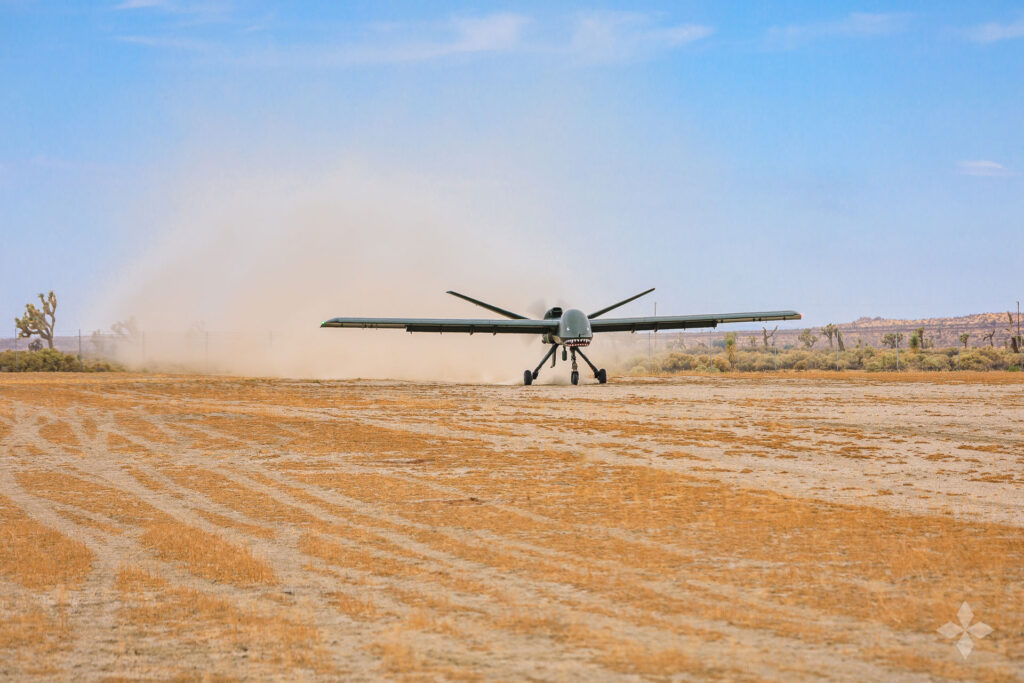
Likewise with the Mojave, a medium-altitude, long-endurance aircraft derived from the company’s highly successful Gray Eagle. With a different engine, wings, control surfaces and landing gear, Mojave had been built to need less ground roll for takeoff and landing, as well as operate from rough or unimproved surfaces.
That, in fact, it had done, with highly successful tests in the California high desert. The aircraft drove through dust and sand at an unpaved test strip with no problem and got airborne in around 586 feet. Those tests mostly were focused on demonstrating the capability, not minimizing the takeoff distance or landing roll.
When they were complete, the engineering team needed to apply what they’d learned to a new operating environment: a ship at sea.
Feet Wet
Fortunately, GA-ASI has an eager partner just as interested in leaning forward into what’s possible.
The British government is a world leader in innovative medium-altitude, long-endurance, remotely piloted aircraft systems. The Royal Air Force is taking delivery of its MQ-9B Protector RG Mk 1 aircraft, manufactured by GA-ASI with significant industrial input from British companies and experts, and the Royal Navy was interested in seeing what Mojave could do aboard one of its most important warships, the aircraft carrier HMS Prince of Wales.
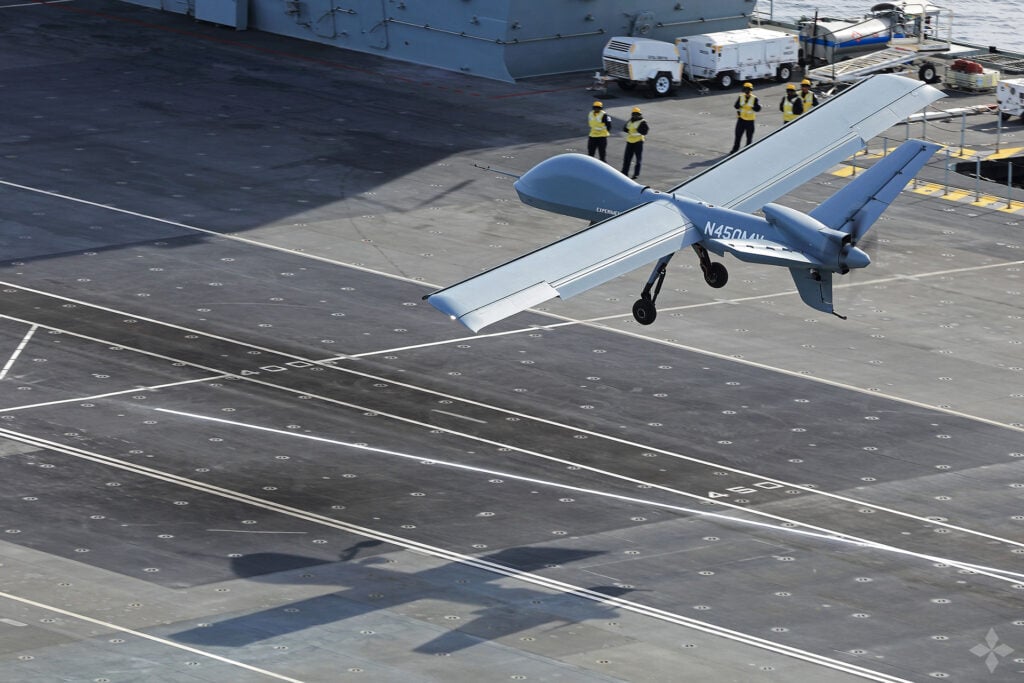
That meant, first, an analysis about how best to operate the aircraft from the ship’s flight deck. One thing the study returned was the conclusion that, even though HMS Prince of Wales has an inclined ramp at its bow to help its jets power into the air on takeoff, Mojave wouldn’t need that. Rather than driving the aircraft to a conventional starting position and then running straight down the normal launch axis of the carrier, Mojave could take off in a run from the stern at an angle toward the left – or as sailors say, port – side of the flight deck.
Another factor to consider was the difference between the way remotely piloted aircraft typically are flown – from a ground control station firmly stable on terra firma – and the way Mojave’s pilots would need to be situated on the ship. So GA-ASI engineers built a ground control station on the back of a truck bed and drove it at speeds similar to those used by the Prince of Wales when it’s underway at sea for flight operations.
“One thing we learned real quick was that our guys needed seat belts!” laughed another engineer in the team. “We got them set up with harnesses, they continued training and it didn’t take very long to get the hang of it. These are the kinds of things you always learn when you’re taking something from the concept stage to the operational stage.”
Through more than 100 real-life takeoff and landing cycles at a company test facility, as well as new software for the aircraft, the engineering team achieved a smooth process of execution and developed great confidence in their ability to take the Mojave from land to sea.
“We were hitting the box every time,” the second engineer said. “We knew it was going to go good.”
So it proved, with a successful takeoff on the first attempt from HMS Prince of Wales at sea off the East Coast of the United States. The ship’s flight controllers talked on the radio to Mojave’s pilot as though he were onboard the aircraft, even though he was sitting at his instruments in a different part of the ship. After the flight, the ship recovered the aircraft as expected, just as it would any other in its air wing.
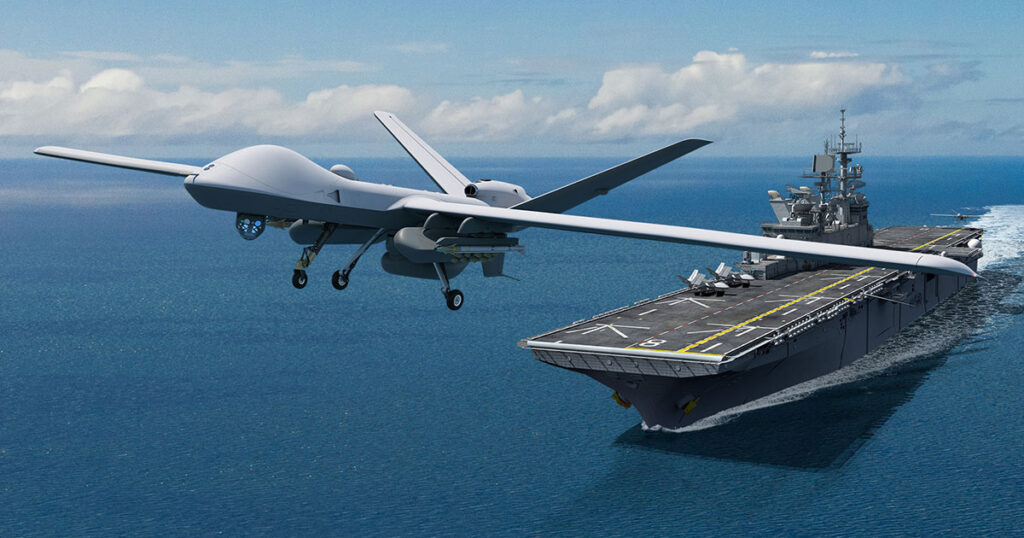
Mojave’s carrier operations were part of a broader effort by GA-ASI and its partners to push the world-changing capabilities of medium-altitude, remotely piloted aircraft. These aircraft have changed warfare, intelligence, disaster response, lifesaving and other missions forever, though nearly always operating from conventional land bases.
Maritime Operations
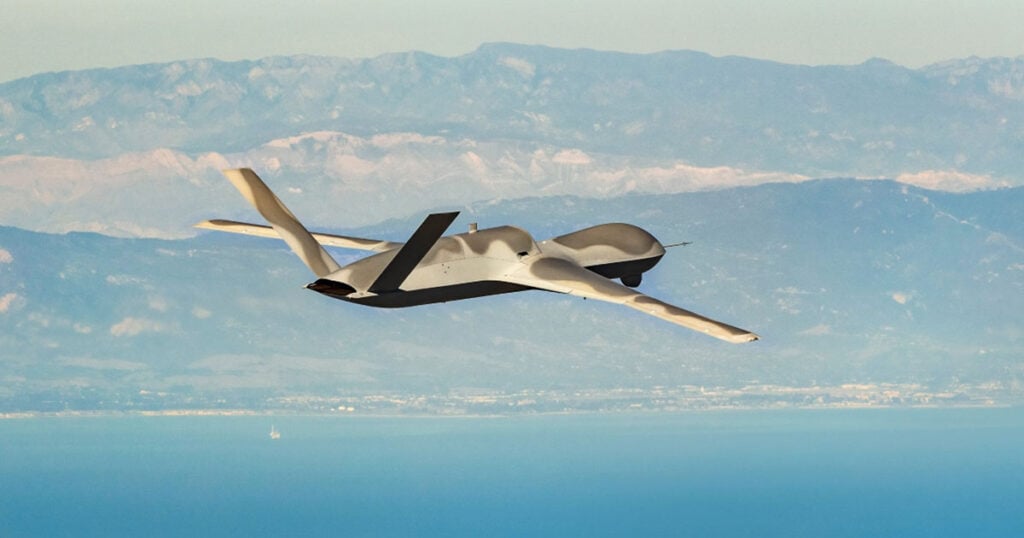
More than 70 percent of Earth’s surface, however, is ocean. Deploying a new aircraft such as the short takeoff and landing, or STOL, variant of the MQ-9B SeaGuardian – larger and more capable than the demonstrator Mojave – will revolutionize how navies operate.
The current version of the MQ-9B can fly for 40 hours, in some configurations, far longer than any conventional human-occupied aircraft. It has already logged many operational successes in service with the Japan Coast Guard, the Indian Navy and in exercises with the U.S. and international navies. A sea-based STOL version would take those capabilities anywhere allied warships, like the HMS Prince of Wales, need to operate.
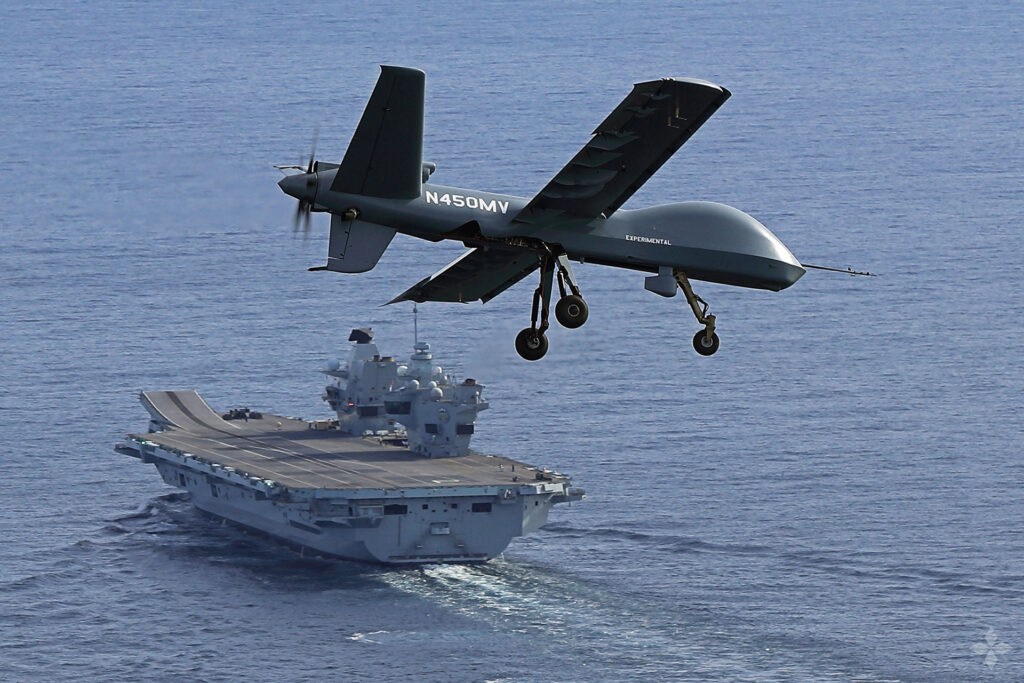
MQ-9B STOL might contribute to fleet defense by serving as an intelligence, surveillance and reconnaissance platform for the carrier strike group. It might scout ahead to be sure the waters were clear ahead of the ships’ transit through a choke point. The ship might serve as a communications relay, or it might help hunt for enemy submarines.
Or allied militaries could launch MQ-9B STOL and deploy it to coastal areas, or deep inland, to contribute to missions without the need for a regional airbase on land to support the aircraft. MQ-9B STOL could support humanitarian assistance and disaster recovery operations such as with wildfire response, flood recovery, or take on a number of other roles staging from the carrier offshore.
Mojave’s successful test aboard HMS Prince of Wales has shown what’s possible and where new aircraft could lead; Royal Navy leaders already say they are thinking about what will come next.
“During a deployment centered around experimentation and expanding the envelope of the Queen Elizabeth class, this is one of the highlights,” said Royal Navy Cmdr. Martin Russell, head of air operations aboard the HMS Prince of Wales. “Integrating the Navy Develop and General Atomics personnel into the Prince of Wales team was key to enabling such a large remotely piloted air system to operate from the deck during this trial, with the capability feeling like a glimpse into the future of these ships.”
The Royal Navy’s Second Sea Lord, Vice Adm. Martin Connell, also suggested that his might not be the only sea service that could adopt new aircraft and capabilities following the demonstration about what’s possible for these platforms at sea.
“With so many international partners interested in the results of these Mojave trials on board HMS Prince of Wales, I am delighted that we are taking the lead in such exciting and important work to unlock the longer-term potential of the aircraft carrier and push it deep into the 21st Century as a highly potent striking capability.”