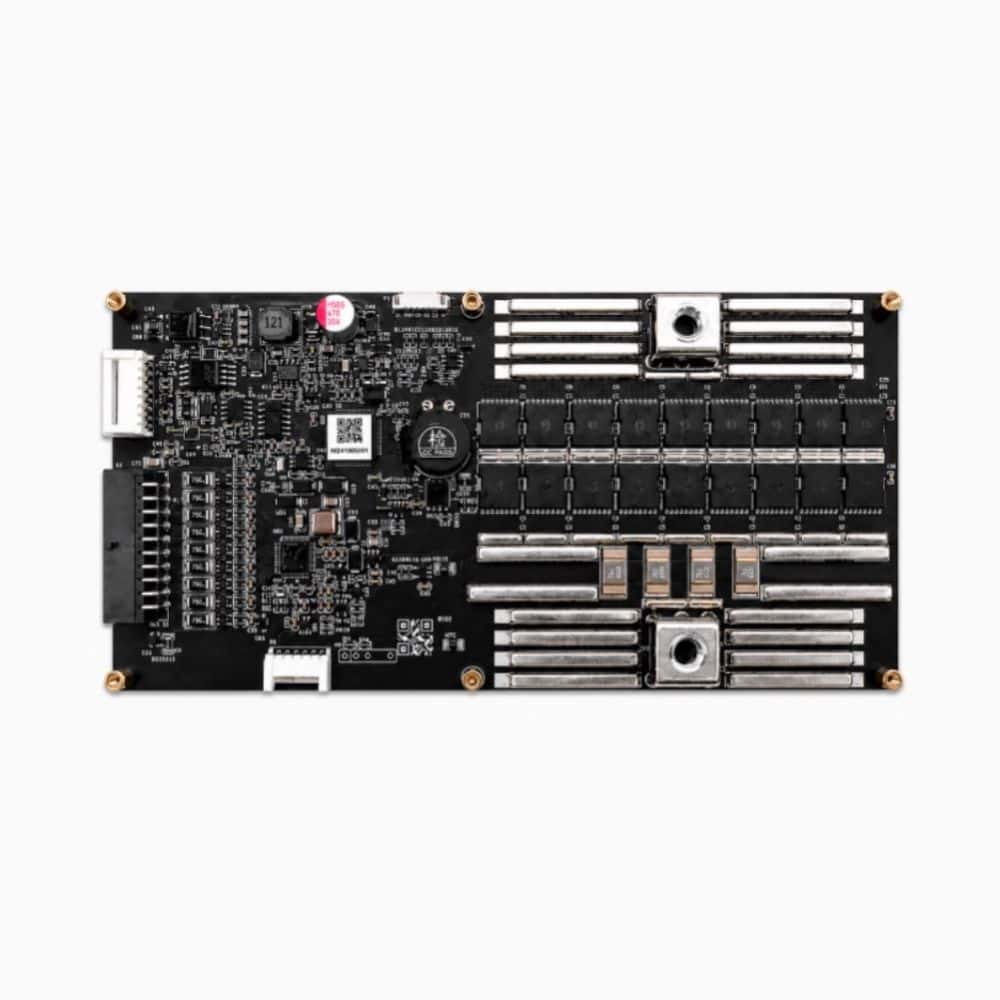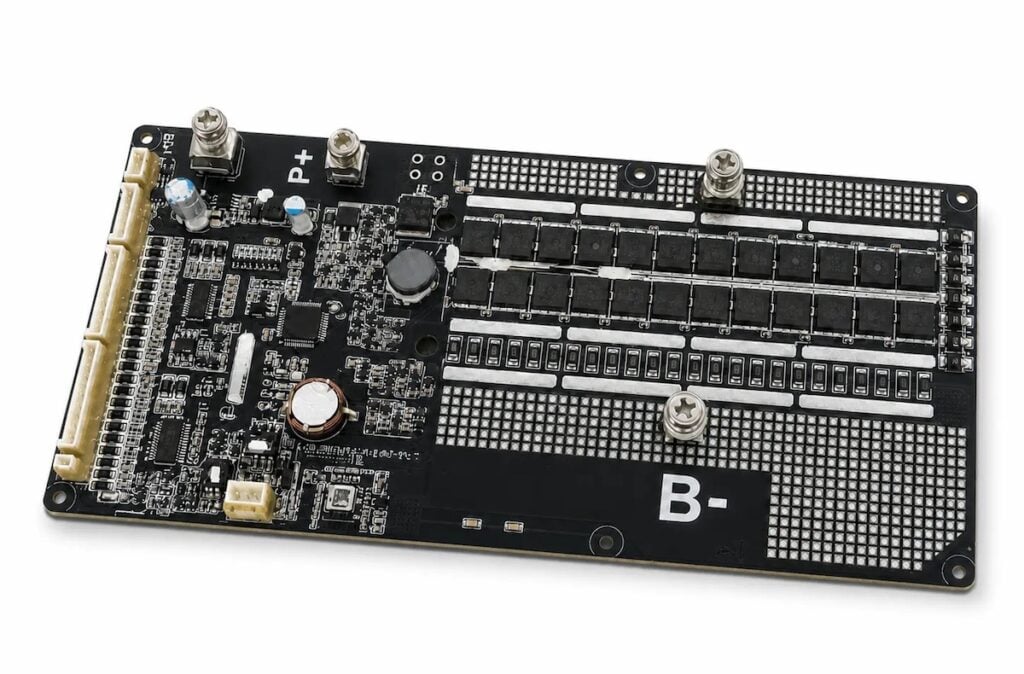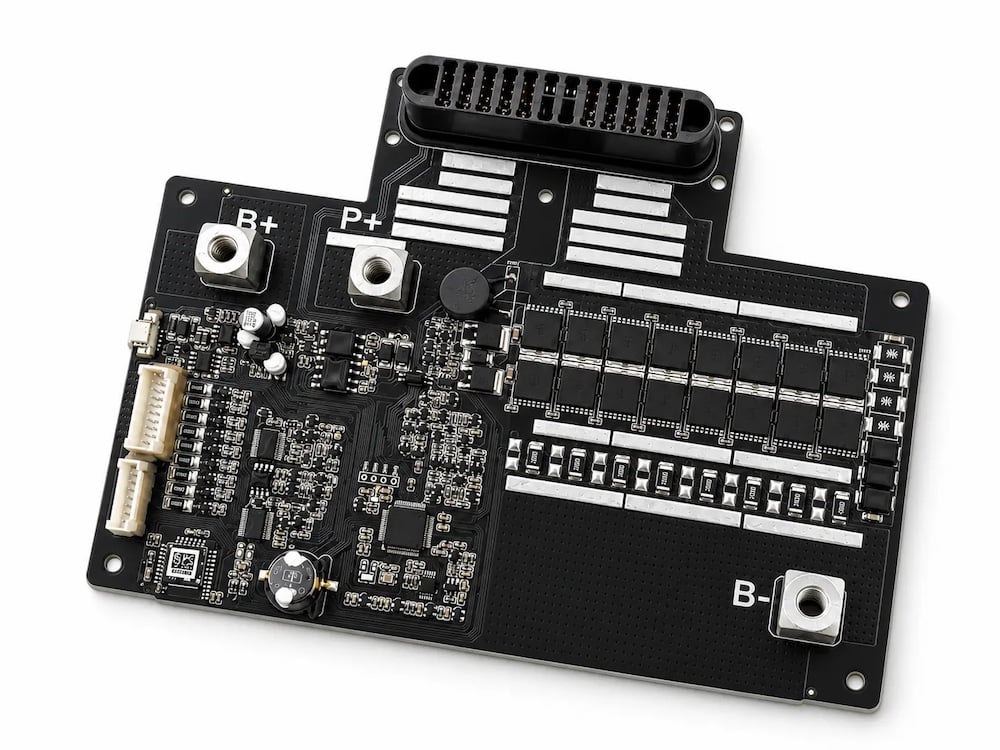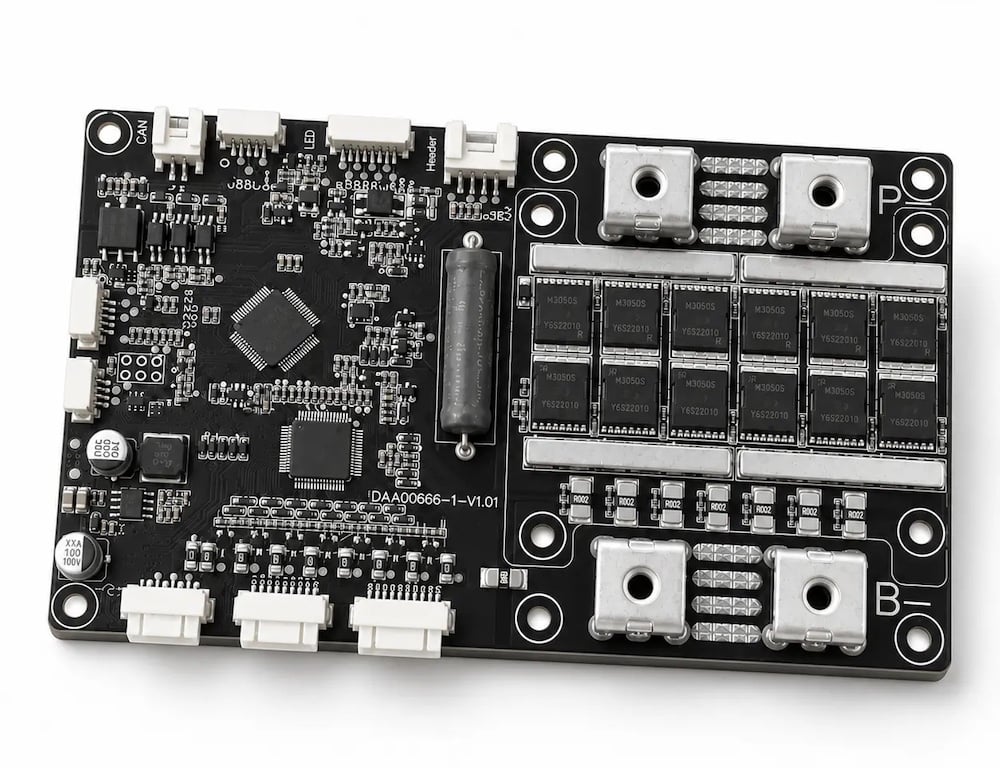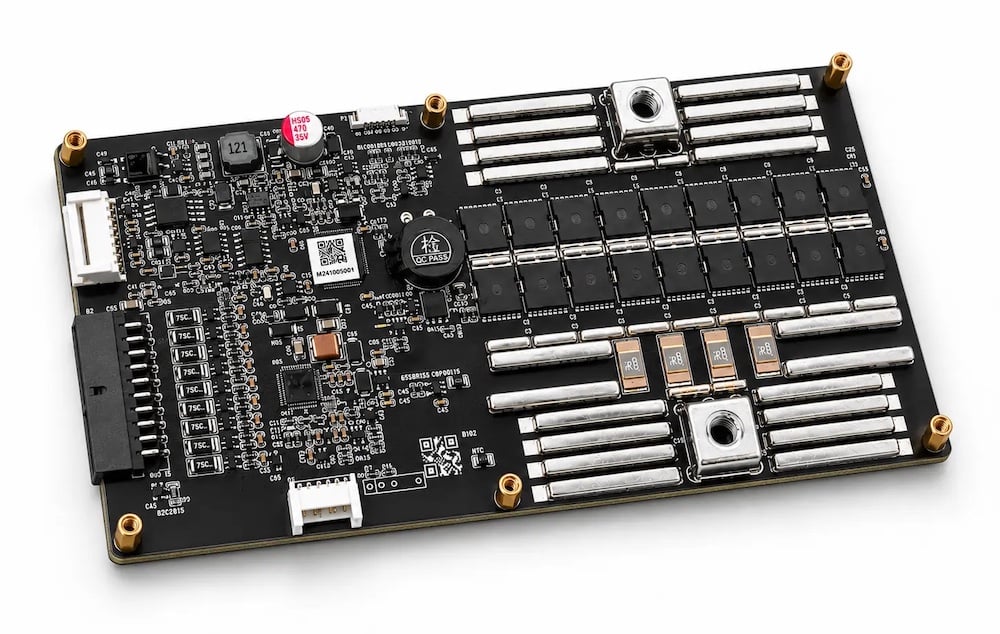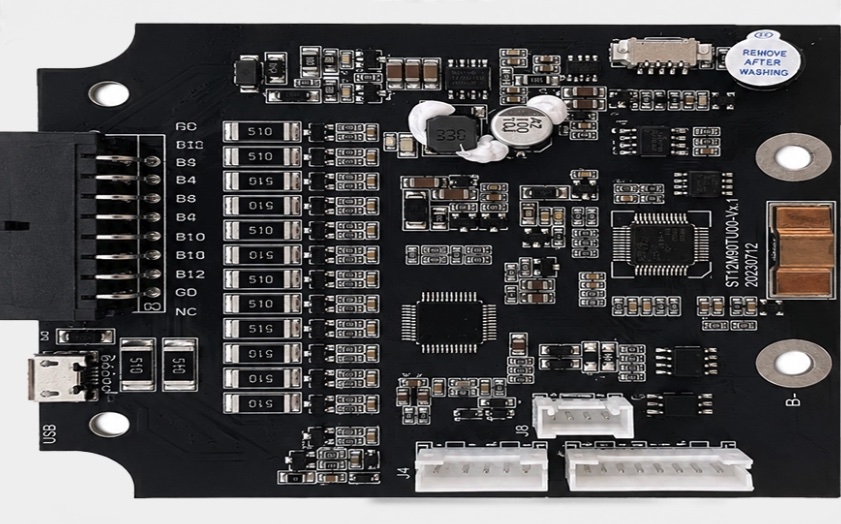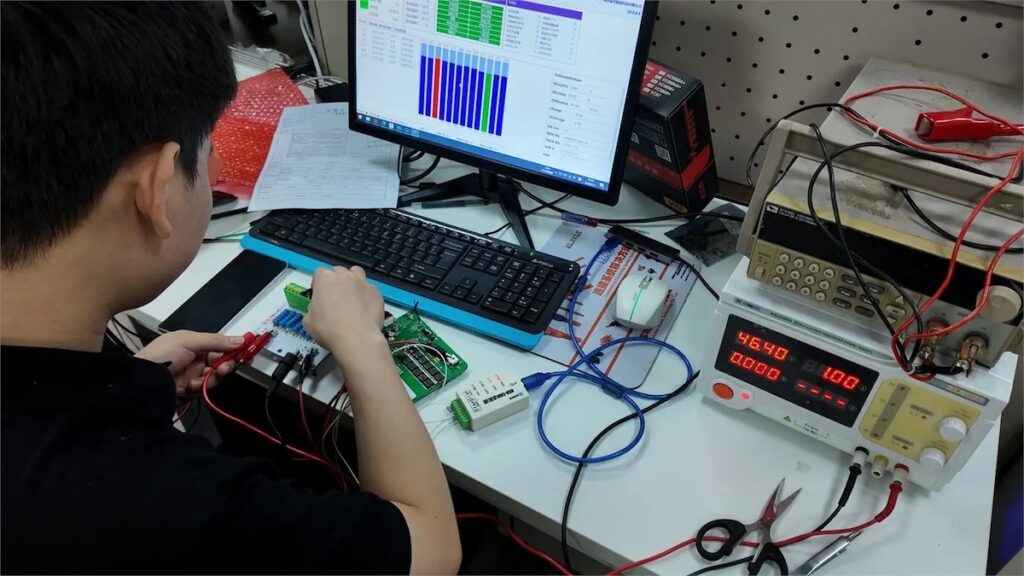
Below, AYAATECH explores how modern drone battery management systems support safer and more reliable industrial UAV operations, examining the role of real-time cell monitoring, thermal protection, active balancing, current regulation, and battery health data in reducing in-flight power risks and extending battery service life.
The Real Cost of Battery Failure in Industrial Drone Operations
In 2024, a European energy company lost a $45,000 inspection drone when its battery pack failed mid-flight over an offshore wind farm. The lithium pack, lacking a proper battery management system, experienced a single-cell voltage collapse — and within seconds, the UAV was unrecoverable.
This isn’t an isolated incident.
Industrial drones fly in conditions consumer drones never face: 40°C+ heat above solar farms, sub-zero temperatures during pipeline inspections in Siberia, heavy payloads on construction sites, and continuous 40-minute missions over agricultural fields. In every one of these scenarios, the battery is the single most stressed component — and the most common point of failure.
A drone BMS (Battery Management System) changes that equation. It’s not just a protection circuit — it’s the difference between a completed mission and a $50,000 write-off.
What Makes a Modern Drone BMS Different
Ten years ago, a “BMS” on a drone battery meant a basic overcharge protection board — essentially a cutoff switch. If voltage went too high, it disconnected. If temperature spiked, it disconnected. That was it.
Today’s drone battery management systems are fundamentally different. They’re embedded intelligence platforms that continuously monitor, predict, and optimize battery behavior throughout the entire charge-discharge cycle.
Here’s what a modern drone BMS actually does:
- Real-time per-cell voltage monitoring — tracking each cell individually, not just pack-level averages
- Active cell balancing — redistributing energy between cells during both charge and discharge
- Dynamic current regulation — adjusting power delivery based on flight phase (takeoff surge vs. cruise efficiency)
- Multi-point thermal sensing — typically 2–4 sensors placed at critical heat zones
- State-of-Charge (SOC) and State-of-Health (SOH) estimation — not just “how much juice is left,” but “how healthy is this pack after 200 cycles”
- Fault prediction and logging — flagging anomalies before they become failures
The difference is measurable. In testing environments, UAVs equipped with advanced drone BMS solutions consistently demonstrate 30–40% longer battery cycle life compared to basic protection-only boards — simply because cells are kept within optimal voltage and temperature windows at all times.
Key Technologies Powering Advanced Drone BMS
Intelligent Voltage Management & Cell Balancing
Lithium polymer (LiPo) and lithium-ion (Li-ion) packs used in industrial UAVs typically contain 4 to 12 cells in series. Without active balancing, voltage drift between cells is inevitable — and it accelerates with every charge cycle.
Here’s why this matters: in a 6S pack, if one cell drops to 3.2V while others sit at 3.7V, the BMS has two choices — cut off the entire pack (mission over) or let the weak cell continue discharging (permanent damage). A drone BMS with active balancing solves this by shuttling energy from higher-voltage cells to the lagging one in real time, keeping all cells within 10–20mV of each other.
Result: more usable capacity per flight, longer pack lifespan, and no surprise voltage sag at 30% remaining.
Multi-Zone Thermal Management
Heat kills lithium batteries faster than anything else. At 45°C internal temperature, cycle life degradation roughly doubles compared to 25°C operation. For drones flying inspection routes over solar farms in Arizona or pipeline patrols in the Middle East, this isn’t a corner case — it’s daily reality.
Advanced drone battery management systems place thermal sensors at multiple strategic points: near the main discharge MOSFETs (where switch losses generate heat), at the cell terminals (where internal resistance heating concentrates), and on the BMS PCB itself. When any zone exceeds safe thresholds, the system responds in layers:
- Throttle back — reduce maximum discharge current by 15–30%
- Alert the operator — push a warning to the ground station with remaining safe flight time
- Emergency disconnect — cut power only as a last resort if temperature continues rising
This layered approach means the drone can often complete its mission safely rather than aborting unnecessarily.
Smart Current Regulation During Mission-Critical Flight Phases
Takeoff draws 3–5x more current than cruise flight. A heavy-lift agricultural drone spraying pesticide might pull 120A for the first 15 seconds, then settle to 35A for the remainder of the flight.
A basic BMS treats all current demands the same — if 120A exceeds the threshold, it cuts off. A smart UAV battery monitoring system understands flight profiles. It allows brief current surges during takeoff and rapid maneuvers while enforcing stricter limits during sustained high-load scenarios that could cause cumulative heat buildup.
This is the difference between a drone that lifts off reliably 500 times and one that triggers false protection events every 20 flights.
Multi-Layer Protection Architecture
Protection isn’t one thing — it’s layers:
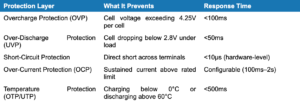
Each layer operates independently, so a failure in one protection circuit doesn’t compromise the entire system. This redundancy is one reason drone BMS systems from reputable manufacturers carry certifications like IEC 62133 and UN 38.3 — standards that require demonstrated fault tolerance.
Communication & Data Integration
A BMS that doesn’t talk is a BMS you can’t trust. Modern drone battery management systems support multiple communication protocols, each suited to different use cases:
- CAN bus — the standard for industrial UAVs; robust, differential signaling, multi-node support
- SMBus / I²C — common in smaller commercial drones; simpler, lower pin count
- UART (TTL) — direct serial link to flight controllers like Pixhawk and ArduPilot
- RS485 — long-distance wired telemetry for ground stations
- Bluetooth LE — convenient for pre-flight battery checks via smartphone
What flows through these channels? Real-time data streams that include:
- Per-cell voltages (mV precision)
- Charge/discharge current (A)
- Internal temperature at each sensor point
- Calculated SOC (%)
- Cycle count
- SOH estimate (%)
- Fault flags and event logs
For fleet operators managing 20+ drones simultaneously, this data feeds into ground control software or cloud dashboards. Instead of guessing which packs need replacement, operators get flagged alerts: “Pack #47: SOH at 72%, recommend cycling out within 10 flights.”
Drone BMS Across Industries
Agriculture
Crop spraying drones fly low, slow, and heavy — often carrying 20–40L tanks for 15–25 minute missions. The discharge curve is unusually flat, meaning the agriculture BMS must distinguish between a healthy pack at 30% SOC and a degraded pack that’s about to sag. Active balancing makes the difference here; without it, agricultural operators routinely over-discharge the weakest cell, killing packs in under 100 cycles.
Power Line & Pipeline Inspection
Inspection drones operate in electromagnetic environments that can induce noise on sensor lines. A well-designed drone BMS filters this noise rather than triggering false fault detections. Additionally, these missions often run BVLOS (Beyond Visual Line of Sight), meaning the operator can’t see the drone — battery telemetry is their only window into system health.
Mapping & Surveying
Photogrammetry missions require consistent speed and altitude for image overlap. Voltage sag mid-flight causes the drone to slow down, creating gaps in coverage that require costly re-flights. Cell-level voltage stability, maintained by the BMS, directly impacts data quality.
Emergency Response
Search-and-rescue drones face unpredictable conditions — sudden altitude changes, high winds, and the pressure of time-critical missions. The BMS must handle rapid current fluctuations without tripping protections, all while providing accurate remaining-flight-time estimates so operators know exactly when to recall the drone.
How to Choose the Right Drone BMS
Selecting a drone battery management system isn’t about checking boxes on a spec sheet — it’s about matching the BMS to your actual operational profile. Here’s what to evaluate:
1. Voltage and Cell Configuration
Match the BMS to your pack configuration (e.g., 6S, 12S, 14S). Over-speccing adds unnecessary weight and cost; under-speccing means the BMS can’t protect your pack properly.
2. Continuous Discharge Current Rating
This is where many buyers go wrong. A BMS rated for 60A continuous might handle your drone’s 55A cruise current on paper — but what about the 110A takeoff surge? Look for BMS solutions that specify both continuous and peak current ratings, with the peak duration clearly stated (e.g., “120A peak for 10 seconds”).
3. Communication Protocol Compatibility
If your flight controller speaks CAN, don’t buy a UART-only BMS and hope a converter will work. Protocol mismatches are the #1 source of integration headaches. AYAATECH’s BMS solutions, for example, ship with native CAN, UART, and RS485 support — eliminating the need for external adapters.
4. Thermal Design
Ask about sensor placement and count. Two sensors is minimum; four is better for larger packs. Also check if the BMS PCB itself is rated for the ambient temperature range your drones actually encounter, not just ideal lab conditions.
5. Certification Requirements
If you’re shipping to the EU or North America, your battery system likely needs UN 38.3 (transport safety) and potentially IEC 62133 (cell safety). A BMS that has been validated as part of a certified pack design saves months of re-certification work.
Quick Selection Checklist
- Series cell count matches your pack design
- Continuous current rating ≥ 1.3× your max sustained draw
- Peak current rating covers takeoff surge duration
- Communication protocol matches your flight controller
- Thermal sensor count ≥ 3 for packs over 10Ah
- Certifications aligned with your target markets
FAQ
Q: What is a BMS in drones, and why can’t I just use a balance charger instead?
A: A BMS is an onboard electronic system that monitors and protects each cell in your lithium battery pack during actual flight — not just during charging. A balance charger only works on the ground. The BMS is what prevents a single weak cell from collapsing mid-flight, cutting power, and downing your drone. For any industrial UAV carrying expensive payloads or flying over people, a BMS is not optional.
Q: How much extra weight does a drone BMS add?
A: A modern compact BMS for a 6S–12S pack typically weighs 30–80 grams — roughly 2–4% of a typical 2kg industrial drone battery. The weight is marginal compared to the cost of replacing packs prematurely or, worse, losing a drone to battery failure.
Q: Can a BMS extend my drone’s flight time?
A: Directly, no — a BMS doesn’t create energy. But indirectly, yes. By keeping all cells balanced and within optimal voltage ranges, a BMS enables you to safely use more of the pack’s actual capacity (higher depth-of-discharge without damaging cells). In practice, operators often report 5–10% more usable flight time per cycle compared to unprotected packs.
Q: What’s the difference between passive and active cell balancing?
A: Passive balancing burns off excess energy from higher-voltage cells as heat through resistors — simple but wasteful. Active balancing redistributes that excess energy to lower-voltage cells, preserving it for actual flight use. For industrial UAVs where every watt-hour counts, active balancing is worth the small additional cost.
Q: How do I know when my drone battery needs replacement?
A: A quality BMS tracks State-of-Health (SOH) over cycles. When SOH drops below 70–80%, internal resistance has increased significantly, capacity is diminished, and the risk of mid-flight voltage sag rises. The BMS can flag this automatically, removing the guesswork from fleet battery management.
Conclusion
Battery failure is the most preventable cause of drone mission loss — and a proper drone BMS is the single most effective safeguard against it. From per-cell voltage monitoring and active balancing to multi-zone thermal protection and real-time telemetry, modern BMS technology has evolved far beyond the simple cutoff boards of a decade ago.
For operators in agriculture, inspection, mapping, and emergency response — where every flight carries real cost and risk — investing in an advanced drone battery management system pays for itself in longer pack life, fewer aborted missions, and more predictable fleet operations.
Looking for a BMS solution matched to your specific UAV platform? Contact AYAATECH’s engineering team → to discuss your voltage, current, and communication requirements.