UAV engine combustion analysis systems provide critical, crank-angle-resolved data to ensure powertrain reliability and optimize range.
This category details leading providers and manufacturers of combustion analysis solutions, including research-grade indicating and flight-test diagnostic equipment. The following guide explores the technical considerations for specifying combustion analyzer instrumentation within unmanned aviation applications.
If you design, build or supply UAV Engine Combustion Analysis Systems, create a profile to showcase your capabilities and connect with visitors who have an active requirement for your solutions.
In-cylinder diagnostics for unmanned aerial vehicle (UAV) internal combustion engine (ICE) powertrains depend on highly integrated instrumentation and software stacks. These systems quantify thermodynamic activity directly inside the cylinder or infer it with high confidence across dynamic mission profiles. Operating at the modern nexus of propulsion development, flight-test validation, and structural reliability engineering, these platforms allow engineering teams to directly evaluate combustion phasing, cyclic stability, knock margin, mixture preparation, and localized thermal stress.
The immediate utility of this hardware lies in converting transient physical phenomena into structural ECU map adjustments, physical component modifications, or safe flight envelopes. Unlike generic automotive test benches, a specialized engine combustion test system deployed within drone applications must survive stringent size, weight, power, and cost (SWaP-C) constraints, withstand severe high-frequency vibration, tolerate alternator and ignition electromagnetic interference (EMI), and deliver high-fidelity diagnostics fast enough to support rapid, iterative field deployment. Propulsion engineers leverage these tools to match platform profiles with the correct architecture, spanning from high-fidelity test-cell indicating to ruggedized flight-test data loggers and embedded monitoring systems.
What Engineers Learn From Combustion Testing in UAVs
Implementing comprehensive combustion testing within an unmanned aircraft development program converts unobservable internal cylinder physics into clear metrics that dictate operational success. Relying solely on aggregate variables like brake torque or exhaust gas temperature (EGT) frequently masks destructive performance anomalies. An engine can exhibit seemingly normal thermal readings while undergoing excessive cyclic variability, destructive borderline knock at extreme density altitudes, or localized misfires.
Advanced combustion testing equipment exposes the precise boundaries imposed by mixture preparation, ignition energy, induction breathing losses, and cylinder-to-cylinder imbalances. In unmanned aviation, where propulsion performance directly governs platform endurance, payload power availability, rate of climb, and acoustic signatures, these insights are indispensable. By relying on objective indicators like mass fraction burned and pressure rise rates, propulsion teams eliminate trial-and-error methods, allowing rapid validation of changes made to propellers, intake configurations, alternative fuels, and electronic control strategies.
Types of Combustion Analysis Systems
Research-Grade Indicating Systems
Research-grade systems represent the laboratory benchmark for internal combustion engine testing. They deliver high-bandwidth, crank-angle-resolved measurements of in-cylinder pressure to compute IMEP, net mean effective pressure (NMEP), pumping losses, and precise mass fraction burned locations. These installations are optimized for stable test-cell environments where continuous power supplies, protected wiring runs, and rigid external encoders are readily integrated.
For foundational UAV development, these architectures are required to evaluate combustion chamber shapes, compression ratio limitations, ignition types, and intake manifold geometry.
Flight-test platforms trade extreme laboratory resolution for environmental ruggedness, compact enclosures, and field practicality. The engineering focus centers on high-shock data acquisition modules, sealed connectors, and processing metrics that remain accurate within high-noise environments. These field-ready combustion analyzers run continuously during flight campaigns, saving combustion stability values and knock variables alongside aircraft altitude, GPS speed, and ECU telemetry.
ECU-Integrated / Embedded Combustion Monitoring
Embedded architectures use production-grade sensors and processing hardware that remain permanently on board the aircraft. Rather than relying on direct cylinder head modifications, these configurations typically infer the combustion state by tracking ionization currents across the spark plug gap, reading rugged block-mounted resonant knock sensors, or processing high-speed crankshaft speed fluctuations. This delivers continuous health tracking and real-time fault isolation with minimal impact on platform SWaP constraints.
Hybrid Architectures With Edge Analytics
Hybrid setups combine distributed physical sensors with localized edge computing to calculate complex combustion variables in real time, minimizing telemetry bandwidth requirements while preserving critical raw metrics. This balance allows teams to install a single direct cylinder pressure sensor or a high-response ion-sensing module alongside real-time calculators that output IMEP trends and knock indices directly to the primary flight logger.
DC Inc. manufactures dedicated high-rate data acquisition and combustion testing hardware tailored specifically for internal combustion and hybrid UAV propulsion configurations. Unlike general industrial test providers, the company designs its line around the specific constraints of small displacement, high-output engines. This focus supports drone developers and OEMs looking to optimize payload margins, extend platform range, and verify component durability. Their hardware lines combine high-speed analog capture with integrated engine parameter calculations, making them well-suited for bench testing, powertrain verification, and rapid prototype evaluation.
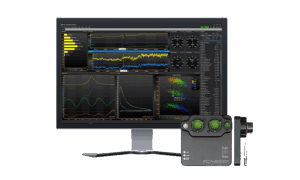
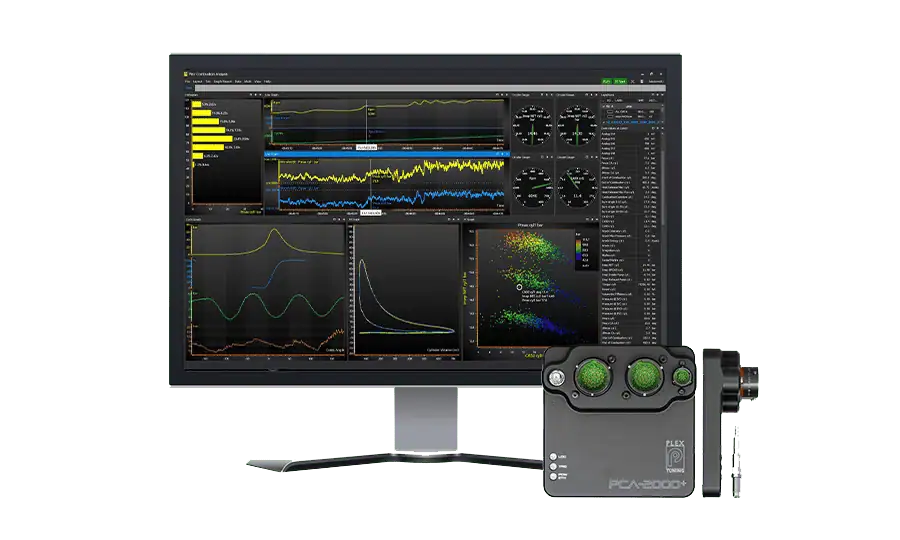
PLEX Tuning produces portable combustion analysis systems and calibration instrumentation for high-performance engines, motorsport applications, and unmanned powertrains. The company specializes in compact, field-deployable diagnostic systems that eliminate the need for fixed test-cell infrastructure. This portability makes their equipment highly relevant for field teams working with high-output UAV engines that require on-site knock tracking, ignition optimization, and rapid ECU calibration. Their primary platform, the PLEX PCA-2000plus, functions as a multi-channel portable combustion analyzer designed for spark-ignition, compression-ignition, and alternative-fuel configurations operating in demanding field environments.
Kistler
Kistler manufactures high-precision piezoelectric pressure transducers, charge amplification electronics, and integrated combustion analysis hardware for engine research and development. The company’s sensor lines are widely used in UAV development, where accurate cylinder pressure data is necessary to define knock limits, optimize ignition timing, and manage structural thermal loads. Kistler provides complete, calibrated measurement chains, including specialized miniature sensors and instrumented measuring spark plugs.
Dewesoft
Dewesoft provides modular data acquisition hardware and specialized combustion analysis software for internal combustion testing. The company’s platforms are utilized by propulsion teams requiring flexible systems that combine in-cylinder pressure and crank-angle tracking with auxiliary inputs like structure-borne vibration, temperatures, CAN bus channels, and fluid pressures within a unified hardware interface. Dewesoft builds its solutions to support development benches and high-performance field testing across gasoline, diesel, alternative fuel, and hybrid powertrains, prioritizing open data structures and real-time visualization features.
Selecting a UAV Engine Combustion Analysis Systems Supplier
When reviewing suppliers, engineers should cross-reference vendor instrumentation capabilities with the specific SWaP, data bandwidth, and environmental constraints of their flight program. Selecting a partner with proven experience in unmanned aviation ensures that the resulting measurement hardware, sensors, and workflow software will effectively support rapid design iteration and platform reliability goals.
DC Inc., details the Plex PCA-2000Plus, a compact, field-deployable combustion analysis system for UAV engines, alongside its turnkey hardware, calibration, and engineering support.
The latest unmanned systems news, straight to your inbox.
Get our weekly roundup of technology developments, new products and industry news.
THANK YOU FOR SIGNING UP
Thanks for joining us. Check your inbox.
We've sent you an email. Click the confirmation link to complete your subscription to the weekly eBrief. In the meantime, explore the latest news, suppliers and technologies on UST.
Advancing Unmanned Systems Through Strategic Collaboration
UST works with major OEMs to foster collaboration and increase engagement with SMEs, to accelerate innovation and drive unmanned systems capabilities forward.