




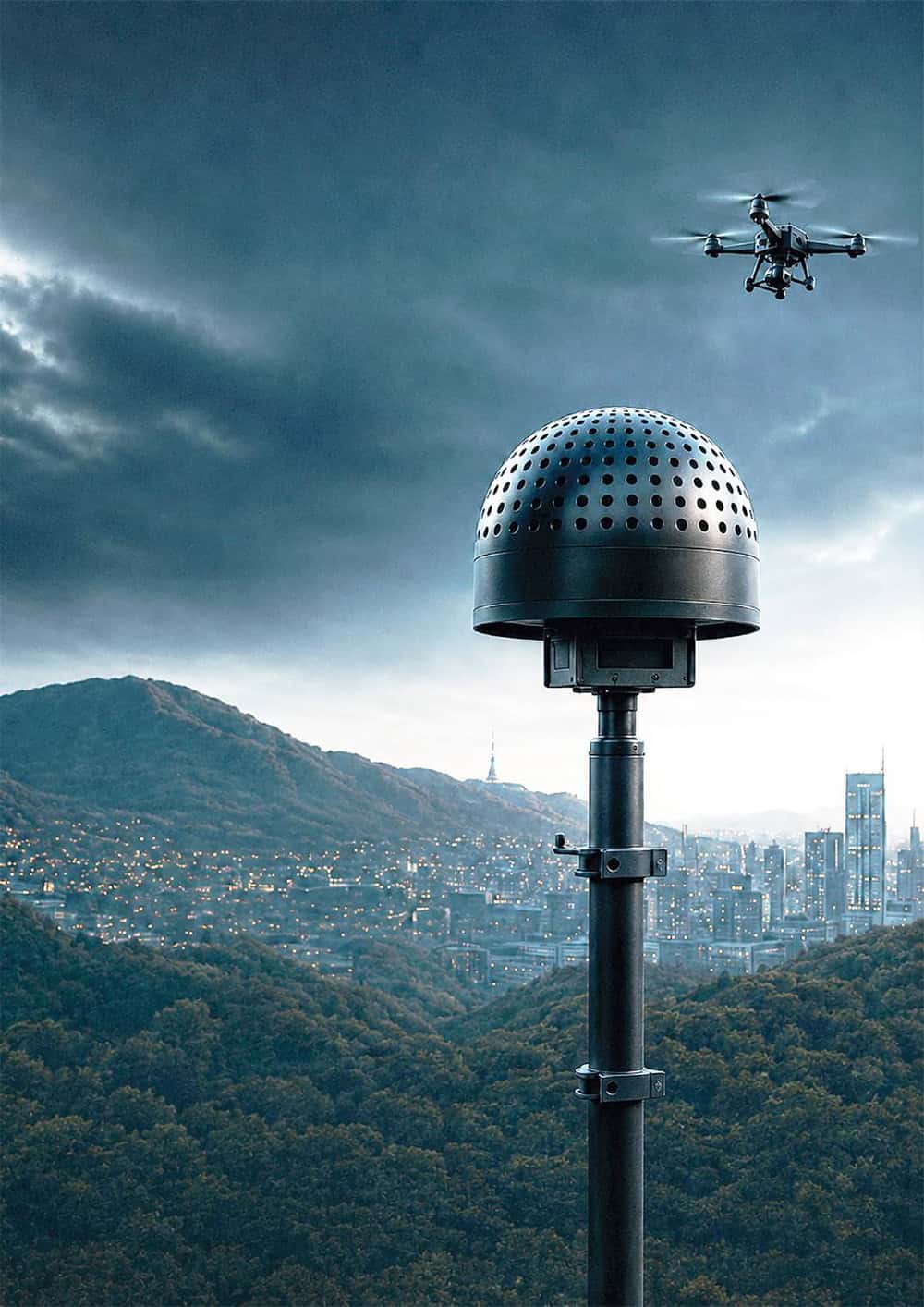
ADTS is a passive acoustic system that uses artificial intelligence to detect and identify UAVs from the characteristic frequencies generated by their motors and propellers. It provides 360-degree coverage with 5-degree angular precision, and operates across an acoustic detection band of 0.4 to 2 kHz.
The system can continuously track rotary-wing drones with a wingspan of approximately 80 cm at up to 570 m and detect them at up to 700 m. Internal-combustion fixed-wing drones with a wingspan of approximately 2.5 m can be detected from 2.5 to 3 km. By using the diffraction properties of sound, ADTS can also monitor close-range threats approaching from behind buildings, through narrow streets and across other radar blind spots.
Multiple units can form a wired or wireless mesh network and transmit acoustic data to a central command system. Fixed systems are available for buildings and border lines, while mobile units can be installed on vehicles and other equipment. The plug-and-play system provides more than 12 hours of operation and displays tracking data on a tablet or computer.
Specifications:
| Dimensions | Fixed version: 20 x 20 x 20 cm; mobile version: 10 x 10 x 10 cm |
| Operating time | >12 hours |
| Rotary-wing tracking range | Up to 570 m, approximately 80 cm wingspan |
| Rotary-wing detection range | Up to 700 m, approximately 80 cm wingspan |
| Fixed-wing detection range | 2.5-3.0 km, approximately 2.5 m wingspan, internal-combustion propulsion |
| Detection angle | 360° |
| Angular precision | 5° |
| Detection frequency | 0.4-2 kHz |
| Close-range blind-spot monitoring | Under 500 m |





