



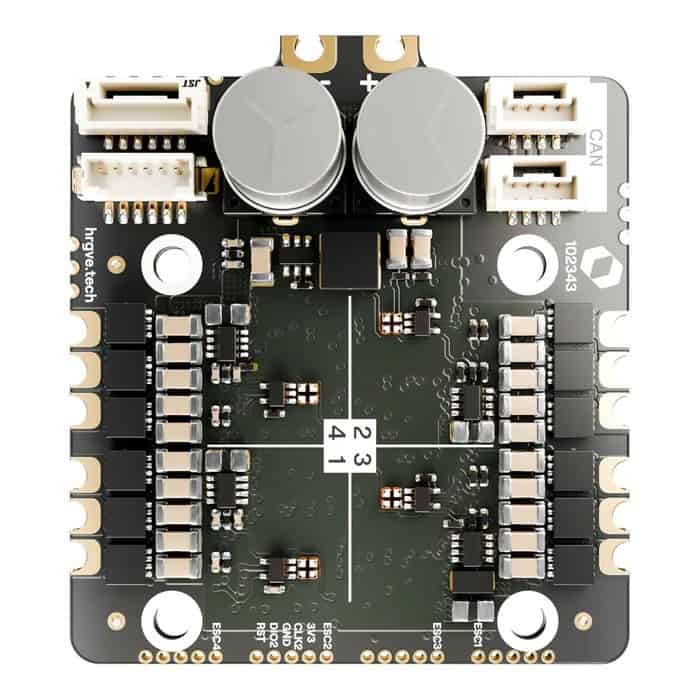
Hargrave nanoDRIVE 4LPi 4-in-1 ESC
Hargrave Technologies' NDAA-compliant nanoDRIVE 4LPi 4-in-1 ESC combines four UAV motor controllers on a single 20 g board, simplifying multirotor power and signal wiring. Each channel is rated for 20 A continuous current and 40 A peak current, with a 7 to 25 V recommended input range and an integrated 5 V, 2.5 A BEC.
The controller can use the FOCAL field-oriented algorithm or trapezoidal commutation and accepts standard or bidirectional DShot150 to DShot600 and servo PWM inputs. DroneCAN provides control, telemetry, and firmware updates, with ARINC 825 support identified for a future firmware release.
Additional functions include regenerative braking, configurable switching from 4 to 64 kHz, and CAN, serial, and PWM telemetry.
| Nominal Power Supply Voltage | 7 to 25 V (3S to 6S) |
|---|---|
| Absolute Power Supply Voltage | 6 to 35 V |
| Rated Phase Current | 20 A per channel |
| Peak Phase Current | 40 A per channel |
| Weight | 20 g (0.7 oz) |
| Auxiliary Output Rail / BEC | 5 V, 2.5 A |
| Input Resolution | 10 bit |
| Minimum Switching Frequency | 4 kHz |
| Maximum Switching Frequency | 64 kHz |
| Efficiency | Up to 99% |
| Maximum RPM (Trapezoidal) | 500,000 eRPM |
| Maximum RPM (FOCAL) | 200,000 eRPM |
| Operating Temperature | -20 to 110 °C (-4 to 230 °F) |