



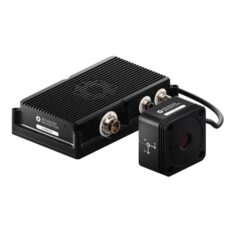
Chimera Land is a non-contact Laser Velocity Sensor (LVS) designed to deliver uncompromised dead reckoning reliability for autonomous and remotely operated ground vehicles. Using infrared laser Doppler velocimetry, it measures true 3D body velocity and feeds highly accurate motion data directly into Advanced Navigation’s INS filter, eliminating errors associated with mechanical odometry such as wheel slip and scaling drift. The result is stable, infrastructure-independent positioning in GNSS-denied, jammed, or spoofed environments.
When integrated with the Boreas D90 Inertial Navigation System, Chimera Land achieves ~0.05% of distance traveled (CEP50) across 1–100 km at average speeds ≥7 km/h, with a maximum 3D body-velocity scaling error of 200 ppm. Compatible with Boreas and Certus Evo INS platforms, it enhances long-duration dead reckoning performance for unmanned ground vehicles operating underground, in tactical scenarios, and in harsh industrial terrain. Its rugged, non-contact design supports reliable operation in dust, vibration, and extreme temperatures.
Highly accurate 3D velocity measurementInfrared laser Doppler sensing enables precise measurement of full 3D body motion, resolving subtle dynamics such as vibration and wheel slip that impact navigation performance.
Extended dead reckoning performanceBy supplying drift-resistant velocity updates to Advanced Navigation’s INS, Chimera Land significantly reduces inertial position growth over extended distances in GNSS-compromised environments.
Ruggedized for extreme environmentsEngineered for defense and mining applications, the sensor withstands dust, shock, vibration, and temperature variation without mechanical wear components.
Applications:- Autonomous haulage and fleet operations
- Underground localization and navigation
- High-precision machine guidance
- Mining haulage systems
- Tactical ground vehicles
| Sensor type: | Infrared laser Doppler velocity sensor (non-contact) |
| Measured output: | 3D body velocity |
| 3D dead reckoning positional error: | ~0.05% of distance traveled (CEP50) |
| Distance basis: | 1–100 km, average velocity ≥ 7 km/h |
| 3D body-velocity scaling error: | 200 ppm (maximum) |
| INS compatibility: | Boreas D90 and Certus Evo |
| Operational focus: | GNSS-denied and infrastructure-limited environments |





