

Ground Control Stations (GCS)
Discover cutting-edge solutions from 13 leading global suppliers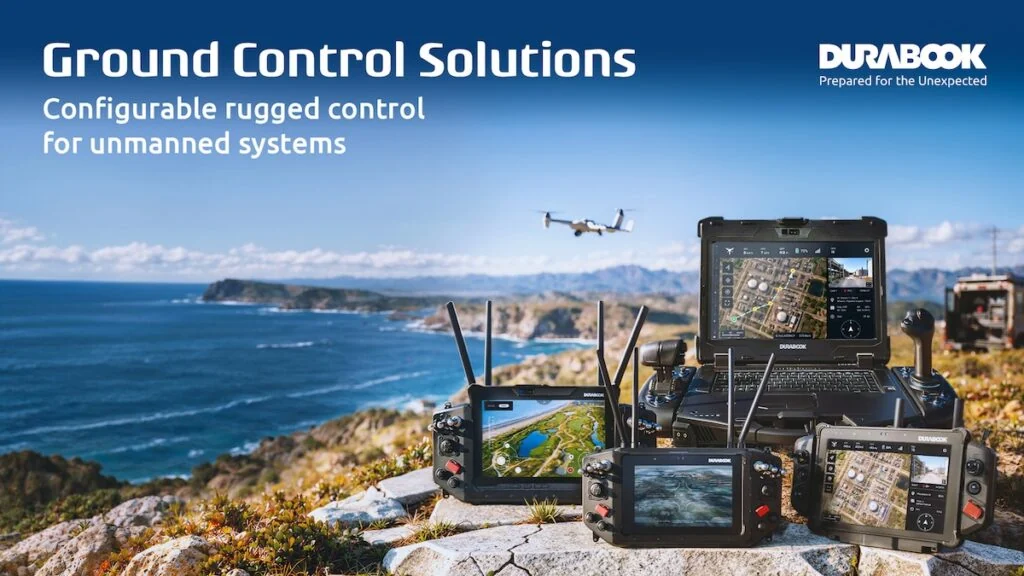
Durabook, the global rugged mobile solutions brand owned by Twinhead International Corporation, has introduced a configurable Ground Control Station (GCS) portfolio engineered for aerial, ground, and maritime unmanned applications.
Designed for system integrators, solution providers, and end users across defense, public safety, and industrial operations, the lineup spans five base platforms tailored to different field workflows. For compact, mobile operations, the portfolio includes the 8-inch GC-R8 and GC-R8S tablet controllers, while the 10-inch GC-R10 and GC-R10S tablet controllers offer expanded screen space for mission software and operational data. For operators requiring a traditional keyboard alongside integrated hardware controls, the company offers the laptop-based GC-Z14I platform.
Rather than relying on fixed control layouts, customers work directly with Durabook and its integration partners to define controller configurations based on specific operator tasks, connected equipment, and deployment conditions. Physical control modules can be populated with various combinations of joysticks, switches, assignable buttons, and thumbwheels to provide direct tactile access to platform navigation, payload operation, and camera control. Additional interfaces and expansion options accommodate mission-specific peripherals.
“Every customer brings a different combination of operator needs, mission software, and connected equipment,” said Sasha Wang, president of Durabook Americas. “Our strength is combining field reliability with the flexibility to bring these elements together. We work closely with customers and integration partners to configure rugged ground control solutions around their applications, from the computing platform and physical controls to the interfaces and communications their teams need in the field.”
On the software side, the computing platforms support both Windows and Linux operating systems to align with existing mission architectures. Windows-based configurations enable compatibility with software such as the WinTAK geospatial situational awareness and mission management application, whereas Linux support allows development teams to integrate custom and open-source software environments.
To maintain links with unmanned assets across varied operating ranges, the systems support third-party radio integration alongside connectivity options that include Wi-Fi, 4G/5G, and external RF radios, depending on the platform and configuration. Deployments operating outside conventional network coverage can also incorporate satellite backhaul via a separate terminal. Across the portfolio, configurations are available to meet MIL-STD-810H, MIL-STD-461G, and IP66 requirements for operation in environments involving dust, rain, shock, and vibration, with specific certifications and ratings varying by model and setup.