

Discover World-Leading Unmanned and Autonomous Technologies
Discover cutting-edge solutions from leading global suppliers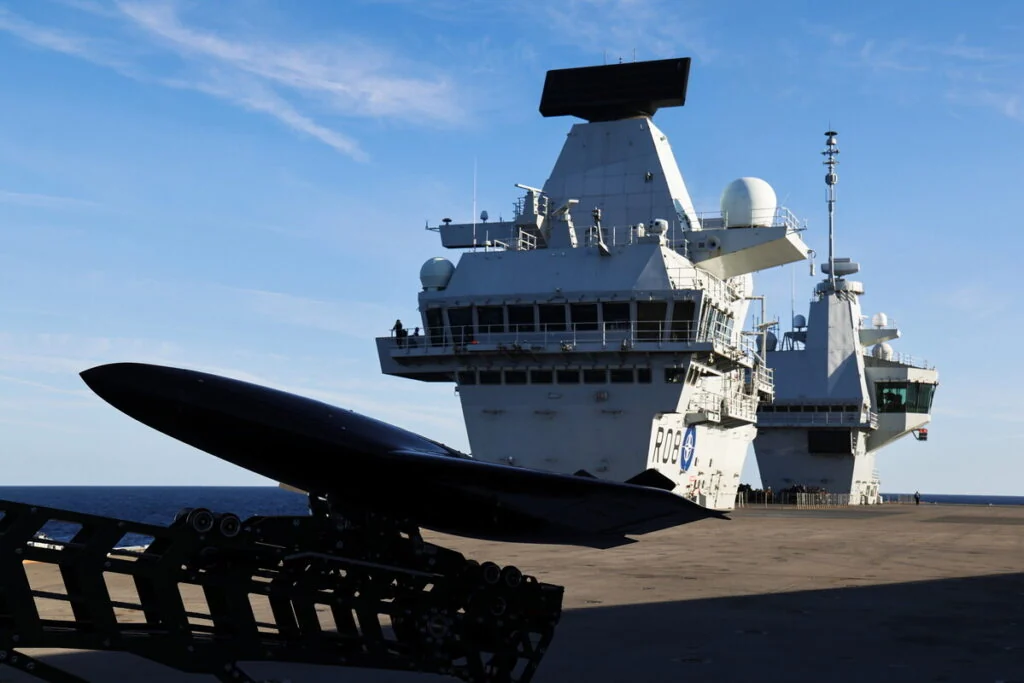
The Nyan One-Way Effector (OWE) Uncrewed Air System (UAS), designed and built by BAE Systems’ Callen-Lenz, has successfully completed four launches from the Royal Navy aircraft carrier HMS Queen Elizabeth for the first time.
Conducted in the North Atlantic as part of Exercise Neptune Reach B, the trials saw all four drones successfully hit their designated strike points. The activity demonstrated the ability of the small, 2.9-meter-wingspan aircraft to safely integrate and operate from a large, complex maritime platform, supporting the Royal Navy’s efforts to develop a hybrid navy.
The exercise brought together the Royal Navy, British Army, and Royal Air Force under Project Vantage, an initiative focused on accelerating the testing and fielding of maritime strike drones. It followed Nyan’s first seaborne launch from the Royal Navy experimental vessel XV Patrick Blackett during Exercise Neptune Reach A earlier this year.
Lieutenant Commander David Burton, Capability Sponsor, Royal Navy, said, “Neptune Reach B marks an important milestone in the Royal Navy’s understanding of how Maritime One-Way Effectors will contribute to future Carrier Strike operations. Through Project Vantage we are generating the evidence, operational insight and confidence required to inform future capability decisions while supporting the wider Defence One-Way Effector programme.”
He added, “Conducting these activities from HMS Queen Elizabeth allows us to explore how uncrewed strike drones might operate alongside other crewed and uncrewed capabilities within a maritime task group. The lessons identified will directly contribute to Maritime Aviation Transformation and our vision for a Hybrid Navy that delivers greater operational choice and effect.”
Designed to offer precision strike capability, Nyan forms part of BAE Systems’ wider investment in uncrewed technologies intended to address evolving operational requirements. This approach is also reflected in the expanding portfolio of uncrewed air systems developed through the company’s FalconWorks advanced research and technology hub.
With more than 25 years of experience in uncrewed and autonomous systems, BAE Systems is delivering a range of products capable of working alongside current and future frontline platforms to provide affordable combat mass.
Matt Foster, CEO of BAE Systems’ Callen-Lenz, commented, “The successful operation of Nyan from HMS Queen Elizabeth provides another proof-point of how this capability can support future force development and the evolution of the Royal Navy’s vision for a hybrid navy. As operational requirements evolve, we continue to invest in uncrewed systems that can provide affordable, scalable combat mass and increase the impact of existing capabilities.”