


Discover World-Leading Unmanned and Autonomous Technologies
Discover cutting-edge solutions from leading global suppliers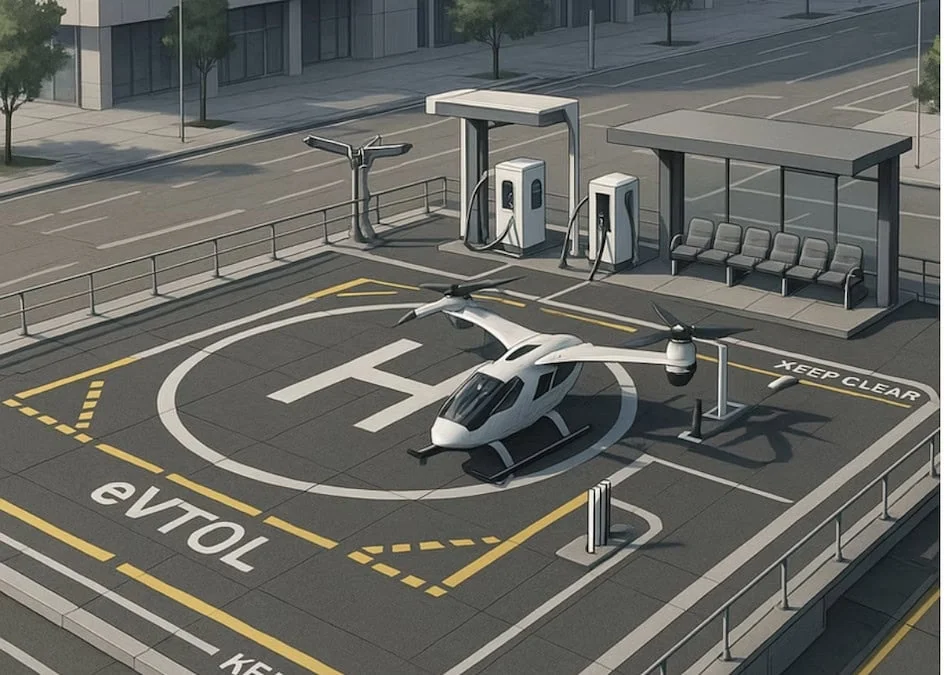
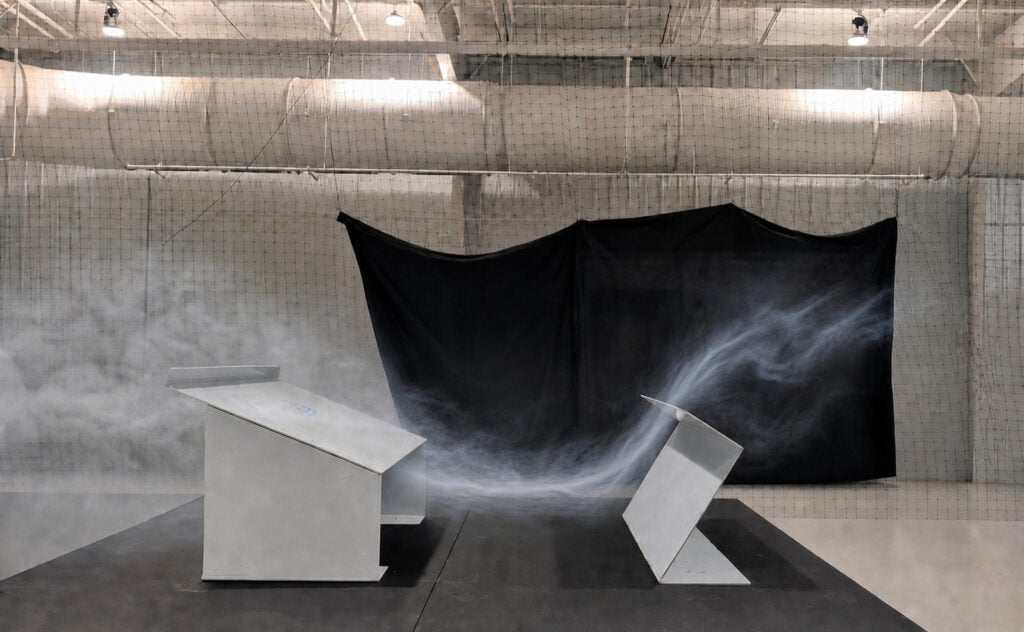
Peniel Infrastructure has introduced the Peniel Deflector, a modular airflow-management system designed to mitigate downwash and outwash hazards associated with electric Vertical Take-Off and Landing (eVTOL) operations at vertiports.
The FAA’s draft Advisory Circular (AC) 150/5390-4, Vertical Flight Aircraft Infrastructure Design signals an important step toward more standardized, scalable vertiport development in the United States. The guidance reflects the FAA’s broader move toward data-derived, performance-based vertical-flight infrastructure standards, including consideration of aircraft-specific performance, engineering analysis, testing and site-specific conditions when demonstrating that applicable safety objectives are met.
Downwash and outwash can create hazards to people and property around VTOL operations, and existing FAA vertiport guidance recognizes wall-type measures and slat structures/blast screens as potential means of mitigating DWOW exposure in appropriate site conditions.
With the FAA’s draft framework now available, Peniel Infrastructure is bringing the Peniel Deflector to market: a modular system engineered to manage eVTOL-generated airflow and associated ground-level hazards. The company says the solution is intended to support site-specific engineering efforts to manage DWOW exposure and DCA-related constraints where supported by aircraft-specific analysis, testing, and applicable approvals.
“Vertiport development cannot depend only on large, unconstrained sites that may be unavailable or unaffordable in the communities where AAM will be most valuable,” said Yen-Chen Chen, Founder and Chief Executive Officer of Peniel Infrastructure. “Our goal is to give developers a practical, deployable way to manage the real effects of eVTOL airflow—so that more sites can become viable for safe operations.”
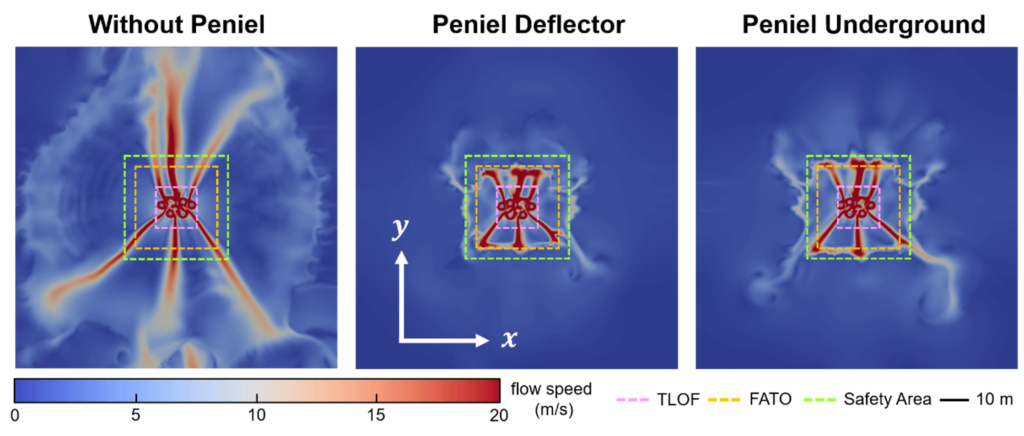
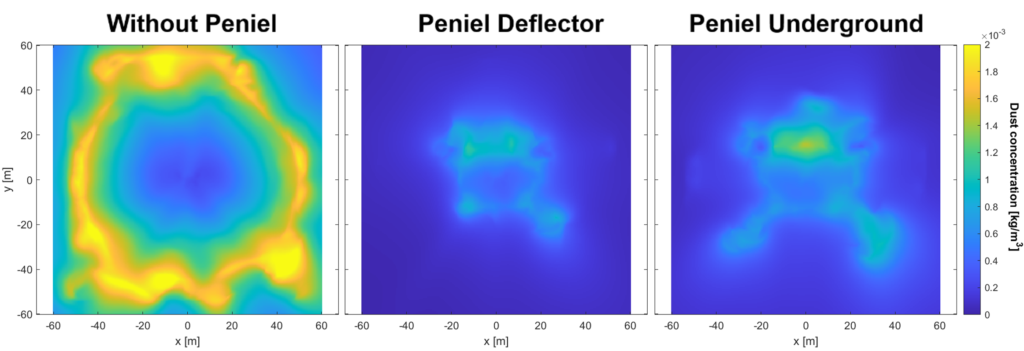
The Peniel Deflector is designed to redirect and moderate high-energy airflow created during eVTOL landing, takeoff, and hover. Peniel says the system addresses not only outwash, but also several downstream effects that can occur when airflow interacts with the ground and nearby infrastructure:
- Dust emissions that may impair near-ground visibility
- Localized airflow recirculation and turbulence
- Foreign Object Debris (FOD) mobilization risks
- Aerodynamic interaction noise affecting nearby operations and communities
The company’s modular system has a profile below 2 feet (~60 cm), intended to preserve sightlines for pilots and passengers. Its heaviest individual module weighs less than 30 lb., facilitating manual handling, and the units are assembled with standardized bolts and nuts. Peniel states that installation can be completed in less than one day, depending on the site and overall project scope.
“FAA Engineering Brief 105A brought needed attention to downwash and outwash as a central vertiport-design issue,” said Robert Bassey, former FAA Office of Airports technical lead for vertiport infrastructure guidance and author of FAA Engineering Briefs 105 and 105A. “Performance-based engineering provides a disciplined way to evaluate whether site-specific mitigation achieves the applicable safety objective, while potentially allowing more efficient use of constrained sites.”
Peniel says it has used wind-tunnel testing conducted in collaboration with WindShape Inc. to calibrate and support elements of its airflow-management analysis. The company positions the Peniel Deflector as a compact, multi-hazard mitigation solution that may help developers assess paved sites otherwise constrained by land area or operational hazards for possible vertiport use. Any site-specific application would remain subject to applicable FAA, state and local, zoning, permitting, operational, and other approval requirements.