

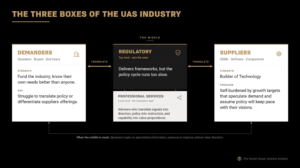
The unmanned aircraft systems (UAS) industry operates through three interconnected stakeholder groups: demanders, suppliers, and the organizations responsible for regulation and professional services. The Tactien Group examines how this three-part structure can help explain the commercial, technical, and regulatory challenges affecting the industry, particularly as consolidation, mergers, and market attrition introduce further complexity.
Although the UAS sector encompasses numerous technologies, applications, and organizations, this framework provides a way to identify where responsibilities lie, how stakeholders interact, and where misalignment can impede market development.
Demanders and the Challenge of Evaluating UAS Capabilities
Demanders represent the operators, purchasers, and end users that generate demand for UAS technology. Their primary strength is an understanding of their own operational requirements and the problems they need to address.
However, identifying an operational need does not necessarily mean an organization has the internal expertise to assess the available solutions. Demanders may struggle to interpret regulatory policy, distinguish between competing supplier capabilities, or determine whether a proposed system can meet their requirements.
This creates a potential gap between operational expectations and technical delivery. Buyers may understand what they want to achieve without having the tools or experience needed to verify whether a supplier’s proposed solution is suitable.
Responsibility for closing this gap extends beyond the demander. Suppliers also have a role in accurately communicating their capabilities and ensuring that proposed technologies are appropriate for the applications being considered.
Suppliers Face Competing Commercial and Regulatory Pressures
The supply side encompasses manufacturers and developers of UAS aircraft, software, and components. These organizations must reconcile customer requirements with the capabilities of their technologies and the operational limitations established by regulators.
This requires suppliers to interpret demand signals while determining what can realistically be developed, delivered, and operated within existing regulatory frameworks.
For venture-backed companies, a further challenge arises from investor expectations. Growth targets may depend on demand developing at a sufficient rate and regulatory policy permitting technologies to operate at scale.
When market demand or regulatory progress falls behind commercial expectations, suppliers can face pressure to maintain growth trajectories that are not supported by actual market conditions.
This imbalance can influence commercial decisions, particularly when funding milestones or short-term revenue requirements become more immediate than the technical and regulatory conditions necessary for sustainable deployment.
The Role of Regulators and Professional Services
The third stakeholder category occupies the space between demand and supply. Within this group, two distinct levels perform different functions.
The first consists of regulatory authorities, such as the Federal Aviation Administration (FAA) in the United States. These organizations establish the rules and frameworks governing UAS operations, with safety forming a central consideration.
The second consists of professional services organizations that interpret and communicate requirements across the industry.
Their role involves translating operational needs into specifications that suppliers can address, while helping demanders evaluate validated technical capabilities rather than relying solely on supplier specifications or commercial claims.
Professional services organizations also facilitate communication with regulators. On the demand side, this means explaining operational requirements to regulatory authorities and helping end users understand how existing policies affect proposed activities.
On the supply side, it involves interpreting regulatory requirements in terms relevant to engineering and development, while communicating actual supplier capabilities and operational intentions to regulatory bodies.
These relationships are important because each stakeholder group approaches UAS deployment from a different perspective. Without effective translation, misunderstandings about technical performance, operational requirements, or regulatory permissions can persist throughout the procurement and development process.
Effective coordination between these groups can support safer transactions and more realistic expectations. Where such coordination is absent, interpretations may instead reflect the individual commercial or organizational interests of the parties involved.
Where Misalignment Creates Industry Challenges
The three-part framework highlights several recurring sources of friction, each associated with a different stakeholder group.
Supplier capability and commercial expectations
Suppliers operating under substantial financial pressure may face incentives to present capabilities more favorably than their current level of development or validation supports.
When sales targets, investment rounds, or quarterly performance requirements take precedence, commercial claims can extend beyond demonstrated technical capabilities.
Demand definition and solution validation
Demanders may lack sufficient familiarity with the regulatory restrictions affecting their intended operations. They may also find it difficult to convert practical operational needs into sufficiently precise technical requirements.
In some cases, this can result in inaccurate demand signals being communicated to suppliers. In others, the difficulty lies in assessing whether a proposed solution actually addresses the original operational requirement.
Regulatory timelines and commercial viability
Regulatory authorities are responsible for establishing and maintaining safety frameworks, but the pace of policy development may not match the rate of technological development or emerging operational demand.
This creates a structural difference between regulators and commercial organizations. Suppliers depend on continued revenue, investment, and performance milestones to remain viable, while regulatory authorities do not face the same immediate commercial pressures.
Consequently, delays in regulatory development can create financial difficulties for businesses whose products or operational models depend on policy changes.
The challenge is not necessarily attributable to individual organizations. It reflects differing institutional responsibilities and economic incentives that can affect the pace at which UAS technologies move toward wider operational use.
Aligning Demand, Capability, and Regulatory Requirements
Addressing these challenges requires consideration of the limitations and responsibilities within each stakeholder group.
Regulatory authorities provide essential safety frameworks, but the evolution of policy can lag behind both technological capability and demand for new applications.
Demanders, meanwhile, need to communicate operational requirements precisely and develop the ability to evaluate competing solutions. Clear requirements alone are insufficient if purchasing decisions do not also recognize suppliers capable of meeting those needs fully and ethically.
For suppliers, alignment with credible demand and competent regulatory standards is an important consideration before accepting investment commitments that impose aggressive growth expectations.
Where growth targets are established before the necessary demand and regulatory conditions exist, financial pressure can become disconnected from the industry’s actual ability to support deployment.
Professional services organizations can help address these differences by improving communication, clarifying requirements, and supporting more accurate assessments of technical and regulatory feasibility.
A Framework for Understanding the UAS Market
As the UAS industry continues to develop, consolidation, mergers, and market attrition may change the organizations operating within it. However, the underlying relationships between demanders, suppliers, regulators, and professional services organizations remain relevant.
The three-category framework outlined by The Tactien Group provides a means of examining these relationships without relying on the structure of individual companies or specific technologies.
Understanding which role an organization occupies, and how its priorities and constraints are perceived by the other stakeholder groups, can help identify where commercial, technical, and regulatory expectations diverge.
Ultimately, the framework emphasizes that progress in the UAS industry depends not only on technological capability or operational demand, but also on how effectively those requirements are communicated, validated, and reconciled with the regulatory environment.
Read Everyone in the UAS Industry Fits in One of Three Boxes on the Tactien Group website.