



AMCORIS Technical Account Manager Sebastian Sauer discusses the company’s quartz-based motion sensing technologies, including Inertial Measurement Units (IMUs), accelerometers and gyroscopes, and their role in navigation, flight control, stabilisation and autonomous uncrewed systems.
1. Could you introduce AMCORIS and its sensor portfolio, and explain where you see the company’s technologies fitting within today’s uncrewed and autonomous systems?
AMCORIS stands for Autonomous Motion Control & Intelligent Systems. It is a registered brand of Channel Microelectronic GmbH in Esslingen near Stuttgart, Germany, specialised in sensing and motion technologies for autonomous systems. Today our focus is Epson’s quartz-based motion sensing, IMUs, accelerometers, vibration and gyro sensors, built on a partnership of around 35 years. We are open to further technology partnerships that strengthen this focus.
We work as an engineering partner during design-in: we help customers choose the right performance grade, provide evaluation kits, support integration and stay with the project into series supply.
In uncrewed systems, inertial sensing drives flight and vehicle control, navigation when GNSS is degraded or jammed, and payload stabilisation. These platforms are tight on size, weight and power and operate under constant vibration and wide temperature ranges. Epson’s technology fits that well: gyro bias instability below 1 °/h in a 10-gram, one-inch module, factory-calibrated from –40 to +85 °C and ITAR-free.
2. Could you tell us more about some of AMCORIS’s IMU products and the capabilities they offer for applications such as UAV navigation, stabilization and flight control?
The core of our IMU offering is Epson’s PDG series on the one-inch platform: 24 × 24 × 10mm, 10 g, SPI/UART. All three models share footprint, connector and software interface, so a design can move between performance grades without touching the board – and series volumes stay on one product family.
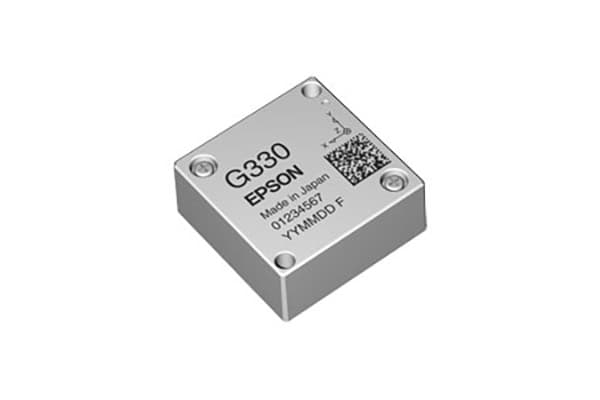
- M-G330PDG – entry level: 3 °/h bias instability, 0.1 °/√h angle random walk (ARW).
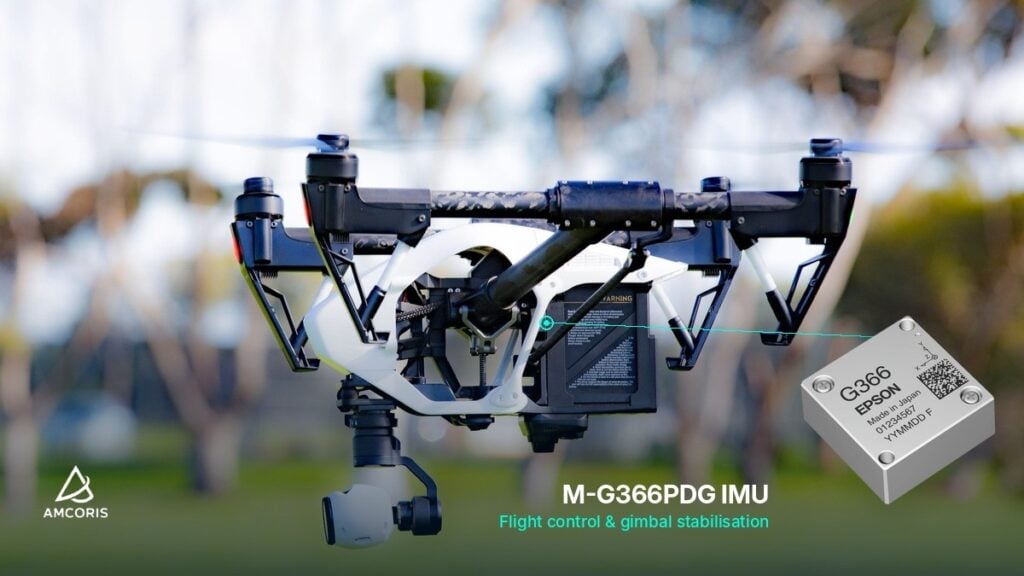
- M-G366PDG – the SWaP-C sweet spot for autopilots and stabilisation: 1.2 °/h, 0.08 °/√h.
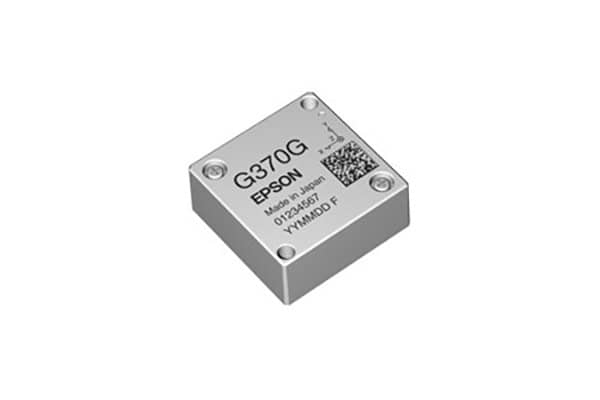
- M-G370PDG – high performance for navigation and INS: 0.8 °/h, 0.06 °/√h.
On the same platform, the low-noise M-G370PDT (0.03 °/√h ARW) is a strong choice for high-end gimbals, and the M-G355QDG is designed to IEC 61508 SIL1 for safety-related platforms.
Each unit is calibrated for bias, scale factor and axis alignment over temperature. Output rates reach 2,000 samples per second, the accelerometer range is selectable at ±8 or ±16G, and delta-angle and delta-velocity outputs plus an external trigger make fusion with GNSS, cameras or LiDAR straightforward.
For larger UAVs, surface vessels and ground vehicles, the IP67 M-G570PR20 (0.5 °/h, RS-422) and M-G552 series (CANopen or RS-422, 9–32 V) are ready for harsh environments and vehicle networks.
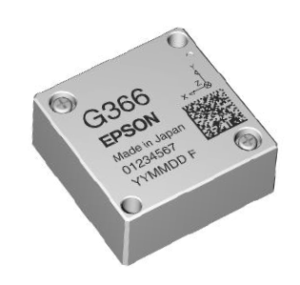
The M-G366PDG on Epson’s one-inch IMU platform: 24 × 24 × 10 mm, 10 g.
3. AMCORIS also offers accelerometers and gyroscopes. Are there particular products in this portfolio that are especially well suited to uncrewed platforms, and what makes them stand out?
Epson’s accelerometers use a quartz resonator whose frequency changes with acceleration and is counted digitally. Because the sensing structure is entirely quartz, sensitivity stays very stable over temperature, and the output is digital from the start.
- M-A370AD10 – our lowest-noise model at 0.02 μG/√Hz, with ±0.5 mG bias error from – 30 to +85 °C; a precise tilt and gravity reference.
- M-A352AD10 – ±15 G and DC to 460 Hz at only 13 mA; an all-rounder for tilt, levelling and vibration.
- M-A552AC10 / AR10 – the M-A352 in an IP67 housing with CANopen or RS-422, for outdoor vehicles and vessels.
Our quartz gyro sensors use Epson’s double-T element in a 5.0 × 3.2 mm package. The XV7181BB (0.065 °/√h ARW, 1.2 mA) suits gimbal axes, heading hold on small ground robots or a redundant rate channel next to an IMU, and the XV4311BD with SafeSPI interface targets automotive-grade ground platforms. The M-A342VD10 and IP67 M-A542VR10 vibration sensors complete the range for condition monitoring of motors and rotors.
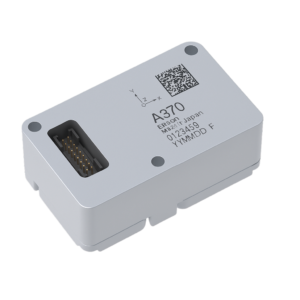
The M-A370AD10 accelerometer offers a noise density of 0.02 μG/√Hz.
4. AMCORIS offers both MEMS-based IMUs and quartz-based sensing technologies. What advantages do these different approaches provide, and how can engineers determine which is best suited to a particular application?
In our portfolio this is less of an either-or than it seems. Epson’s QMEMS technology produces single-crystal quartz elements with MEMS micro-fabrication, so our IMUs are MEMS-sized devices built around quartz gyros. The real comparison is quartz versus conventional silicon MEMS.
Quartz is piezoelectric and mechanically and thermally very stable. Epson’s double-T gyro structure separates drive and detection, which gives low noise and high bias stability over temperature while keeping MEMS size, power and cost. Silicon MEMS offers very low unit cost and high integration, a sensible choice for consumer-grade flight controllers where GNSS is always available.
We advise engineers to start from the error budget, not the technology. Tolerable drift during a GNSS outage defines the bias instability needed, pointing accuracy defines ARW and noise, and environment, interface and safety requirements narrow the choice further. In practice, the M-G366PDG or M-G370PDG covers agile flight control, the low-noise M-G370PDT suits gimbals and payload stabilisation, and the M-G370PDG or M-G570PR20 bridges GNSS outages. Rugged surface and ground vehicles are best served by the IP67 M-G570PR20 or M-G552, safety-related platforms by the SIL1-designed M-G355QDG, and precise tilt and levelling by the M-A370AD10 or M-A352AD10. For cost-driven volume designs, the M-G330PDG offers the same footprint as the higher grades.
Finally, we always recommend validating on the real platform. Evaluation kits are available on free loan for qualified projects, so engineers can record Allan variance on the bench and log data in their own vehicle before committing to a design.
5. Looking across the AMCORIS portfolio, which products or technologies are generating the most interest from uncrewed system manufacturers, and what are customers looking for from the next generation of sensing technology?
Most IMU interest is in the PDG series. The M-G366PDG is our most requested model – already in series use in gimbals and also used in mobile mapping, antenna pointing and vessel motion sensing. The M-G370PDG comes in where navigation performance matters, for example in INS developments, autopilots and inspection robots, and the M-G330PDG where unit cost dominates. For high-end gimbals the low-noise M-G370PDT is drawing strong interest, and on the accelerometer side the M-A370AD10 leads the requests.

IP67-rated IMUs such as the M-G552 series suit autonomous ground vehicles in harsh environments.
What customers ask us for:
- Resilience without GNSS: lower bias and better temperature stability per gram and milliwatt, to bridge longer outages on inertial data alone.
- Easy integration: digital interfaces, time synchronisation and support in common autopilot software.
- Proven behaviour: test data under vibration, temperature and special environments, such as Epson’s published radiation and helium-exposure results.
- Supply security: ITAR-free parts, long-term availability and local engineering support in Europe.
- Functional safety: certifiable sensors as autonomous vehicles share space with people.
Looking ahead, customers want lower noise and bias in the same or smaller formats, and robust variants for air, land and sea. Our job is to turn that into working systems quickly, from the first evaluation kit to series production.
Find out more about AMCORIS’ advanced sensor technologies for drones and autonomous vehicles > >