




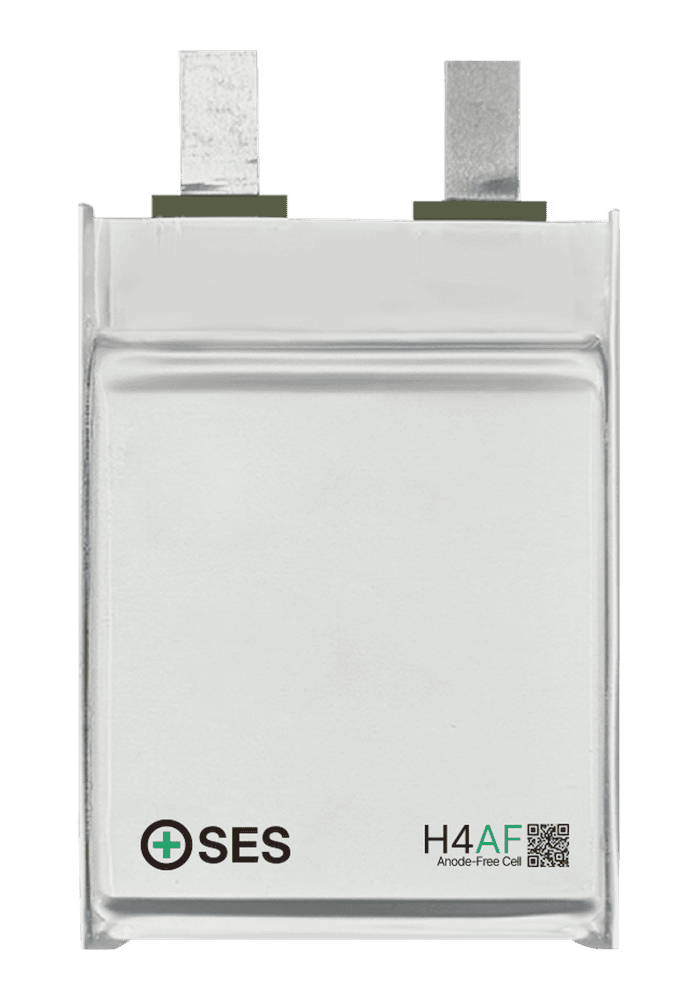
The H4AF from SES AI is an NMC, anode-free pouch cell rated at 4.1 Ah typical capacity and 15.7 Wh typical energy, with a 3.82 V nominal voltage. Its gravimetric energy density is specified at 450 Wh/kg at 25°C, 100% depth of discharge, and C/5. The cell weighs 34.9 ± 1.0 g and uses a compact pouch format measuring 71.5 ± 1.0 mm in length, 48.5 ± 0.5 mm in width, and 4.4 ± 0.2 mm in thickness at 0% state of charge.
The H4AF is specified for a maximum continuous discharge rate of 12C and a maximum 20C pulse at 50% state of charge, 25°C, for 30 seconds. Its operating data covers discharge from -30 to 60°C and charging from 0 to 45°C. The brochure also documents discharge behavior from 0.2C through 12C, charge profiles from 0.33C to 3C, and temperature-dependent discharge at 45°C, 25°C, 0°C, and -30°C. Under the stated +0.2C/-1C cycle-life test, the cell exceeds 100 cycles to 80% SOH at 25°C with 150 psi applied pressure, compared with more than 10 cycles at 0 psi.
| Capacity: | 4.1 Ah typical |
| Energy: | 15.7 Wh typical |
| Nominal voltage: | 3.82 V |
| Charge voltage: | 4.3 V |
| Discharge voltage: | 2.5 V |
| Typical charge rate: | C/5 |
| Maximum continuous discharge rate: | 12C |
| Maximum pulse discharge: | 20C at 50% SoC, 25°C, 30 s |
| Discharge temperature: | -30 to 60°C |
| Charge temperature: | 0 to 45°C |
| AC internal resistance: | ≤6 mΩ, 1 kHz at 30% SoC |
| DC internal resistance: | ≤15 mΩ, 50% SoC, 3C/10 s |
| Weight: | 34.9 ± 1.0 g |
| Packaging: | Pouch |
| Chemistry: | NMC / Anode Free |
| Gravimetric energy density: | 450 Wh/kg at 25°C, 100% DoD, C/5 |
| Cycle life at 150 psi: | >100 cycles at 25°C to 80% SOH, +0.2C/-1C, 2.5–4.3 V |
| Cycle life at 0 psi: | >10 cycles at 25°C to 80% SOH, +0.2C/-1C, 2.5–4.3 V |
| Certification: | UN38.3 |
| Length: | 71.5 ± 1.0 mm |
| Width: | 48.5 ± 0.5 mm |
| Thickness: | 4.4 ± 0.2 mm at 0% SoC |





