




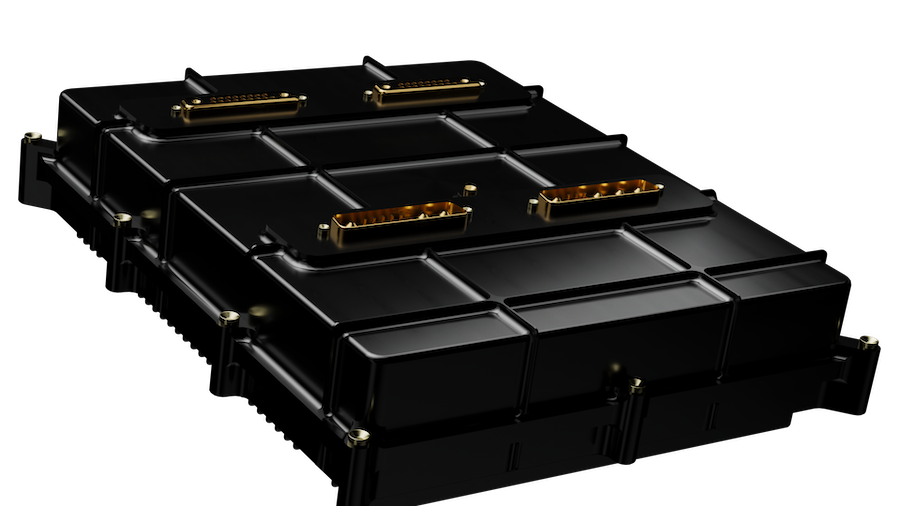
Orbital’s PMSMKII is a power management system for UAVs that regulates, protects, and monitors electrical delivery across the engine, payload, communications equipment, sensors, gimbals, batteries, and other flight-critical hardware. The sealed, passively cooled unit accepts alternator, battery, and shore-power inputs, switching between available sources under load while maintaining regulated downstream power. Dual independently configurable main outputs provide 12–48 V DC at up to 21 A per bus, while parallel operation supports up to 42 A. A separate 8–16 V DC system output and configurable battery-charging functions support broader onboard electrical requirements.
Designed around changing airborne loads, the PMSMKII incorporates reverse-polarity and short-circuit protection, power sharing at low engine speeds, and real-time CAN bus diagnostics. When paired with the FlexECU® Argon, electrical-load changes can also be incorporated into engine fuelling response, helping prevent payload demand from adversely affecting engine operation. The IP66 enclosure, when fitted with suitably sealed mating connectors, supports operation from -40 to +65 °C, while airflow requirements scale with combined output power from 500 W through 1200 W.
| Specification: | Value: | Conditions / notes: |
| Length: | 207 mm | |
| Width: | 172 mm | |
| Height: | 50 mm | Excluding optional fan(s) |
| Weight: | 1400 g | Excluding optional fan(s) |
| Ambient operating temperature: | -40 to +65 °C | Thermal derating applies at higher ambient temperatures |
| Storage temperature: | -40 to +71 °C | |
| Maximum internal temperature: | +110 °C | PMS temperatures require monitoring |
| Minimum heatsink airflow, up to 500 W: | >5 m/s | |
| Minimum heatsink airflow, up to 1000 W: | >10 m/s | |
| Minimum heatsink airflow, up to 1200 W: | >15 m/s | |
| Ingress protection: | IP66 | With suitably sealed mating connectors |
| Typical efficiency: | >90% | Alternator operation at 800 W / 28 V, 100 W / 14 V, and 200 W / 35 V battery charging |
| Idle power consumption: | <10 W | Shore-power operation with no output loads |
| Rated engine speed range: | 2200–7500 RPM | |
| Minimum rectified alternator voltage: | 12 V DC | Backup battery or shore power may be required below this level, depending on output loads |
| Maximum rectified alternator voltage: | 120 V DC | |
| Maximum rectified alternator current: | 35 A DC | |
| Alternator voltage sense accuracy: | ±2% | |
| Alternator current sense accuracy: | ±3% | |
| Supported battery configuration: | 6S–14S LiPo | Other chemistries with equivalent voltages are supported |
| Battery input voltage range: | 18–60 V DC | Battery operation is not permitted outside this range |
| Maximum battery input current: | 35 A DC | |
| Battery voltage sense accuracy: | ±2% | |
| Battery current sense accuracy: | ±3% | |
| Shore-power input voltage range: | 12–60 V DC | Measured at PMS |
| Maximum shore-power input current: | 35 A DC | |
| Shore-power voltage sense accuracy: | ±2% | |
| Shore-power current sense accuracy: | ±3% | |
| Main outputs, independent-mode setpoint: | 12–48 V DC ±2.5% | Configurable at time of order |
| Main outputs, independent-mode maximum current: | 21 A DC per bus | Varies with output voltage |
| Main-output voltage sense accuracy: | ±1% | |
| Main-output current sense accuracy: | ±3% | |
| Main output, parallel-mode setpoint: | 12–48 V DC ±2.5% | Configurable at time of order |
| Main output, parallel-mode maximum current: | 42 A DC | Varies with output voltage |
| System-power output setpoint: | 8–16 V DC ±2.5% | Configurable at time of order |
| System-power maximum output current: | 15 A DC | Varies with output voltage |
| System-power voltage sense accuracy: | ±1% | |
| System-power current sense accuracy: | ±3% | |
| Battery-charger voltage: | 25–60 V DC | Constant Voltage mode; configurable at time of order |
| Battery-charger current: | 1–35 A DC | Constant Current mode; varies with output voltage |
| Battery-charger voltage sense accuracy: | ±2% | |
| Battery-charger current sense accuracy: | ±5% |





