


VTOL UAV
Discover cutting-edge solutions from 34 leading global suppliers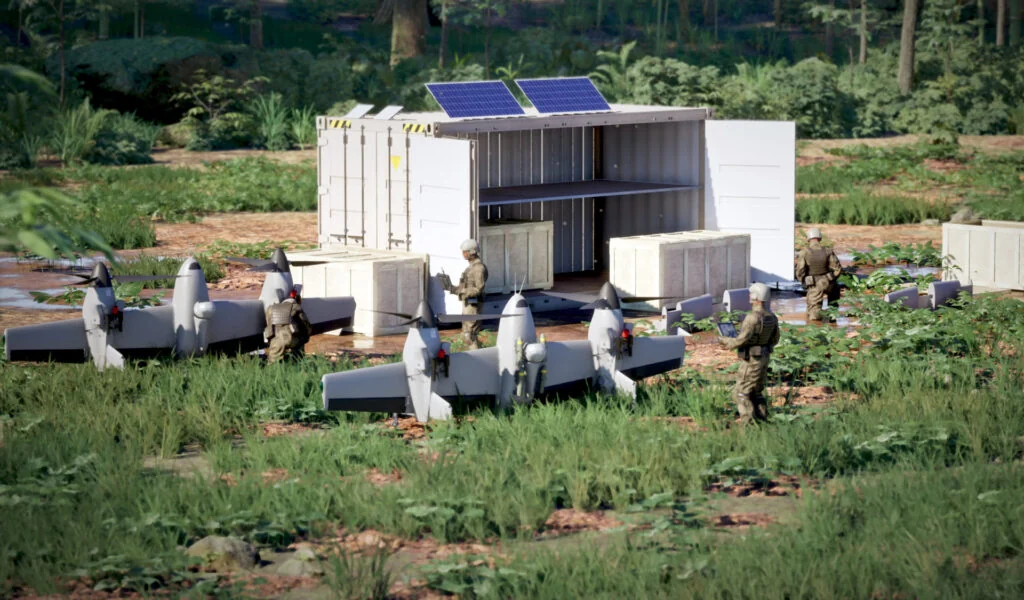
Sikorsky, a Lockheed Martin company, has introduced a self-contained, containerized Uncrewed Aerial System (UAS) package designed to rapidly deploy autonomous Vertical Takeoff and Landing (VTOL) capabilities in austere and infrastructure-limited environments.
Known as the Nomad 100 fast pack, the system brings together four Nomad 100 aircraft, mission-command software, power, communications and sustainment equipment within a standard 20-foot ISO container. The design addresses military requirements for compact, low-footprint autonomous platforms capable of rapid deployment, sustainment and repositioning in contested operating environments.
Rich Benton, Vice President and General Manager at Sikorsky, said, “Military leaders are challenging industry to expand the inventory of uncrewed aircraft, and Sikorsky is delivering proven autonomous air capability with speed and scale, offering field-ready solutions to deploy and sustain those systems where they are needed most.“
“By packaging aircraft, mission command, communications, power and sustainment into a single containerized system, we are making it easier to move, employ and reposition VTOL UAS capability with urgency and flexibility.”
The fast pack is designed for rapid setup with minimal personnel requirements. In its planned configuration, two Nomad 100 aircraft can be mission ready in less than 15 minutes, with the remaining two available within four to six hours. Runway-independent operations are intended to support launches from locations including tactical vehicle staging areas, naval vessels and improvised landing zones.
Integrated communications, power and sustainment equipment are designed to extend mission availability while reducing the need for external support. Mobility is also central to the system’s design. Following a mission, the container can be repacked, loaded onto a compatible transport vehicle and relocated to another operating site to support follow-on operations.
Depending on customer configuration, the Nomad 100 fast pack can enable missions including ISR-T, light attack and contested logistics, providing multirole capabilities for challenging and dynamic operating environments.
The Nomad 100 belongs to Sikorsky’s wider Nomad family of runway-independent VTOL UAS, designed for operations across land and sea. Enabled by Lockheed Martin’s MATRIX autonomy technology, the Nomad family combines the vertical lift and hover characteristics of helicopters with the speed, range and endurance advantages of fixed-wing aircraft.
Lockheed Martin is also advancing a mission-focused approach to autonomy, moving beyond basic automated flight towards operator-commanded systems designed to plan, execute and adapt complex operations in dynamic environments.