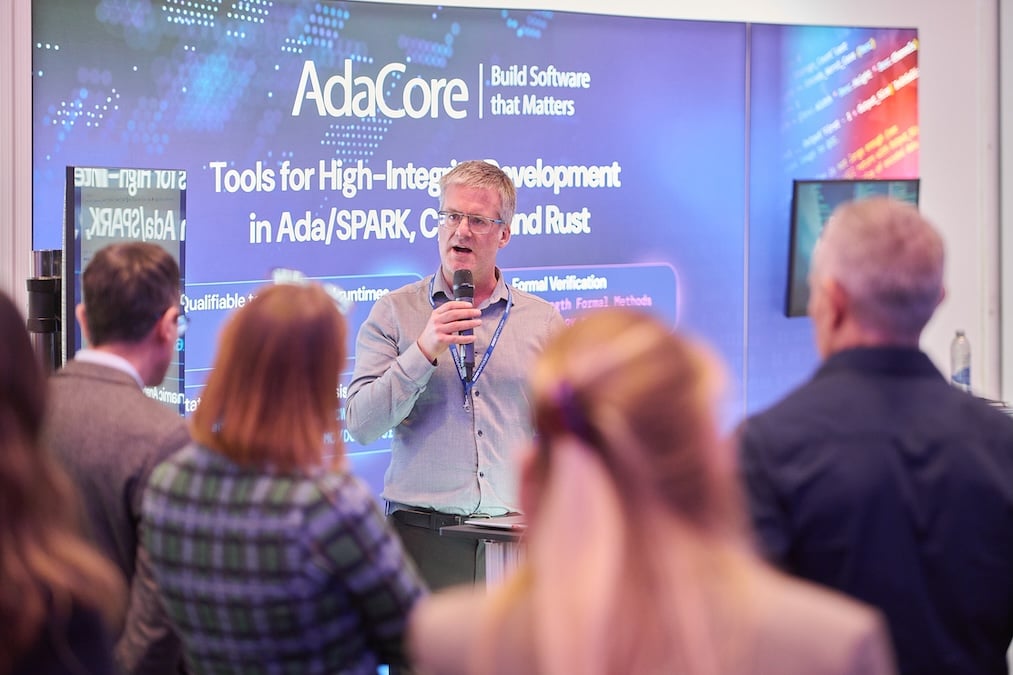




AdaCore has reported a significant increase in design wins across US aerospace and defense programs using the memory-safe programming languages Ada, SPARK and Rust.
The growth covers mission-critical applications including avionics flight control, autonomous uncrewed systems, ground-based command-and-control infrastructure, secure communications platforms and next-generation satellite systems.
According to AdaCore, the increase reflects a broader move away from memory-unsafe languages such as C and C++, influenced by regulatory pressure, national security requirements and lessons from high-profile software vulnerabilities affecting defense platforms.
Memory-safety vulnerabilities, including buffer overflows, use-after-free errors and null pointer dereferences, account for approximately 70 percent of critical software security vulnerabilities, based on research published by Microsoft and Google and reflected in guidance from the National Security Agency.
These vulnerabilities can be particularly consequential in embedded aerospace and defense systems, where software defects may contribute to mission failure, loss of life or security weaknesses that could be exploited by adversaries. Such systems may also remain in service for years or decades without receiving software updates, increasing the importance of designing correctness and security into the software from the outset.
SPARK supports formal verification, allowing engineers to mathematically demonstrate the absence of certain classes of runtime errors before software is deployed on target hardware. Rust uses an ownership and borrowing model enforced at compile time to prevent common memory-safety errors without sacrificing performance.
The adoption trend is supported by an independent VDC Strategy report titled ‘Memory-Safe Languages Offer Protection for Devices and TCO’. Based on a survey of more than 500 embedded software decision-makers, the research ranked Ada, SPARK and Rust as the three best languages for meeting safety and security requirements among the 26 languages evaluated.
More than 85 percent of respondents said programming-language choice can directly affect product safety and security.
The report also identified potential schedule and cost advantages. Ada projects were four times more likely than C projects to finish ahead of schedule, while SPARK showed the strongest schedule performance in the survey.
Projects using memory-safe languages reported median development costs two to four times lower than projects developed using C and C++. Over a typical seven-year deployment, memory-safe languages were also associated with patching and defect-remediation savings of up to 60 percent.
These findings are particularly relevant to aerospace and defense programs, where certification activity, late-stage verification and long-term sustainment can represent significant cost drivers.
The research also examined the use of AI-generated code. Users of memory-safe languages reported greater trust in AI-generated software than users of C or C++, with SPARK’s formal verification capabilities cited as one way to increase confidence in code produced through agentic AI workflows.
Quentin Ochem, President and CEO of AdaCore, commented, “Our customers in aerospace and defense cannot patch their way out of a software defect once a system is fielded, so correctness has to be built in from the start. Memory safety is increasingly seen as a baseline requirement, not a nice-to-have. The independent research released alongside these design wins confirms that this is not only the safer path, it is also the faster and more cost-effective one.”
The move toward memory-safe programming languages is also being encouraged by US government policy guidance. The National Security Agency, the Cybersecurity and Infrastructure Security Agency and the White House Office of the National Cyber Director have each urged the defense industrial base to transition away from memory-unsafe languages.
CISA’s Secure by Design initiative and the ONCD’s ‘Back to the Building Blocks’ report have identified memory safety as a foundational requirement for software used in critical infrastructure and national security systems.
The full VDC Strategy report, ‘Memory-Safe Languages Offer Protection for Devices and TCO‘, is available through AdaCore.