Discover World-Leading Unmanned and Autonomous Technologies
Discover cutting-edge solutions from leading global suppliers
ZIYAN has launched the “Non-Stop Wind Turbine Blade Intelligent Inspection Solution,” which leverages the F15 long-endurance unmanned helicopter to enhance both the efficiency and accuracy of turbine inspections while reducing operational and maintenance (O&M) costs.
The system integrates a gigapixel-level dynamic ultra-HD payload with an intelligent inspection management platform, enabling uninterrupted turbine inspection without the need for turbine shutdowns.
High-Efficiency Data Acquisition
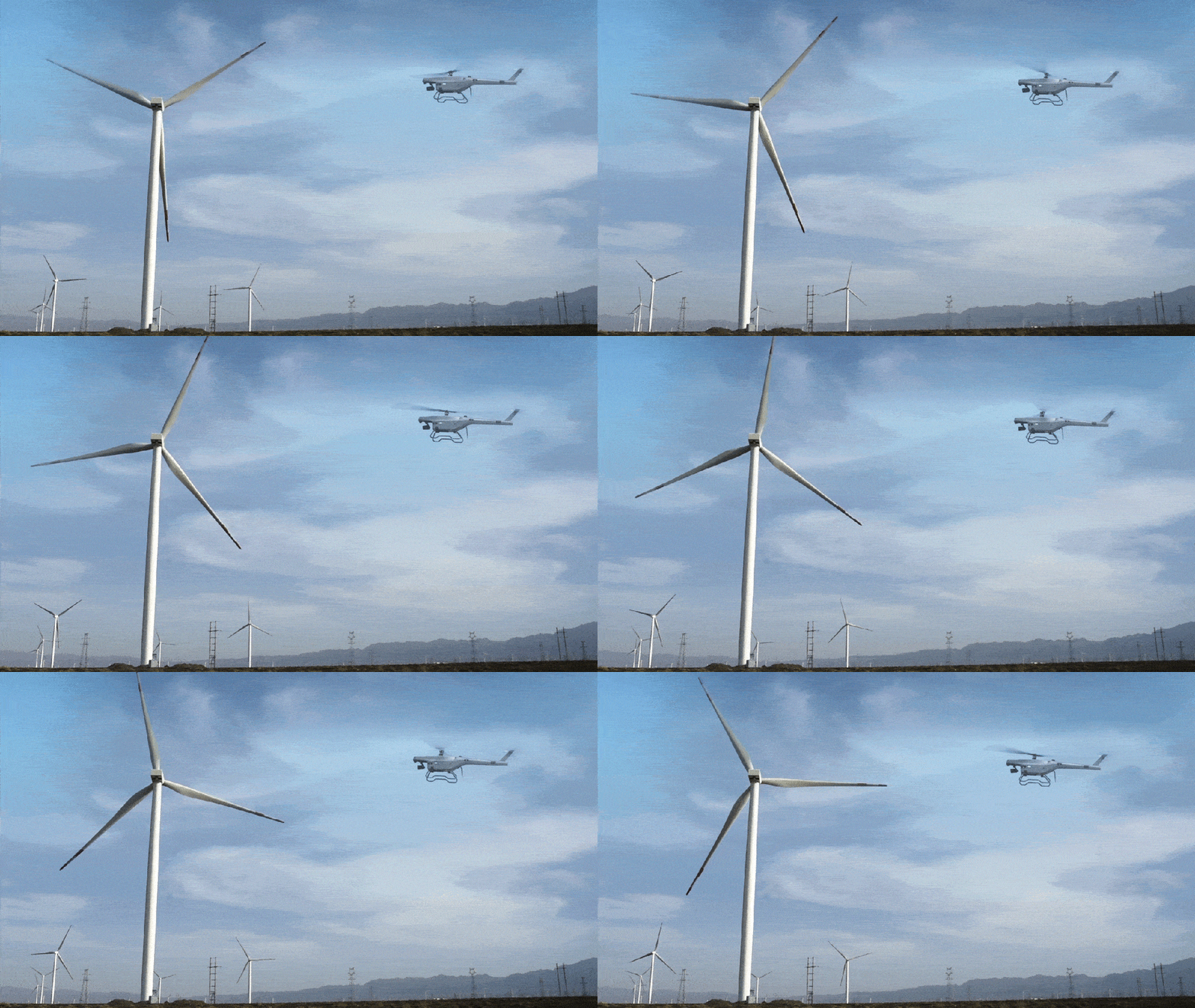
The system offers a significant boost in inspection efficiency. Each turbine can be inspected in just 20 minutes, eliminating the downtime typically associated with manual inspections. The F15 UAV’s 100-minute endurance allows for the inspection of up to three turbines in a single sortie, increasing operational efficiency compared to conventional multirotor UAVs, depending on the specific conditions of each inspection.
Millimetre-Scale Defect Detection
With its gigapixel-level dynamic UHD imaging combined with laser ranging technology, the inspection system can detect blade defects at a millimetre scale. This precision is further enhanced by AI-powered algorithms that classify various defects, including cracks, paint peeling, and lightning strikes, with an accuracy rate exceeding 90%.
Low Operator Workload & High Automation
The solution minimizes human involvement through intelligent route planning and fully autonomous flight. The F15 UAV operates without manual intervention, supporting automated take-off, landing, and charging via unmanned ground stations. This enables 24/7, unattended operations, significantly reducing the workload for human operators. However, some level of human supervision and maintenance may still be required, especially in complex or challenging environments.
Safety & Reliability
Unlike manual inspections, which rely on high-power telescopes and are vulnerable to weather and terrain constraints, this UAV-based inspection method removes those limitations. The F15 UAV offers excellent manoeuvrability and is built to withstand Level 8 wind resistance, making it ideal for use in high-altitude mountainous regions and offshore wind farms. Its robust environmental adaptability ensures safe and reliable operation even in challenging conditions.
Intelligent Management
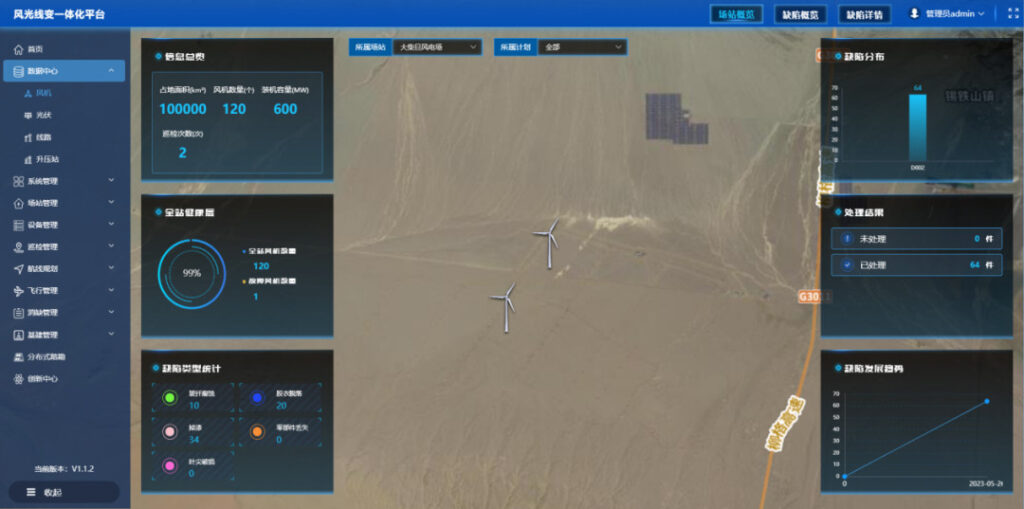
The system’s cloud-based diagnostics provide automatic inspection report generation, marking defect locations and types with full visualisation support. The intelligent management platform features multi-tier user access control, allowing for streamlined management of wind farms, assets, and inspection tasks.
Four-Step Intelligent Inspection Process
- Baseline Data Preparation
Before initiating the inspection, turbine and camera specifications are gathered, including flight parameters such as hub coordinates, blade dimensions, and sensor pixel size. This data forms the foundation for calculating flight and imaging parameters.
- Flight Route Planning
Once the baseline and UAV attitude data are uploaded into the system, the software automatically calculates the UAV’s starting position, hover points, and payload orientation. The system then generates an autonomous flight route, ensuring comprehensive coverage of the turbine blades.
- Autonomous Inspection Flight
During the flight, high-precision laser ranging, fast shutter speeds, and gigapixel cameras capture sharp, blur-free images. The entire inspection process is automated, requiring no human intervention.
- Intelligent Defect Analysis
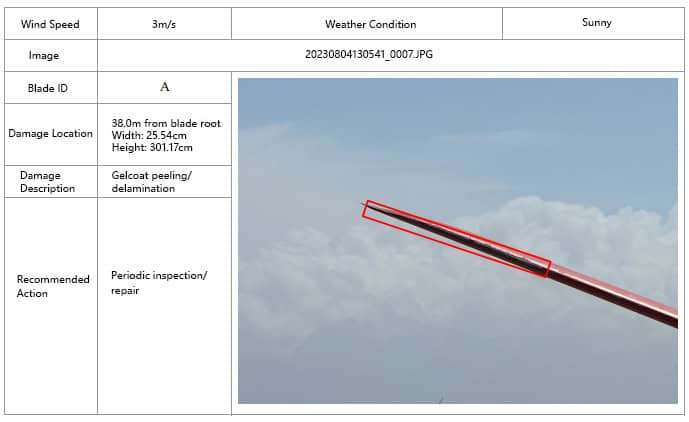
The raw imagery is uploaded to the intelligent management platform, where the AI engine automatically identifies and classifies defects. The system maps the defects to specific blade coordinates and generates a detailed report that includes statistical summaries, defect categories, location mapping, and annotated images. While the AI handles the initial identification and classification, human review may be necessary for validation in some cases.
Reliable Performance in Challenging Environments
Designed to withstand extreme environments, the solution is highly reliable for both high-altitude and offshore wind farms. Its intelligent operational model not only enhances the efficiency of wind power O&M but also contributes to the advancement of clean energy, particularly in remote and challenging locations.