Single Beam Echosounders (SBES) are active acoustic instruments that measure distance to the seabed, submerged boundaries, or nearby targets from ROVs, AUVs, and USVs. By transmitting a focused pulse and timing the returning echo, they support depth sounding, altimetry, terrain following, obstacle detection, and single beam bathymetry surveys.
This page features leading single beam echosounder suppliers, delivering compact designs suited to payload- and bandwidth-constrained unmanned platforms.
If you design, build or supply Single Beam Echosounders, create a profile to showcase your capabilities and connect with visitors who have an active requirement for your solutions.
The Specifiers Guide to Single Beam Echosounders for Unmanned Vessels
Overview by
William Mackenzie
Updated:
Introduction to Single Beam Echosounders
A Single Beam Echosounder (SBES) is an active acoustic instrument designed to measure the distance between an underwater transducer and a boundary or target. The system emits a controlled acoustic pulse, detects the returning echo, and calculates the range from the two-way travel time and the speed of sound in water. For underwater platforms, this configuration serves as a vital tool to map depths, calculate altitude above the seabed, or ensure safe clearance.
Unlike multibeam systems that map a broad swath, a single beam sonar system produces a depth or range measurement along a narrow acoustic beam, yielding a sequence of individual soundings along the platform’s path. Consequently, planning a single beam echosounder survey requires careful consideration of line spacing to ensure that features of interest are not missed between adjacent transects. On ROV, AUV, and USV platforms, the compact size, low power demand, and straightforward data output of an SBES make it highly valued where payload capacity, battery life, or communication bandwidth are limited.
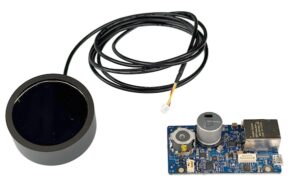
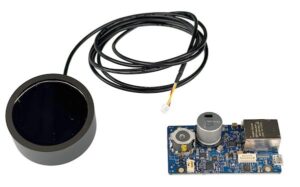
Sounder S500 single beam echosounder by Cerulean Sonar
Applications of Single Beam Echosounders
Hydrographic and Bathymetric Survey
Single beam echosounders measure water depth directly beneath a survey vessel or USV by calculating the travel time of acoustic pulses reflected from the seabed. When combined with accurate positioning data, these measurements can be used to create depth profiles, contours, and bathymetric models for rivers, lakes, canals, harbors, and coastal waters. Because each transmission covers only a narrow area, survey lines must be planned carefully to achieve suitable coverage and reduce the risk of missing seabed features between adjacent transects.
ROV and AUV Altimetry
For underwater vehicles, a downward-looking single beam sonar serves as an altimeter by measuring the distance between the transducer and the seabed. For ROV pilots, real-time altitude data is vital for maintaining a safe standoff distance during visual inspections and manipulator work in low-visibility water. AUVs use this measurement within their guidance and control systems to maintain a stable altitude for optical imaging and side-scan sonar data collection.
Terrain Following and Seabed Clearance
Terrain-following algorithms allow an AUV to track the contours of the seafloor rather than maintaining a constant depth, keeping onboard sensors within their optimal operating range. The single beam altimeter provides a continuous stream of distance measurements to the vehicle’s guidance computer, which adjusts control surfaces or thrusters to maintain the commanded altitude. Practical implementations require data validation and robust digital filtering to prevent anomalous echoes from marine life, suspended material, steep slopes, or debris from triggering inappropriate control responses.
Obstacle Detection and Collision Avoidance
By mounting a single beam echosounder in a forward-facing or lateral orientation, operators can use it for directional proximity measurement, obstacle warning, or docking assistance. The sensor measures range only within its narrow acoustic beam and does not provide the target shape, bearing coverage, or spatial detail available from an imaging sonar. It is therefore generally used as a supplementary ranging sensor rather than as the vehicle’s sole collision-avoidance system. Multiple compact units can be positioned around the vehicle to provide range measurements in several selected directions.
Lake Mapping and Habitat Monitoring
Small USVs equipped for single beam sonar bathymetry are well suited to mapping lakes, ponds, reservoirs, and sensitive wetland habitats that may be difficult for larger crewed vessels to access. In addition to depth profiling, calibrated acoustic return data may support the interpretation of bottom characteristics, sediment layers, or submerged vegetation. Dual-frequency or broadband systems can provide additional information for separating vegetation echoes from the underlying bottom, although reliable classification generally requires suitable processing, calibration, and supporting ground-truth data.
Key Features of SBES for Unmanned Vessels
Single Beam Echosounders for ROVs
ROV installations require an echosounder that can operate reliably alongside thrusters, hydraulic equipment, power electronics, lighting systems, and tether communications. Integration considerations include pressure rating, operating frequency, measurement range, update rate, data interface, power demand, mounting geometry, and compatibility with the vehicle’s control or navigation system.
The transducer should have an unobstructed acoustic path and be positioned to minimize interference from the ROV frame, tooling, skids, and other sensors. It should also be kept away from thruster wash and areas where turbulence or entrained bubbles may scatter acoustic energy, weaken returns, or cause intermittent loss of bottom-lock. Electrical grounding, cable routing, and synchronization with other acoustic instruments may also be necessary to reduce interference.
Single Beam Echosounders for AUVs
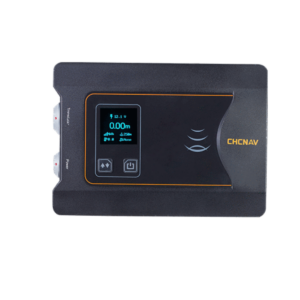
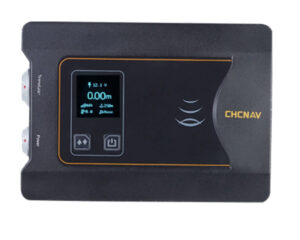
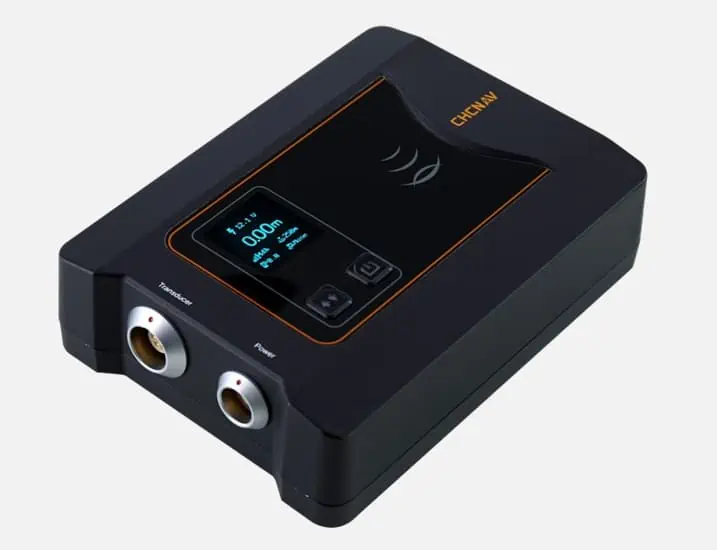
D270 single beam echosounder for bathymetric survey by CHC Navigation
AUVs require high operational autonomy, energy efficiency, and reliable onboard decision-making with an echosounder single beam configuration. Modern AUV altimeters may provide signal-strength information, quality indicators, or bottom-detection status alongside each range measurement. The vehicle’s control system can use these outputs to identify unreliable data or loss of bottom-lock and initiate an appropriate response, such as climbing, slowing down, or changing its mission path.
Single Beam Echosounders for USVs
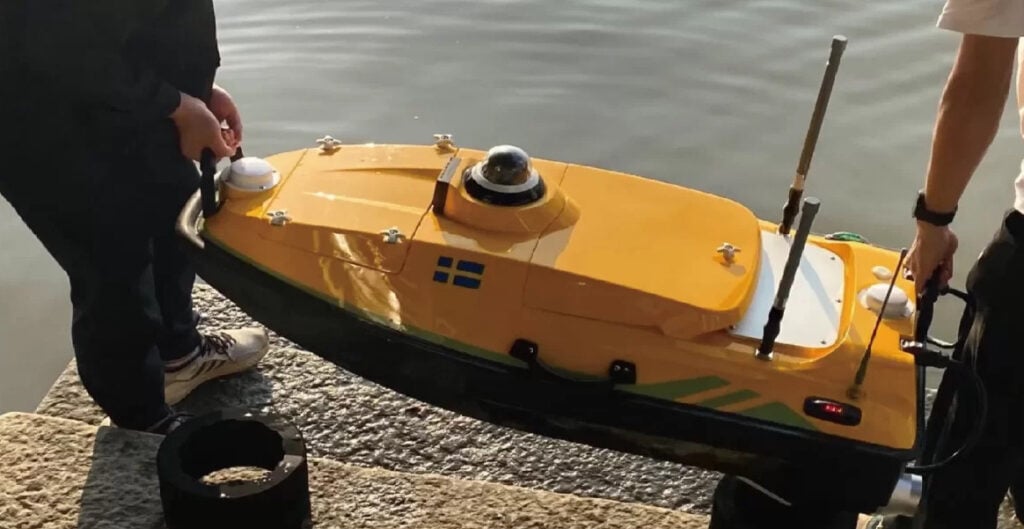
On USV platforms, the transducer is typically integrated through the hull or on a rigid pole to maintain stable and accurately measured offsets relative to the GNSS antenna and other navigation sensors used for single beam bathymetry. The installation must minimize changes in transducer draft, vibration, flow noise, and bubble sweepdown, particularly as vessel speed and sea state increase.
Survey-grade systems commonly incorporate heading and motion measurements so that wave-induced heave, pitch, and roll can be accounted for where required by the survey geometry and accuracy specification. Accurate time synchronization, sound velocity measurements, draft corrections, system calibration, and post-processing are also important for producing reliable georeferenced depths.
Emerging Single Beam Echosounder Technologies
Rapid advancements in sensor-level electronics and digital processing are expanding the role of single beam systems on unmanned platforms.
Compact Low-Power Digital Echosounders: Transceiver electronics can be integrated into or positioned close to the transducer housing, reducing analog cable runs and allowing processed digital measurements to be transmitted to the vehicle.
Broadband and Multi-Frequency Operation: CHIRP and broadband signal processing can improve signal-to-noise performance and range resolution, while multiple operating frequencies may support bottom detection, sediment interpretation, or vegetation analysis.
Adaptive Pulse and Gain Control: Intelligent firmware can adjust pulse length, transmit level, detection thresholds, and receiver gain to maintain reliable measurements across changing ranges and bottom conditions while reducing saturation and false detections.
Edge Processing aboard ROVs, AUVs and USVs: Onboard processing can identify the bottom, assess measurement quality, estimate vegetation canopy height, or derive selected acoustic indicators directly on the vehicle, reducing the amount of raw data that must be transmitted.
By combining these advanced digital capabilities with a fundamentally robust measurement method, modern single beam systems remain a reliable, low-resource option for applications where precise measurements along a narrow acoustic beam are sufficient.
SatLab Geosolutions explores the growing impact of multibeam echosounder systems in enhancing the speed, accuracy, and effectiveness of hydrographic surveys along critical inland waterways
The latest unmanned systems news, straight to your inbox.
Get our weekly roundup of technology developments, new products and industry news.
THANK YOU FOR SIGNING UP
Thanks for joining us. Check your inbox.
We've sent you an email. Click the confirmation link to complete your subscription to the weekly eBrief. In the meantime, explore the latest news, suppliers and technologies on UST.
Advancing Unmanned Systems Through Strategic Collaboration
UST works with major OEMs to foster collaboration and increase engagement with SMEs, to accelerate innovation and drive unmanned systems capabilities forward.