Showcase your capabilities
If you design, build or supply IR Cut Filters, create a profile to showcase your capabilities and connect with visitors who have an active requirement for your solutions.




Infrared (IR) cut filters ensure accurate color reproduction in drone cameras used for aerial imaging by blocking unwanted infrared light. These filters enhance image clarity across applications ranging from aerial photography to environmental monitoring.
This guide highlights suppliers of drone camera IR cut filters for systems that require suppression of unwanted infrared wavelengths, including UV IR cut filters designed to block both ultraviolet and infrared light.
Read the Technology Overview
If you design, build or supply IR Cut Filters, create a profile to showcase your capabilities and connect with visitors who have an active requirement for your solutions.

Camera sensors in drones and unmanned systems are sensitive to a broad spectrum of light, including infrared wavelengths beyond human vision. While this sensitivity can be advantageous in low-light conditions, it often leads to color distortions in daylight imaging. IR cut filters address this by blocking infrared light, allowing only visible wavelengths to reach the sensor and thereby preserving true-to-life color representation.
Typically, an IR cut filter is positioned between the lens and the image sensor. In some systems, especially those requiring day/night functionality, the filter can be mechanically or electronically removed in low-light conditions to permit infrared light, enhancing night vision capabilities.
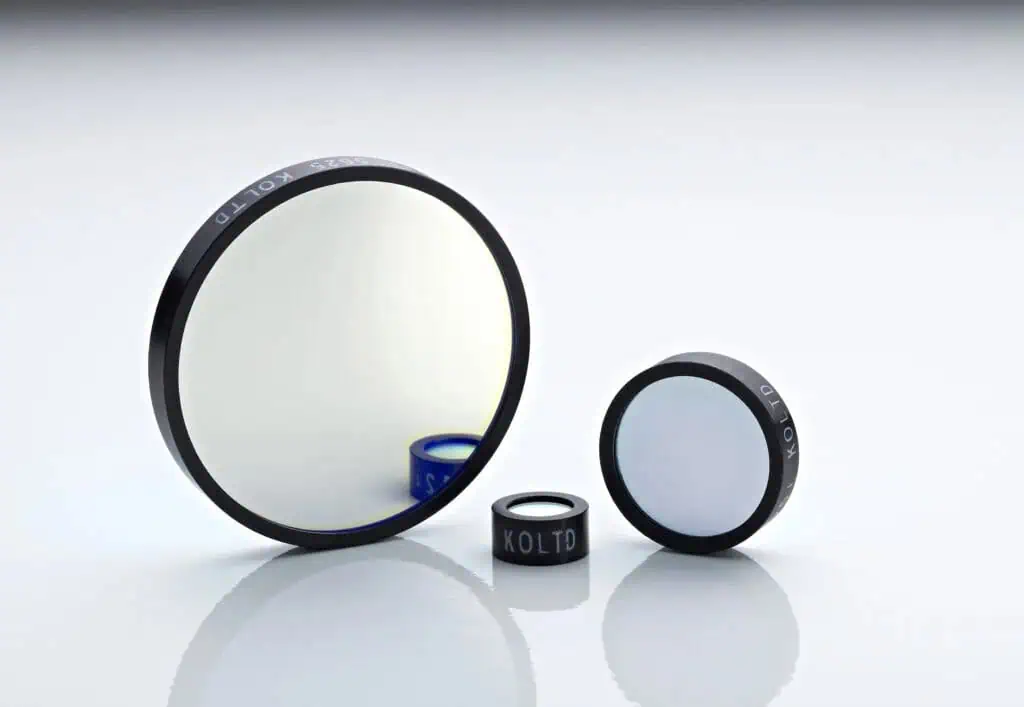
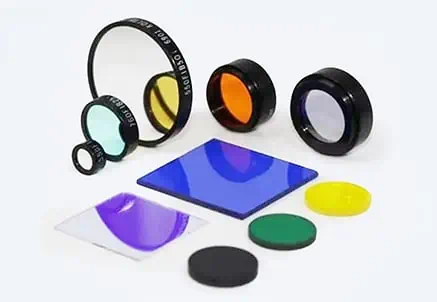
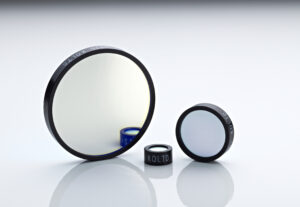
Optical Filters by Knight Optical
Drone cameras equipped with IR cut filters capture images with accurate color balance, essential for applications like photogrammetry and cartography. By eliminating infrared-induced color shifts, these filters ensure the reliability of visual data used in mapping and surveying.
In agricultural mapping, accurate color representation helps in assessing crop health and soil conditions. IR cut filters enable drone cameras to provide clear, true-color images, facilitating better decision-making in precision agriculture.
For tasks like wildlife monitoring and environmental assessments, drone cameras rely on IR cut filters to deliver precise visual data. This accuracy is crucial for tracking changes in ecosystems and detecting environmental anomalies.
In infrastructure inspection, such as power line and pipeline inspection, IR cut filters help drone cameras to capture detailed images, revealing potential issues like corrosion or structural damage. Similarly, in surveillance and reconnaissance, these filters ensure clear visuals, aiding in law enforcement and border patrol operations.
During search and rescue missions, drone cameras are equipped with IR cut filters to provide clear imagery in various lighting conditions. By maintaining color fidelity, these filters enable the effective identification of individuals and assessment of terrains.
Infrared blocking filters come in various types, each designed for specific needs:
The selection depends on factors such as the desired wavelength cutoff, environmental conditions, and specific application requirements.
Combined UV and IR cut filters block both ultraviolet and infrared wavelengths, allowing only visible light to pass through to the sensor. This dual filtering ensures superior color accuracy and prevents unwanted UV and IR radiation from affecting image quality. These filters are often used in high-resolution drone cameras where maintaining accurate color balance and image contrast is critical.
In unmanned systems, UV IR cut filters are particularly valuable when operating in environments with intense sunlight or variable atmospheric conditions. They help minimize lens flare and chromatic aberration while maintaining sharpness and color fidelity.
Common configurations include:
When integrated into drone and unmanned camera systems, these filters support improved image calibration for photogrammetry, environmental surveys, and inspection missions, ensuring consistent performance across varying light conditions.
In multispectral imaging, drones capture data across various wavelengths, including visible and near-infrared. IR cut filters play a crucial role in isolating specific bands, thereby improving the accuracy of analyses in applications such as environmental monitoring and precision agriculture.
The effectiveness of an IR cut filter largely depends on its material composition. Common materials include:
The choice of material affects the filter’s performance, durability, and suitability for specific applications.
IR filter providers are advancing optical filter design with a focus on higher transmission efficiency, spectral precision, and long-term durability. Modern developments in thin-film deposition techniques and advanced coating materials have reduced signal loss while enhancing environmental resistance against temperature fluctuations, humidity, and vibration. These improvements support consistent color accuracy and superior image contrast in visible-light cameras.
In unmanned and remote sensing systems, IR cut filters play a critical role in maintaining optimal sensor performance by selectively blocking infrared wavelengths that can degrade visual clarity. Current models are engineered for compact integration into UAVs, autonomous vehicles, and marine imaging platforms, where stability, optical consistency, and extended operational life are essential. The latest generation of IR optical filters offers enhanced adhesion, anti-reflective properties, and compatibility with high-resolution imaging sensors, contributing to more accurate data capture across a wide range of environmental conditions.


 Searching Companies & Products


 Subscribe to the Weekly eBrief
The latest engineering and technical developments straight to your inbox - join thousands of engineers who receive it.
Subscribe to the Weekly eBrief
The latest engineering and technical developments straight to your inbox - join thousands of engineers who receive it.