

Showcase your capabilities
If you design, build or supply Temperature Probes, create a profile to showcase your capabilities and connect with visitors who have an active requirement for your solutions.



Find suppliers and manufacturers of temperature probes (TAT, OAT and Kiel) for drones and UAVs. Temperature probes provide precise air temperature measurements for flight performance, airspeed computation, and atmospheric data collection.
Read the Technology Overview
Flow Measurement Technologies & Air Data Systems for Unmanned Aerial Vehicles

If you design, build or supply Temperature Probes, create a profile to showcase your capabilities and connect with visitors who have an active requirement for your solutions.

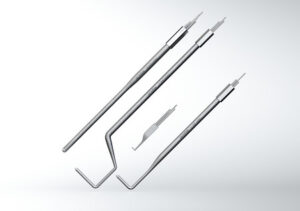
High-Temperature Probes by Vectoflow
Temperature probes are precision instruments used in unmanned aerial vehicles (UAVs) to measure air temperature, a vital input for air data computers (ADCs) and flight control systems. By compensating for temperature effects on air density and pressure, these probes enable accurate airspeed, altitude, and performance calculations. They are typically integrated into air data systems alongside pitot tubes, static ports, and pressure sensors to deliver reliable flight data for navigation, guidance, and environmental assessment.
Several probe configurations are used across UAV and drone platforms, depending on mission profile, speed range, and required accuracy:
Each probe design may incorporate a PRT, thermistor, or other temperature sensor type, selected for compatibility with the UAV’s air data computer and environmental range.
Accurate temperature data is essential across a wide range of UAV missions:
In both commercial and defense UAVs, reliable temperature measurement improves safety, performance, and data accuracy.
A UAV temperature probe measures the temperature of the free-stream airflow, positioned to minimize interference from the vehicle structure or heat sources. Depending on its design, the probe may record the total air temperature (TAT), true air temperature, or outside air temperature (OAT). The distinction is important:
In UAV applications, temperature probes interface directly with the air data computer, forming part of an integrated suite of sensors including pitot tubes, static ports, and differential pressure transducers. The ADC uses these combined inputs to determine key flight parameters such as true airspeed, Mach number, and altitude.
Depending on configuration, temperature probes provide analog outputs or incorporate internal analog-to-digital converters for direct digital transmission. The air data computer processes the resulting data to support flight control and environmental monitoring functions.
Temperature probes for UAVs are engineered for durability, accuracy, and environmental resilience. Common components include:
Materials such as stainless steel, aluminum, or composite structures are commonly used to balance strength and weight.
| Probe Type | Measurement Focus | Heating Option | Typical Use Case |
| OAT Probe | Ambient air temperature | Optional | General UAV flight and environmental sensing |
| TAT Probe | Total (compressed) air temperature | Heated | High-speed UAVs, flight test aircraft |
| Kiel Probe | Stabilized total temperature | Heated | Turbulent or variable airflow environments |
| Heated Probe | Ice prevention | Yes | Cold weather or high-altitude missions |
| Multi-hole Probe | Combined airspeed and temperature | Optional | Integrated air data systems |
The selection depends on flight envelope, speed, and environmental conditions. Kiel and TAT probes are favored for high-performance drones and research aircraft where precision and stability are critical.
Temperature probes used in UAVs and air data systems are designed and tested to meet aerospace and environmental standards. Common references include:
Calibration ensures that probes maintain consistent measurement accuracy across temperature ranges and airspeeds. This process typically includes wind tunnel validation and in-flight verification with reference instrumentation.
Modern UAV air data systems incorporate temperature probes as part of a tightly coupled sensor network. Data from pitot tubes, static ports, and temperature sensors is fused within the air data computer to produce a comprehensive flight envelope model.
Digital integration through analog-to-digital converters or direct digital communication allows seamless interfacing with avionics, telemetry, and control networks. This integration enhances situational awareness and ensures consistent airspeed and altitude information, even in dynamic flight environments.
When selecting or integrating a temperature probe for UAV use, factors such as airflow alignment, icing susceptibility, and signal compatibility must be considered. Proper mounting reduces aerodynamic interference, while heating elements and protective coatings mitigate ice and moisture effects.
Electrical and data connections must conform to UAV system voltage and signal standards, ensuring clean, accurate communication with the ADC or flight control unit. Regular maintenance and calibration extend probe life and maintain performance across operational cycles.
Recent innovations in temperature probe technology for unmanned systems include digital converters and miniaturized ADC interfaces that reduce latency and improve accuracy. Advanced materials and additive manufacturing techniques have enhanced probe aerodynamics and reduced mass.
Smart sensors with integrated diagnostics can now self-monitor for icing or element degradation, improving reliability during long-duration autonomous missions. These developments support broader trends in UAV systems toward compact, lightweight, and networked air data solutions.
Temperature probes, including Kiel and total air temperature probes, play a critical role in UAV and drone air data systems. They enable precise temperature measurement for flight control, airspeed calculation, and environmental data collection. Through careful integration with pitot tubes, static ports, and air data computers, these sensors support reliable performance in both civilian and defense unmanned operations.


 Searching Companies & Products