Drone roof inspection services enable the safe, efficient evaluation of commercial, industrial, and residential structures by capturing visual, thermal, and LiDAR data from UAS platforms. These services support condition monitoring, defect detection, and post-event assessment while reducing exposure to work-at-height hazards.
This category highlights drone roof survey companies using multirotor, sUAS, and heavy-lift systems to meet varied payload and data requirements, producing orthomosaics, 3D models, and thermal maps for maintenance planning.
If you design, build or supply Drone Roof Inspection Services, create a profile to showcase your capabilities and connect with visitors who have an active requirement for your solutions.
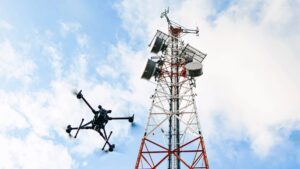
Drone services for aerial data collection & inspection operations
Drone services for aerial data collection & inspection operations
... comprehensive droneservices for commercial and industrial projects requiring aerial imaging,... ...space delivers drone-based solutions for construction and engineering, defense, infrastructure,...
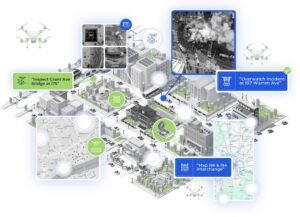
AI-enabled aerial intelligence service for connected urban and regional operations
AI-enabled aerial intelligence service for connected urban and regional operations
...le Drones as a Service (DaaS) platform tailored for smart-city and regional networks. The AI-enabled... ...d right-of-way inspection; flood and storm assessment; traffic monitoring....
Drone roof inspection is an essential service that minimizes risk, enhances data quality, and accelerates maintenance workflows across commercial, industrial, and utilities sectors. Equipped with advanced sensors to rapidly and safely assess the condition, integrity, and geometric characteristics of building roofs, this methodology replaces hazardous manual inspection techniques, leveraging the drone’s ability to fly close to the structure and capture high-resolution visual imagery, thermal data, and three-dimensional point clouds.
Enhanced Roof Condition Reporting for Industrial Asset Management
For construction and asset management professionals, using drones for roof inspection provides a non-intrusive, data-driven approach that minimizes operational risk while providing a comprehensive digital record of the asset’s health. Drones can cover vast areas, such as industrial warehouses or large solar arrays, in minutes, generating data that feeds directly into specialized software for analysis.
This data is used to identify subtle defects, including moisture intrusion (via thermal imaging), membrane degradation, structural settling (via LiDAR/photogrammetry), and physical damage, providing a quantitative, geo-referenced inventory of defects. The result is a highly accurate condition report that enables proactive, targeted maintenance planning and integration with digital twin and Building Information Modeling (BIM) systems.
Key Advantages of Conducting Roof Inspections With a Drone
The transition from rope access, elevated work platforms, and scaffolding to using UAS for aerial inspection offers significant operational and safety benefits, crucial when assessing large or complex facilities.
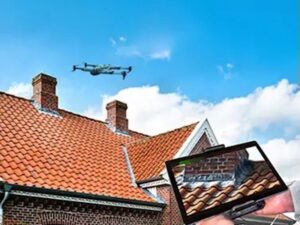
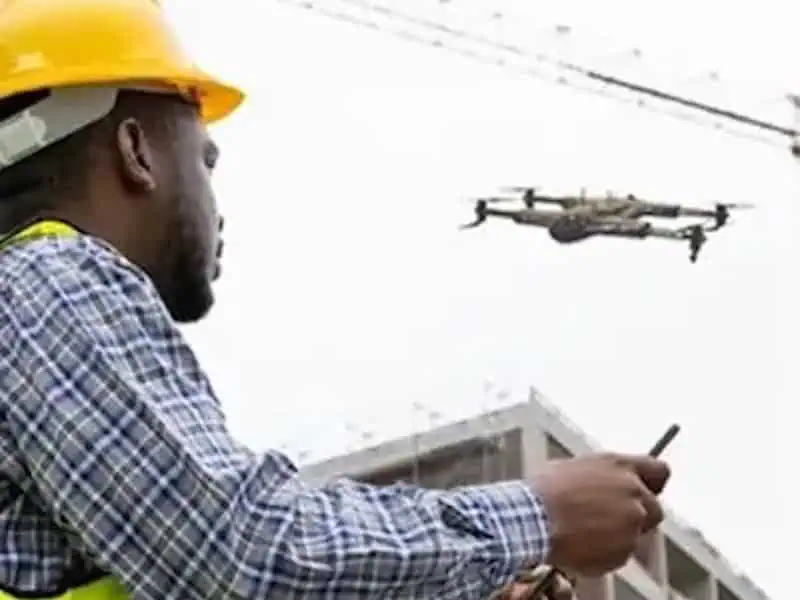
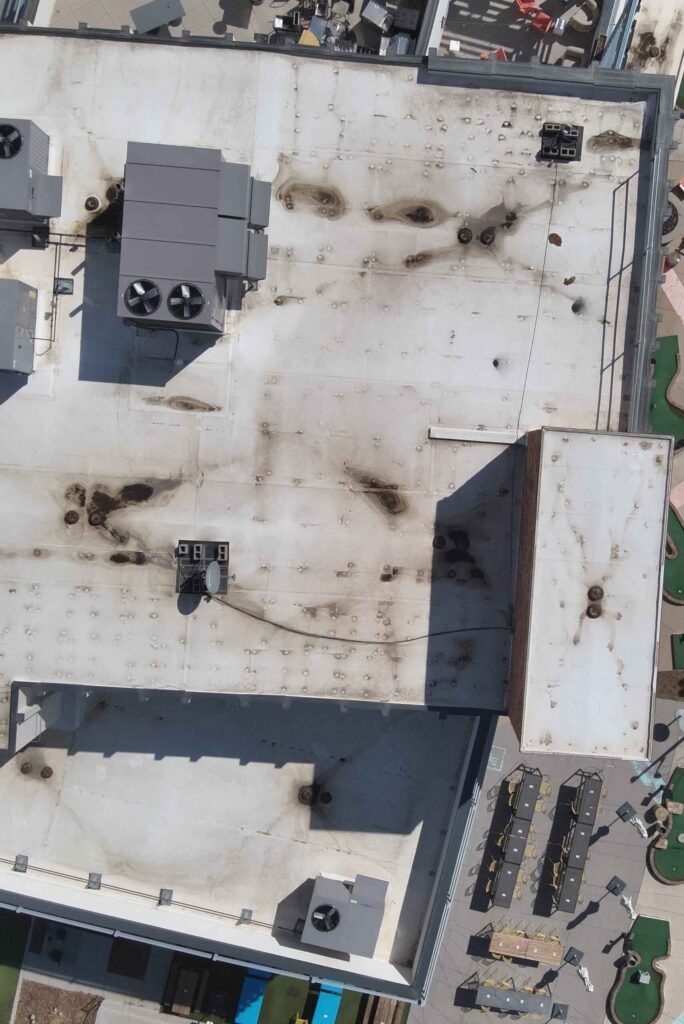
Drone Aerial Imaging Services for Property & Roof Inspection by Blue Nose Aerial Imaging
Safety and Risk Mitigation
Carrying out roof inspections with a drone eliminates the need to expose personnel to the inherent risks associated with working at height. This is a primary driver, particularly on industrial sites and expansive commercial roofs where fall hazards are substantial.
Speed and Scale
A single flight mission allows teams to rapidly assess vast roof areas, including warehouses, logistics centers, and data centers, that would take days or weeks using manual techniques. This speed is invaluable for routine checks and essential during post-disaster assessments.
Consistency and Repeatability
Drones for roof inspection provide uniform, geo-referenced data capture across repeated missions. This high degree of consistency is critical for organizations tracking subtle structural degradation, heat loss, or waterproofing failures over extended time periods.
Data Integration
Drones combine multiple sensor modalities (visual, thermal, LiDAR) within a single sortie, increasing diagnostic value compared to human visual inspection alone. The data is inherently digital, supporting immediate integration with maintenance management systems.
Sectors Using Drones for Roof Inspections
The versatility of the modern roof survey drone platform supports a range of technical applications across the unmanned systems and built environment sectors.
Commercial and Industrial Facilities
Large manufacturing plants, data centers, and critical infrastructure sites benefit from precise imaging to identify membrane deterioration, mechanical damage, ponding water, and sealant failures. Drone surveys minimize operational disruption, producing data tailored for facilities management.
Utilities and Energy Infrastructure
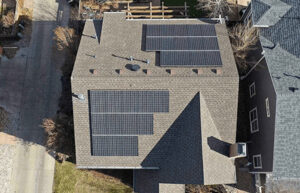
Drone thermal roof inspection is critical for evaluating utility-scale solar arrays. UAS give inspectors the vantage point to assess panel alignment, contamination, thermal anomalies (hotspots), and shading losses. Drones also allow for the inspection of roofing materials over high-voltage substations without introducing personnel risk.
Insurance and Claims Verification
Insurers are increasingly leveraging standardized, geo-referenced drone roof surveys to verify claims following storms or fire events. This provides an audit-ready, objective record, significantly reducing subjectivity and accelerating the claims handling process.
Emergency Response
Following major weather events like hurricanes or hailstorms, drones offer rapid situational awareness. Roofs can be surveyed for collapse risk or penetration long before it is safe or practical to deploy human response teams.
Selecting a Roof Inspection Drone
Selecting the right UAS platform is dependent on the operating environment, required payload, and desired data product.
Wind-Resistant Multirotor UAS
The most common platform type, professional multirotor airframes, feature high-authority flight controllers and robust GPS/RTK positioning. This stability is mandatory for close-range, low-altitude flight, often executed in the turbulent wind fields generated by large building edges.
SUAS & Micro-UAV Platforms
For dense urban settings, small residential sites, or restricted airspaces, operators frequently select sUAS and micro-UAV. Their lower acoustic signatures and reduced visual impact minimize public disruption while still providing sufficient detail around complex geometries like chimneys, parapets, and facades.
Heavy-Lift Platforms
Comprehensive industrial or critical-infrastructure inspections often necessitate multiple simultaneous payloads (e.g., EO, thermal, and LiDAR). Heavy-lift UAS offer the expanded power budget and mounting flexibility required for these multi-sensor capture missions, ensuring maximum data fidelity in a single, efficient flight.
Roof Inspection Payloads & Sensor Technologies
The diagnostic power of a drone inspection lies in its sensor package. A typical drone for roof inspection is equipped with advanced sensors that capture information invisible to the naked eye.
High-Resolution Electro-Optical (EO) Cameras
These sensors are the primary tool for identifying surface defects such as cracking, blistering, sealant degradation, and failed joints. Gimbal-stabilized cameras, typically 20–48 MP, with adjustable focal length, are essential for optimizing clarity across varied roof types and identifying subtle defects.
Thermal Imaging (Infrared) Sensors
Infrared drone roof inspection sensors detect subsurface moisture and insulation failures. Roof membranes with trapped water exhibit a delayed cooling cycle compared to dry areas, enabling thermal analysis to pinpoint areas of moisture ingress that require further, intrusive inspection.
LiDAR Systems for Geometric Accuracy
LiDAR for aerial survey provides dense 3D point clouds essential for identifying sagging, settlement, or long-term deformation on expansive industrial roofs. LiDAR performance is consistent even on low-texture or reflective surfaces where photogrammetry may struggle to generate accurate geometry.
Photogrammetry Payloads
Survey-grade cameras are used in conjunction with high overlap collection methods to create highly accurate orthomosaics, digital surface models (DSMs), and perform volumetric analysis. These datasets are foundational for integrating inspection data into CAD and BIM workflows.
Data Processing, Analysis & Reporting
The data collected by the UAS is then processed through specialized pipelines to extract actionable engineering insights.
Photogrammetric Reconstruction
Structure-from-Motion (SfM) pipelines convert high-overlap imagery into metrically accurate, georeferenced roof models. The resulting orthomosaics clearly reveal surface deterioration patterns, while DSMs help engineering teams accurately assess drainage performance and identify critical ponding zones.
AI- and ML-Assisted Defect Detection
Modern drone roof inspection software increasingly incorporates Machine Learning (ML) pipelines to automate feature identification. Trained models can rapidly classify specific defects, segment heat anomalies, and highlight structural irregularities. This vastly reduces manual review time, supporting consistent, objective reporting, and improving the efficiency of the inspections.
Deliverables for Asset Management
Professional inspection outputs are designed to integrate seamlessly into maintenance planning. These outputs typically include orthomosaic roof surveys, thermal anomaly maps, 3D roof models (point clouds or meshes), geospatially referenced defect inventories, and engineering-grade condition reports for repair prioritization.
Emerging Technologies in Drone Roofing Inspection
The value of UAS inspection data is maximized when it is integrated into the broader digital asset management ecosystem.
BIM and Digital Twins
Inspection data, particularly high-density point clouds and orthophotos, is used to update Building Information Modeling (BIM) systems. This strengthens the integrity of digital-twin strategies by ensuring the model reflects current geometric and thermal conditions, which is essential for long-term structural monitoring.
Cloud Data Management
Cloud-based processing and storage environments allow teams to manage the inherently large datasets generated by drone inspections. Secure, encrypted data transfer is essential for sharing results with contractors, insurers, and asset managers while maintaining compliance and access controls for restricted commercial sites.
Emerging Autonomy and IoT
The future points toward full autonomy. Dock-in-place drone systems and autonomous flight scheduling are emerging for facilities requiring frequent, routine inspections. These systems enable rapid, automated capture following maintenance or weather events, moving the industry toward a true predictive maintenance paradigm by integrating with on-site IoT sensors and smart building networks.
Blue Nose Aerial Imaging explains how drone technology enables safer, faster, and more cost-effective commercial roof inspections, providing detailed aerial imagery and data collection without requiring inspectors to physically access rooftops
Blue Nose Aerial Imaging outlines its drone-based roof inspection services in Chandler, Arizona, supporting owners and facility teams in identifying roof issues, reducing fall risk, and carrying out leak checks, photo surveys, or thermal scans ahead of winter rains
Blue Nose Aerial Imaging’s guide on drones and thermal roof inspections outlines how thermal imaging supports rooftop assessments by identifying temperature variations that may indicate moisture intrusion
Jan 07, 2026
Advancing Unmanned Systems Through Strategic Collaboration
UST works with major OEMs to foster collaboration and increase engagement with SMEs, to accelerate innovation and drive unmanned systems capabilities forward.