Surveillance Radar
Discover cutting-edge solutions from 5 leading global suppliersAccipiter Radar’s smart surveillance network is set to secure the water border between the Ports of Windsor and Detroit, with an integrated network of advanced Accipiter radars and Axis bi-spectral cameras being installed on both sides of the border.
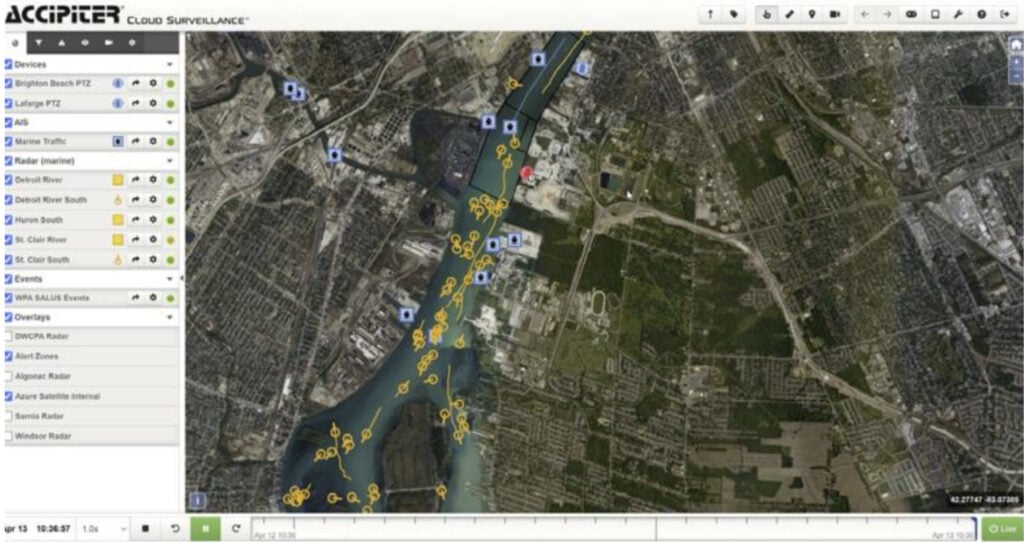
Both Canada and the United States are seeing border security as an urgent concern, involving a multitude of agencies at the federal, provincial/state, and local levels.
Accipiter Radar has a proven reputation in the smart surveillance sector. Accipiter’s surveillance solutions and wide-area radar networks are key enablers for Beyond Visual Line of Sight (BVLOS) UAV operations and Counter-UAS. The company will now use that expertise to secure the 2,000km water border that runs through the Great Lakes at the Ports of Windsor and Detroit.
Accipiter’s network is designed for secure information sharing through the automatic generation and delivery of relevant, surveillance-derived information. This is achieved by utilizing advanced signal and data processing, data mining, and AI technologies to ensure that the right information reaches the right person at the right time.
The effectiveness of these capabilities in enabling intelligence-led enforcement and optimizing frontline resource and response asset utilization, has been operationally proven by multiple agencies in Canada and the US. By enhancing the efficient use of resources such as boats, vehicles, aircraft (e.g. Black Hawks), and drones resulting in force multiplication.
Accipiter’s President and CEO Tim Nohara, commented, “This smart surveillance network simply needs to be expanded as was originally planned under Harper and Obama to cover the critical lakes and rivers through which the border runs, in order to quickly achieve effective border security across Detroit Sector, Buffalo Sector and Swanton Sector as urged by Trump and Homan.”
Nohara continued, “We’ve designed our smart surveillance networks similar to cellular networks, and you roll them out the same way.
“The expanded network can use different surveillance sensors (needed on both sides of the border, kind-of-like roaming) which plug-and-play together just like iPhone and Android smart phones. And the supported sensors include those that track small vessels, low-flying aircraft and drones (C-UAS) used in smuggling guns, drugs and other contraband across our borders, while also enabling the safe, beyond visual line of sight (BVLOS) use of drone as first responder (DFR) by law enforcement by detecting and avoiding (DAA) crewed aircraft in accordance with aviation regulations to share the airspace.
“Furthermore, each user can run their own apps (or use ours) and share information with each other just like sending e-mails or calendar invites to each other even though they are using different software or service providers on their smart phones.”