Discover World-Leading Unmanned and Autonomous Technologies
Discover cutting-edge solutions from leading global suppliers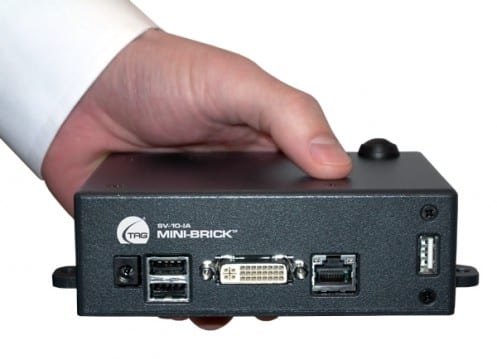
TAG's Custom Designed Mini-Brick
Technology Advancement Group (TAG) expands their rugged small form factor computer research and development to focus on designing custom Mini-Brick computers that are lighter and take up less space in military, industrial, and transportation vehicles.
Technology Advancement Group, a Veteran-Owned Small Business (VOSB) that specializes in advanced engineering solutions, has released the first of several custom designed Mini-Brick™ computer systems optimized for the stringent Size, Weight and Power (SWaP) requirements of autonomous unmanned ground, airborne, and maritime vehicles. Built with a rugged aluminum housing and solid-state technology, the Mini-Brick was designed to withstand the varying levels of shock and vibration of physical transport.
TAG’s Mini-Brick (SV-10-IA) was engineered with a modular design that offers the option of a single or dual-core Intel® Atom™ processor. Leveraging Commercial-Off-The-Shelf (COTS) components and TAG’s integration expertise, the Mini-Brick can be deployed into the field quickly and the small size allows the Mini-Brick to be mounted to any surface available. When fully loaded the Mini-Brick weighs in at 1.4lbs allowing Unmanned Ariel Vehicles (UAV) and other small aircraft to lighten their electronic system payloads.
The low power consumption platform of the Mini-Brick is suited for a range of in-vehicle and hard mounted applications such as mobile communications, video surveillance, and machine control operations. Engineered for military grade performance and operating conditions, the Mini-Brick is also ready for deployment in the security, maritime, oil & gas, mining, construction, and agriculture sectors. The Mini-Brick is designed and manufactured following an intricate engineering process that involves deployable architecture development, mechanical and electrical engineering, thermal simulation, and environmental testing.