NDAA-compliant drone motors are certified propulsion solutions manufactured and sourced to meet U.S. National Defense Authorization Act supply chain and security regulations for UAS. These motors are optimized for unmanned platforms requiring precise thrust-to-weight ratios, long-term environmental resilience, and stringent configuration control for flight-critical operations.
This page features leading suppliers of NDAA-compliant drone motors deployed across defense, tactical security, and government-approved enterprise programs where supply chain traceability, material provenance, and hardware integrity are mandatory.
If you design, build or supply NDAA-Compliant Drone Motors, create a profile to showcase your capabilities and connect with visitors who have an active requirement for your solutions.
The Comprehensive Engineering Guide to NDAA-Compliant Drone Motors
Overview by
William Mackenzie
Updated:
Introduction to NDAA-Compliant Drone Motors
For UAS manufacturers and system integrators, NDAA-compliant drone motors sit at the intersection of aircraft performance, procurement eligibility, and supply chain assurance. A motor’s country of origin, material provenance, ownership structure, and manufacturing controls can affect whether an uncrewed platform is suitable for U.S. federal procurement, Department of Defense (DoD) programs, federally funded public safety deployment, or critical infrastructure operations.
Motor selection is not only a question of thrust, efficiency, size, or weight. Windings, magnets, bearings, laminations, shafts, insulation systems, and production processes all influence how a motor performs under load. If any of these elements change after platform qualification, the aircraft may require further engineering review, particularly where motor behavior affects endurance, vibration, thermal margins, acoustic signature, or payload performance.
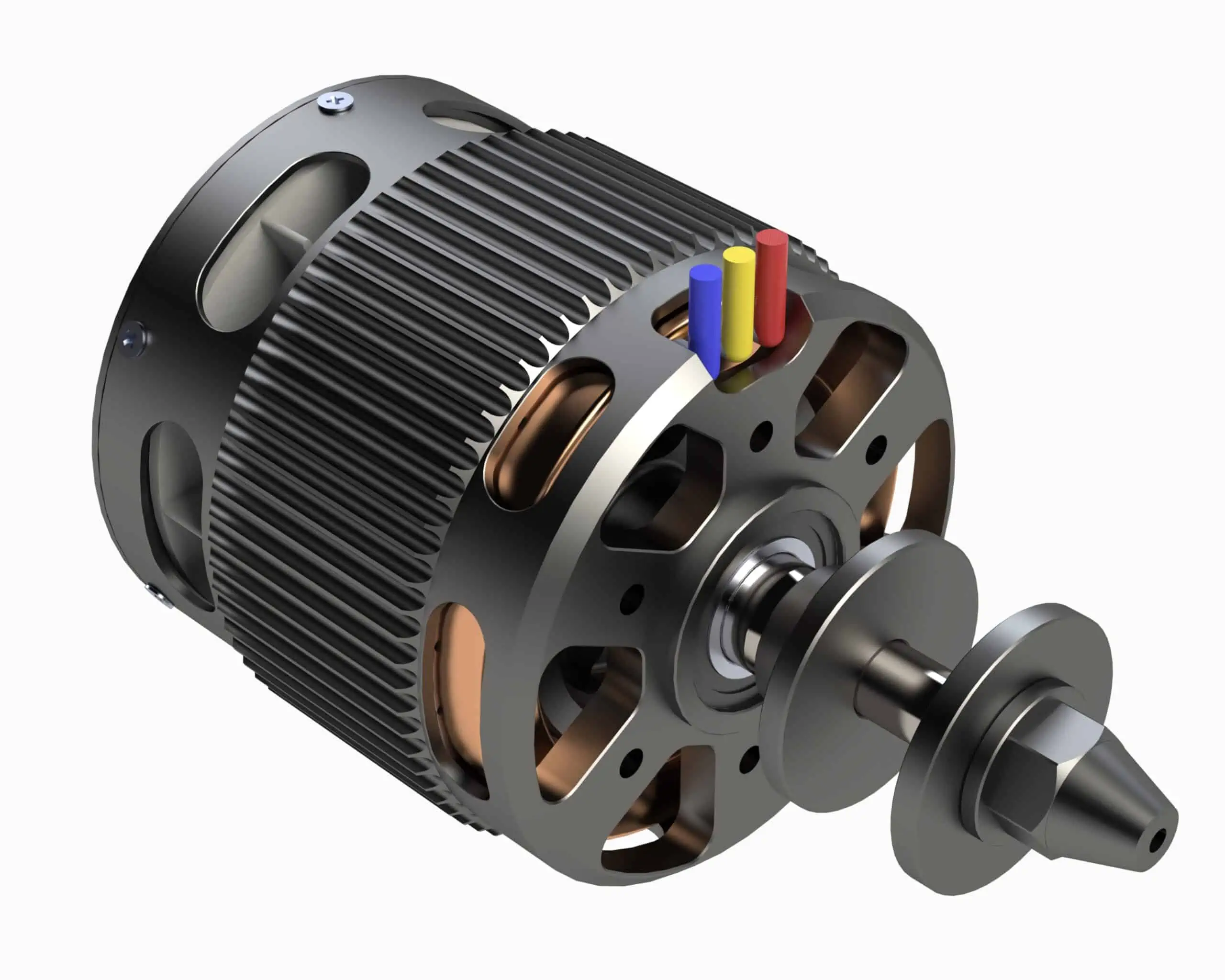
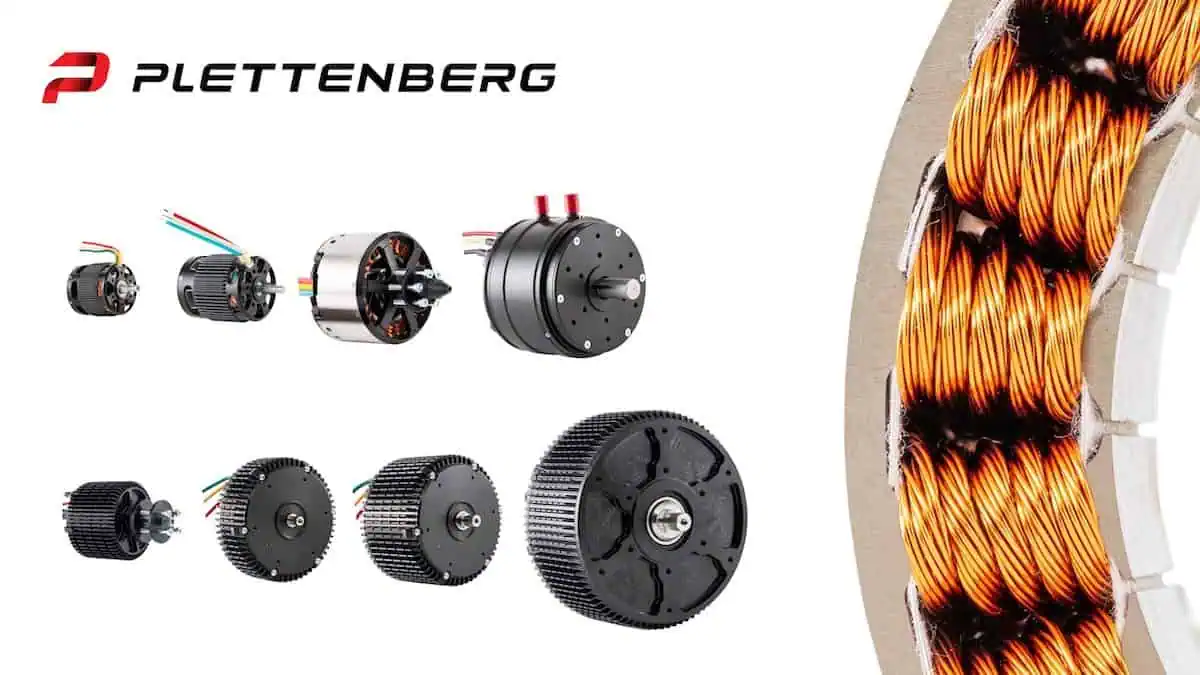
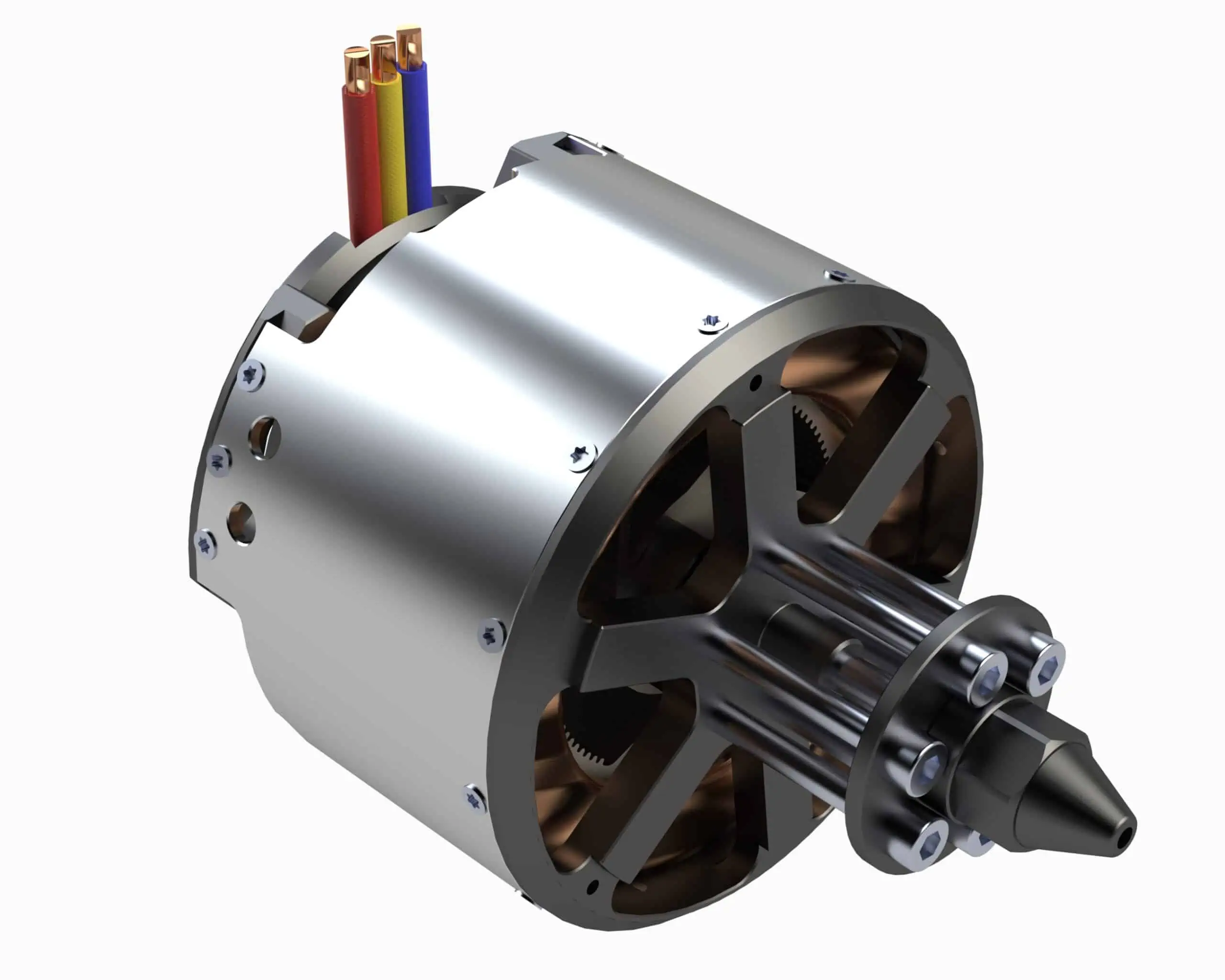
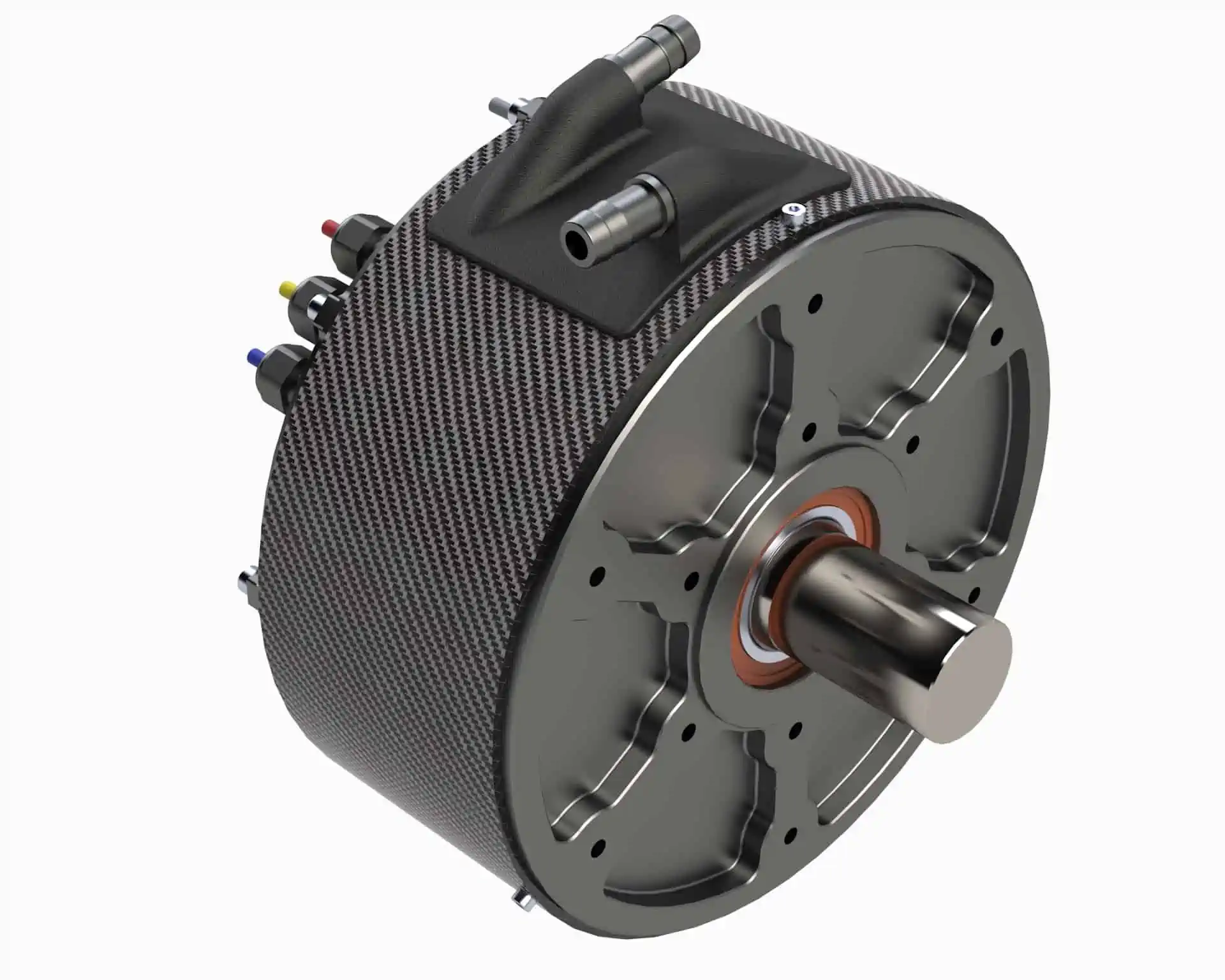
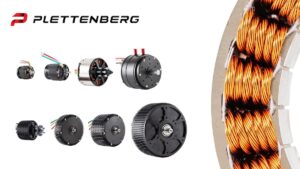
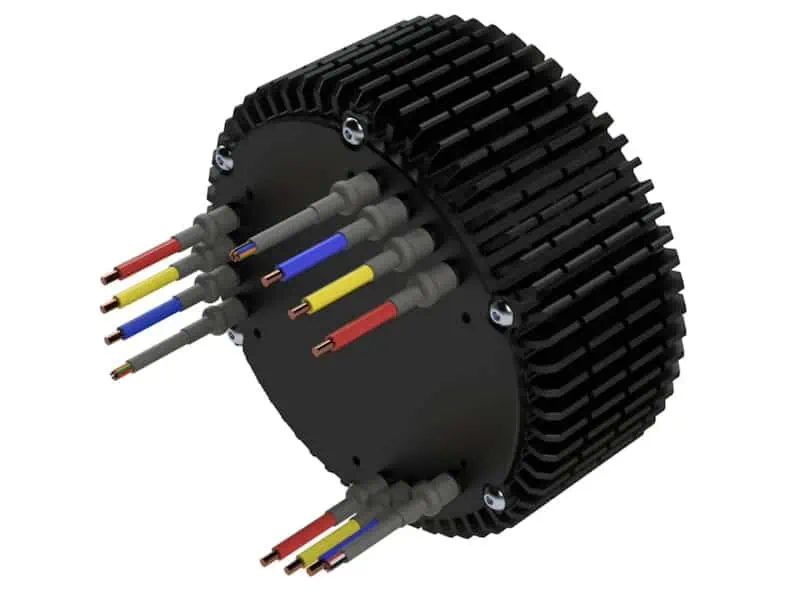
ORBIT Outrunner NDAA-Compliant Drone Motors by Plettenberg
For NDAA-sensitive programs, the strongest drone motor suppliers provide more than output data. Engineering teams need clear documentation for sub-tier components, rare-earth materials, specialty metals, production location, and engineering change control. Where motors are supplied with integrated electronics, telemetry, or matched Electronic Speed Controllers (ESCs), firmware provenance and active component sourcing may also become part of the compliance review.
The NDAA Regulatory Framework for Drone Motors
Statutory Requirements and Supply Chain Security
National Defense Authorization Act (NDAA) procurement restrictions are designed to reduce adversarial dependencies and cybersecurity vulnerabilities within federal technology supply chains. While earlier enforcement often focused on complete airframes, optical payloads, Radio Frequency (RF) data links, and flight control computers, drone motors are increasingly relevant within broader supply chain reviews.
For engineering teams specifying NDAA-compliant drone motors, compliance goes beyond final assembly or point-of-origin labeling. Sourcing vetted NDAA drone motors requires visibility into corporate ownership, manufacturing oversight, and sub-tier component origins.
The Berry Amendment and Specialty Metals
For some defense procurement programs, engineering and sourcing teams may also need to consider the Berry Amendment and related domestic sourcing requirements for specialty metals. These requirements can affect motor components such as shafts, housings, fasteners, stator materials, and other metallic parts, depending on the contract, material type, and program requirements.
This is especially relevant for NDAA-compliant brushless motors for drones that rely on precision alloys, rare-earth magnets, and tightly controlled metallic subcomponents. A motor may be assembled in the United States and still require deeper review if key materials, magnet inputs, or metallic components originate from restricted or non-qualifying sources.
FY2026 NDAA Supply Chain Initiatives
The FY2026 NDAA establishes a dedicated Small-UAS Industrial Base Working Group tasked with assessing domestic supplier capacity, identifying supply chain vulnerabilities, and recommending strategic investments to strengthen the U.S. drone industrial base.
For NDAA-compliant drone motor manufacturers, this highlights growing federal interest in domestic production capability, material traceability, and supply chain resilience for critical sUAS subsystems.
Although the legislation does not create a separate certification pathway for drone motors, it reinforces the importance of documented manufacturing processes, verified material sourcing, and long-term production stability. Motor suppliers seeking placement on qualified Bills of Materials (BOMs) should be prepared to provide reproducible manufacturing data, traceable material streams, and domestic production options where required by federal procurement programs.
Connected Motor Systems and Covered Hardware Considerations
The Federal Communications Commission (FCC) Covered List and related federal supply chain security initiatives have increased scrutiny of certain foreign-produced equipment, communications technologies, and restricted suppliers used within government, defense, and critical infrastructure technology ecosystems.
For drone motor applications, this is most relevant where the motor is supplied as part of an integrated motor/ESC assembly, smart motor module, or telemetry-enabled drive unit. An isolated passive brushless motor contains no processing or communications capability, but integrated motor systems may incorporate microcontrollers, Digital Signal Processors (DSPs), serial communications interfaces, and telemetry functions that warrant additional supply chain review.
Core Applications of NDAA-Compliant Drone Motors
Defense and Tactical UAS Deployment
Military and tactical operators require motors engineered for demanding duty cycles, acoustic discretion, and resilience against environmental ingress, shock, and transport vibration. In tactical environments, motor-level failure can cause airframe loss, mission compromise, and potential exposure of sensitive payload intellectual property.
Defense acquisition programs typically lock down motor configuration during the Engineering and Manufacturing Development (EMD) or prototyping phase. A stable, traceable motor is often preferred over a non-compliant commercial alternative, even where the latter offers marginal gains in raw thrust or peak efficiency.
Public Safety, First Responders, and Law Enforcement
State and local public safety agencies using federal grant funding may face procurement, cybersecurity, or supply chain restrictions that affect UAS platform eligibility. Police, fire, and search-and-rescue teams usually evaluate performance at the aircraft level, but undocumented motors can still create compliance risk for the wider airframe.
Sourcing compliant replacement motors also supports long-term fleet sustainment. If maintenance is performed using unvetted or untraceable motors, agencies may risk fleet grounding or future funding complications during later compliance reviews. This operational risk has increased interest in specialized NDAA-compliant FPV drone motors for high-speed reconnaissance and rapid-deployment fleets.
Critical Infrastructure and Enterprise Inspection
Energy utilities, maritime ports, transport networks, and industrial inspection firms operate uncrewed systems around sensitive national assets. While these commercial operators are not always bound by Title 10 defense procurement laws, they often adopt strict supply chain security requirements to reduce operational liability and espionage risk.
Using compliant drone motors can help enterprise drone programs prepare for regulatory changes, insurance requirements, and client-mandated security standards.
Motor Topologies & Engineering Trade-offs
Brushless DC (BLDC) Motors
Most electric UAS motors are permanent-magnet brushless machines, commonly described as Brushless DC (BLDC) motors, although PMSM and BLDC terminology can vary depending on control method and waveform. These motors are widely used in electric unmanned aircraft because they offer strong power-to-weight ratios, efficient torque production, and low maintenance requirements.
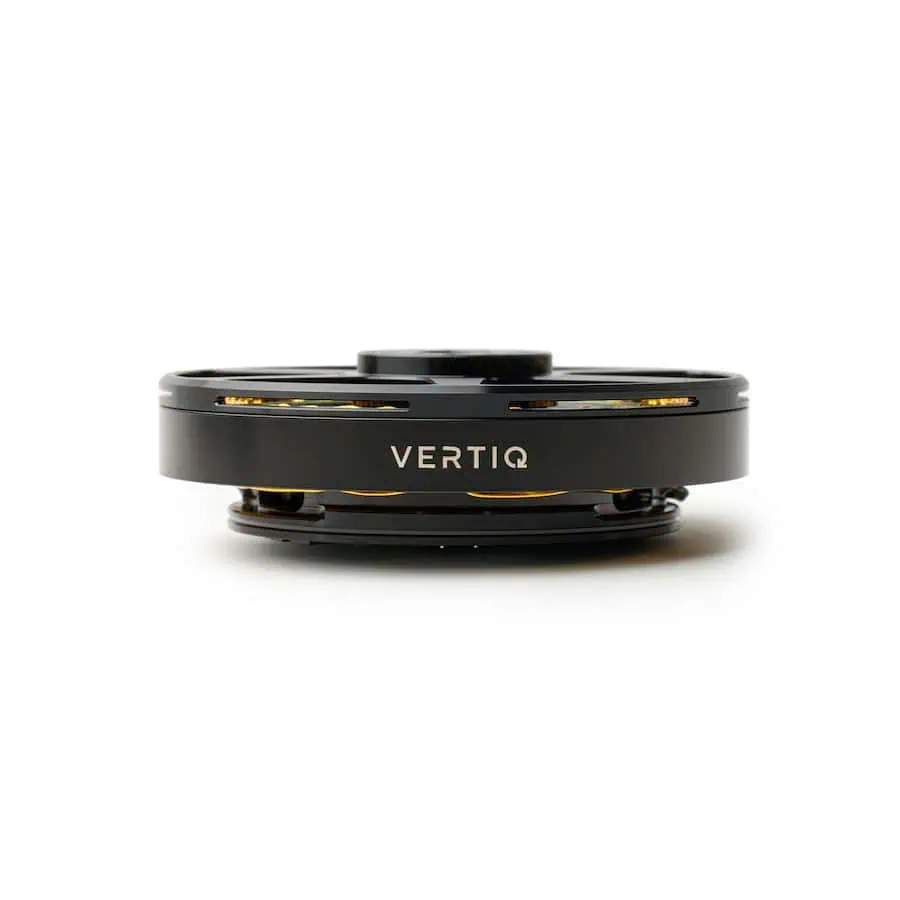
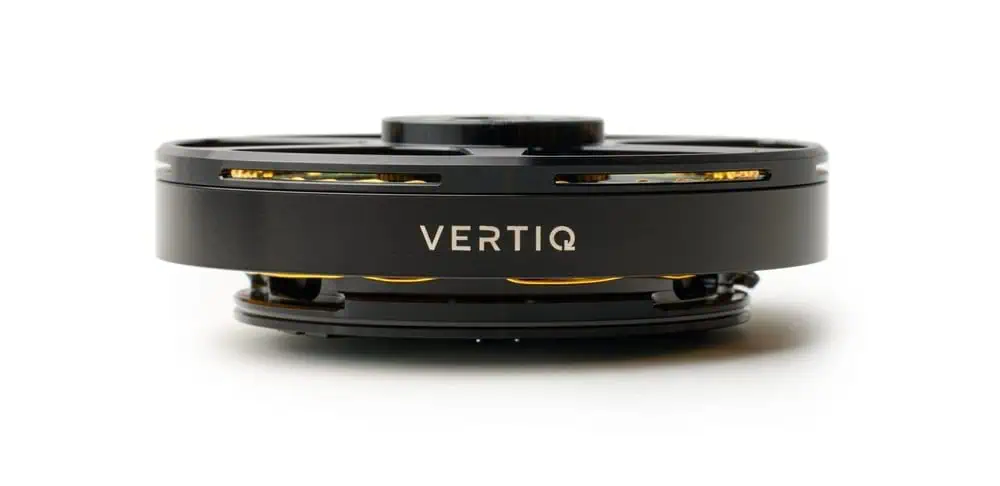
81-08 G2 NDAA Drone Servo Motor Module by Vertiq
In NDAA-sensitive designs, the key issue is repeatability. A compliant brushless motor should be supported by a controlled part number, locked winding specification, verified magnetic material sourcing, and documented bearing selection.
Outrunner Motors
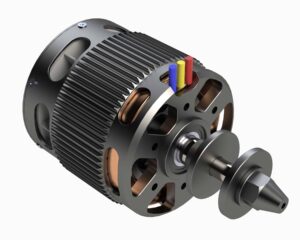
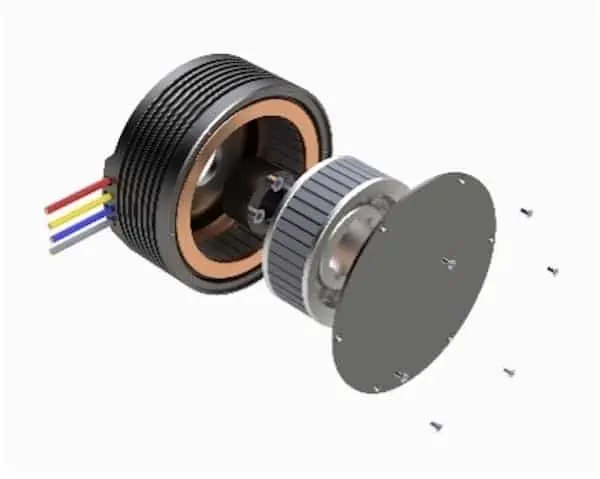
Outrunner configurations, where the external permanent-magnet rotor spins around an internal stator and copper windings, are widely used in multirotor aircraft. They produce high torque at lower rotational speeds, making them suitable for direct-drive propellers and hover-intensive mission profiles.
Many outrunner supply chains originated in the commercial hobbyist market, where suppliers and sub-tier components can change frequently. For defense and enterprise UAS, engineers should request provenance for stator laminations, copper wire insulation, bearings, and rare-earth magnet lots.
Inrunner and Ducted Fan Motors
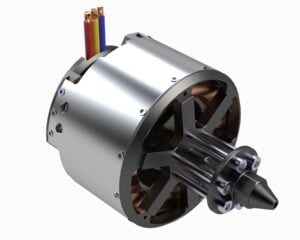
Inrunner configurations place the spinning rotor inside the stationary outer winding assembly, favoring higher rotational speeds and narrower frontal packaging. These motors are typically used in fixed-wing UAS, high-speed tactical aircraft, or enclosed ducted fan housings.
Substituting an undocumented inrunner can alter current draw, acoustic signature, Electromagnetic Interference (EMI), and thermal behavior, even if the static Kv rating appears similar.
Some high-performance aerospace and defense platforms also utilize slotless motor architectures. By eliminating stator slots, these designs can reduce cogging torque, improve smoothness, and enhance efficiency at high rotational speeds.
Axial-Flux Motors
Axial-flux motors direct the magnetic flux path parallel to the motor’s rotational axis rather than radially outward. This architecture can deliver high torque density and compact packaging, making it attractive for heavy-lift tactical cargo UAS, long-endurance hybrid aircraft, and larger uncrewed platforms.
The engineering trade-off is production maturity. Integrators still need to verify that the supplier has a secure materials pipeline and repeatable assembly processes capable of supporting multi-year manufacturing volumes.
NDAA Motor Integration & Configuration Control
A drone motor cannot be optimized in isolation from the aircraft and drive electronics around it. A motor’s velocity constant (Kv), torque constant (Kt), internal resistance (Rm), continuous current limits, and thermal time constants must be matched to propeller aerodynamics, ESC switching frequencies, battery discharge rates, and flight controller Proportional-Integral-Derivative (PID) loops.
For procurement-validated platforms, the qualified motor configuration should be document-controlled:
Motor model and BOM revision: The precise hardware version qualified during testing.
ESC pairing where applicable: The commutation algorithm, timing parameters, and firmware used when the motor is qualified with a specific ESC.
Propeller specification: Diameter, pitch, material, and approved manufacturer used during airframe testing.
Operating limits: DC bus voltage, current limits, thermal limits, and safe peak power thresholds.
Engineering change control: Review procedures for winding changes, bearing changes, magnet substitutions, or manufacturing process revisions.
Supply Chain Integrity & Manufacturing Provenance
Documented Manufacturing vs. Point-of-Origin Claims
A basic point-of-origin label is insufficient for rigorous compliance tracking. Supply chain assurance requires visibility into ownership, material traceability, and manufacturing process control.
Key areas include:
Corporate transparency: Documentation showing ownership and control are not linked to restricted foreign entities.
Component provenance: Lot traceability for magnets, bearings, laminations, copper windings, and shafts.
Process stability: Locked workflows for winding, balancing, and end-of-line testing.
Configuration management: Internal revision control preventing unauthorized substitutions.
Rare-Earth Magnets and Strategic Material Sourcing
High-performance brushless motors rely heavily on sintered rare-earth permanent magnets, especially Neodymium Iron Boron (NdFeB), to achieve high flux density and torque-to-weight efficiency. However, upstream raw material extraction, chemical separation, and magnet manufacturing remain concentrated in limited global regions.
For defense aerospace programs, magnet provenance is often one of the most important points of inspection on a motor’s BOM. Component engineers should work with suppliers that trace raw material inputs, manage approved substitution rules, and provide audit trails back to domestic or allied-nation production where required.
U.S. Manufacturing Capacity
To reduce exposure to foreign material dependencies, UAS integrators are increasingly qualifying US-made drone motors from suppliers that can support configuration control, lot traceability, and audit-ready documentation. Working with US-drone motor manufacturers also allows engineering teams to coordinate on winding specifications, bearing selection, magnet sourcing, dynamometer testing, and engineering change notices.
Integrating drone motors made in USA facilities into a baseline BOM can simplify later validation for military, public safety, and critical infrastructure platforms. However, motor compliance cannot be assessed in isolation when an American-made motor is supplied with an integrated ESC, embedded electronics, firmware, or telemetry interface.
ESC Pairing, Firmware, & Smart Motor Compliance
A passive brushless motor lacks a digital processor, bootloader, or data transceiver. However, when a motor is supplied with, integrated with, or qualified alongside an ESC, the associated electronics become part of the compliance review.
ESC circuit boards may include microcontrollers, gate drivers, power Metal-Oxide-Semiconductor Field-Effect Transistors (MOSFETs), current sensors, and communication interfaces. For defense and security-sensitive UAS programs, engineers should verify whether the semiconductor supply chain introduces cybersecurity, tampering, or sourcing risk.
ESC firmware can also affect motor commutation efficiency, thermal management, current limit protection, and telemetry output. Key review points include firmware ownership, secure boot, update authentication, configuration locking, and maintenance logging.
Telemetry-enabled motors or smart drive units should also be assessed for data path security. Motor telemetry should remain isolated within the local flight controller data loop and should not interface with unvetted ground control software or unauthorized cloud-connected maintenance systems.
Technical Qualification & Engineering Evidence
A vendor statement claiming compliance is only a starting point. For high-assurance aerospace and defense programs, a Certificate of Conformance (CoC) should be supported by assembly prints, revision histories, material test reports, and end-of-line qualification records.
Engineers should request documentation for sintered permanent magnets, precision bearings, stator core laminations, stator windings, structural motor components, and feedback sensors where equipped.
Swapping a brushless motor should be treated as a major engineering change, not a routine maintenance substitution. Even if an alternative motor shares the same mounting dimensions and basic Kv rating, differences in internal resistance, magnetic flux, bearing tolerances, or thermal dissipation can change system behavior. Re-validation should include electrical testing, vibration assessment, thermal checks, and thrust-to-power mapping under representative operating conditions.
Compliance & Validation Pathways for Drone Motor Manufacturers
While NDAA compliance forms the foundation of secure drone motor sourcing, a number of related procurement frameworks, material sourcing requirements, and validation programs may also influence supplier selection and program eligibility.
Pathway or Requirement
What It Covers
Relevance to Drone Motors
NDAA Compliance
Federal procurement restrictions, supply chain rules, and restricted-source exclusions.
Establishes the baseline sourcing expectation for drone motors used in federal, defense, or security-sensitive UAS programs.
Berry Amendment and Specialty Metals
Domestic or qualifying-country sourcing requirements for certain materials, depending on contract scope.
May affect shafts, housings, fasteners, stator materials, precision alloys, and other metallic motor components.
FCC Covered List and Covered Hardware Restrictions
Scrutiny of certain foreign-produced equipment, restricted suppliers, communications hardware, and covered electronics.
Most relevant where motors are integrated with ESCs, telemetry, embedded control electronics, or smart motor modules, rather than standalone passive motor assemblies.
Blue UAS
Department of Defense validation pathway for secure, NDAA-compliant drones and selected components.
Motor relevance usually depends on integration into a validated aircraft, approved component ecosystem, or specific procurement pathway, rather than standalone certification for every motor.
Green UAS
Industry-led validation route for cybersecurity, supply chain, and secure development practices.
May support commercial and non-DoD aircraft validation programs where component sourcing and supply chain documentation form part of a broader system assessment.
As federal procurement requirements, supply chain scrutiny, and domestic manufacturing initiatives continue to evolve, drone motor manufacturers in the USA and suppliers across the globe that can demonstrate traceability, configuration control, and long-term production stability are likely to be better positioned for defense, public safety, and critical infrastructure programs.
Aerora's hardware solutions and engineering services allow you to equip your UAV platforms with ultra-reliable components, accelerate your time to market, and effortlessly scale your operations
Vertiq's 81-08 G2 servo motor and control system for Group 2 sUAS has become the first motor and ESC combination to be approved under the U.S. government's Blue UAS Framework
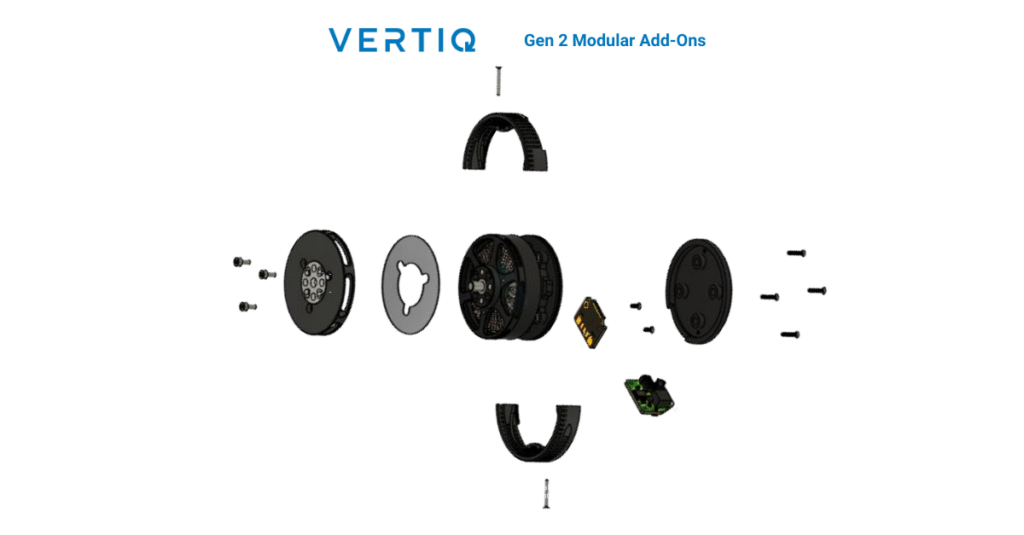
Vertiq's second-generation products are designed to accommodate a wide range of add-ons to tailor drone propulsion solutions specifically to customer requirements
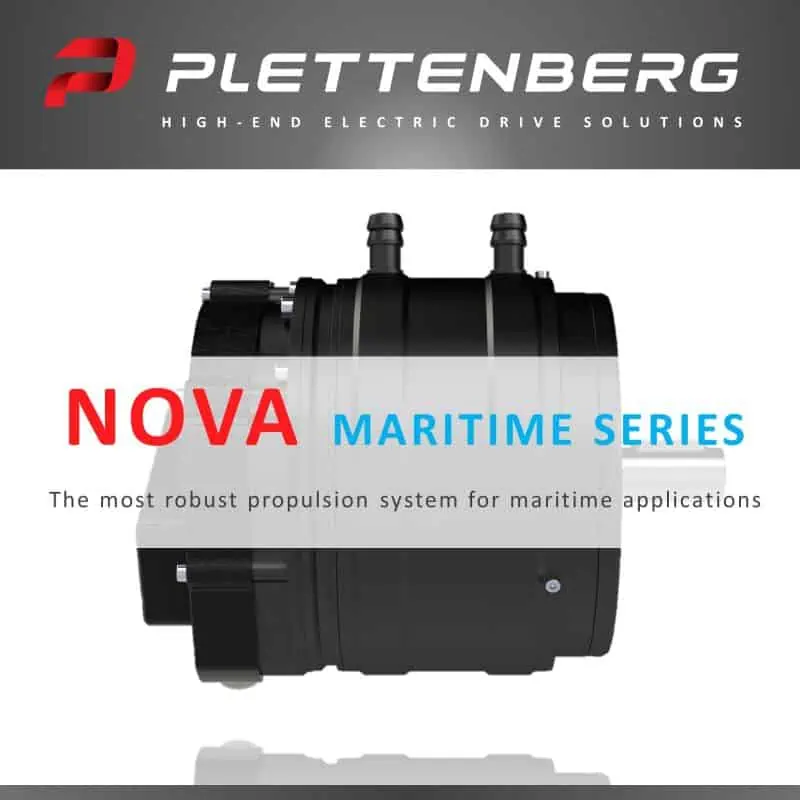
Developer and manufacturer of tailored propulsion solutions for the maritime industry Plettenberg has released the NOVA Maritime Series of inrunner BLDC motors
Plettenberg's drive solutions are made-to-order and tailored to specific customer requirements
May 05, 2022
Advancing Unmanned Systems Through Strategic Collaboration
UST works with major OEMs to foster collaboration and increase engagement with SMEs, to accelerate innovation and drive unmanned systems capabilities forward.