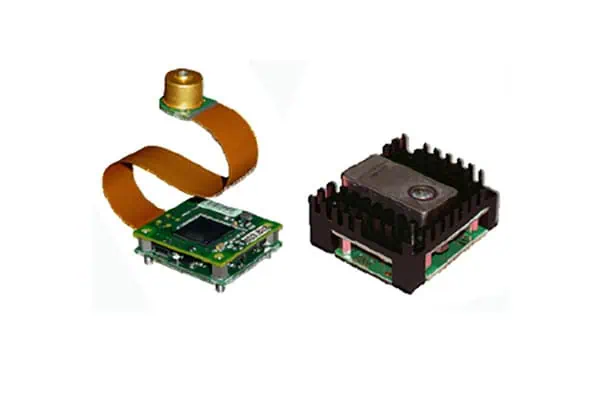
Continuous Wave (CW) laser diode drivers are precision current-control subsystems designed to power laser diodes in a constant emission state with high stability and low noise. In unmanned systems, these drivers underpin LiDAR mapping, free-space optical communications, laser illumination, and precision sensing payloads on UAVs, UGVs, and UUVs.
This guide features leading CW laser diode driver suppliers supporting ACC and APC control modes to balance optical stability, efficiency, and diode protection.
If you design, build or supply Continuous Wave (CW) Laser Diode Drivers, create a profile to showcase your capabilities and connect with visitors who have an active requirement for your solutions.
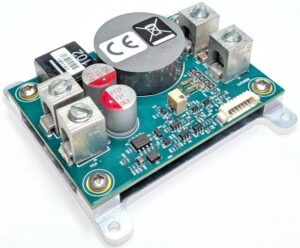
Continuous wave & pulsed laser diode driver with adjustable output current
Continuous wave & pulsed laser diode driver with adjustable output current
... CW and Pulsed LaserDiodeDriver is a high-efficiency, current-regulated buck converter designed to... ... critical. The driver supports up to 1.5 kW average and 2.25 kW peak output power, with the ability...
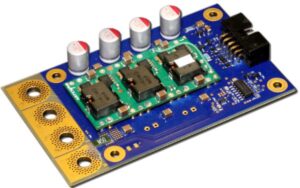
High- and low-current drivers for continuous-wave laser applications
High- and low-current drivers for continuous-wave laser applications
...s range of CW(continuous-wave)laserdiodedrivers provides options for a wide range of UAV and... ...8217;s COTS CWlaserdiodedrivers can also be customized to meet specific OEM requirements –...
Introduction to Continuous Wave Laser Diode Drivers
Continuous Wave (CW) laser diode drivers are high-precision electronic subsystems engineered to deliver a tightly regulated, stable current to laser diodes operating in a constant emission state. Unlike pulsed drivers that deliver energy in short bursts, CW lasers require a non-stop, ripple-free electrical supply. This demand places significant pressure on the driver’s electrical stability, thermal management, and noise suppression capabilities.
Across unmanned platforms, these drivers are mission-enabling hardware, supporting LiDAR mapping, Free-Space Optical Communications (FSOC), laser illumination, and high-resolution sensing payloads on UAVs, UGVs, and subsea UUVs. Any minor instability in the driver translates to optical noise, wavelength drift, or reduced diode lifespan, which are unacceptable outcomes in professional ISR and precision sensing missions.
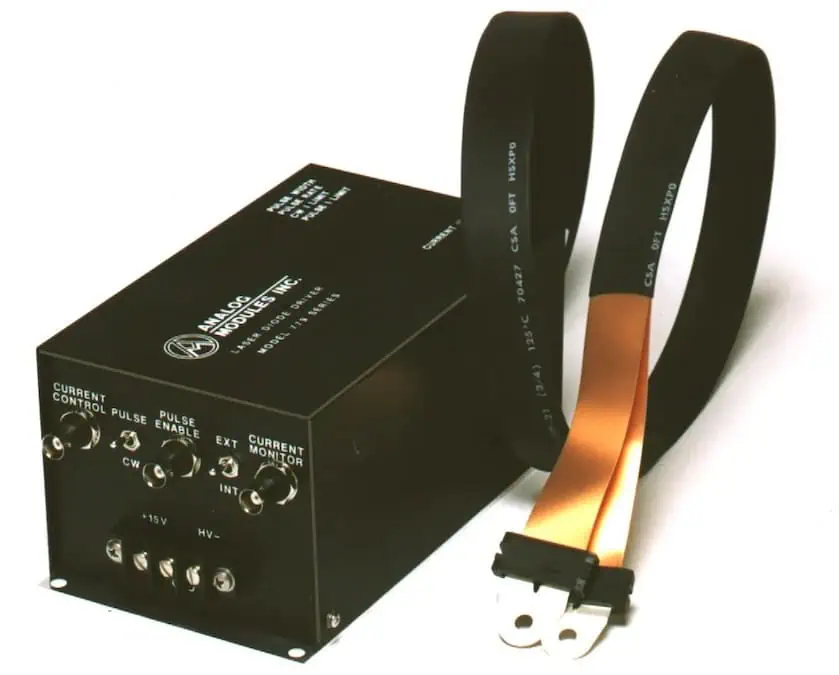
Continuous wave laser diode drivers by Analog Modules.
Key Performance Features of CW Laser Diode Drivers
The integration of a high-spec CW laser diode driver allows a system to maximize the inherent advantages of continuous wave emission. When measured against industry performance parameters, these drivers provide the following technical benefits:
Current Accuracy and Optical Stability
The primary advantage of a quality CW laser diode driver is the ability to maintain a rock-solid optical output over long durations. Because laser diodes are current-sensitive semiconductors, precision regulation ensures:
Wavelength Consistency: In spectroscopic sensing and gas detection, even a minor current shift changes the emission wavelength. High-stability drivers prevent this drift, ensuring measurement accuracy.
Minimized Signal Noise: By achieving sub-microamp RMS noise levels, the driver ensures the laser provides the high signal-to-noise ratio (SNR) required for long-range LiDAR and high-speed data links.
Predictable Thermal Loads: Stable current prevents junction temperature spikes, allowing for more compact and efficient thermal management designs in weight-sensitive UAVs.
Drive Modes: ACC vs. APC
In professional unmanned systems, the choice of drive mode allows engineers to optimize for specific mission parameters:
Automatic Current Control (ACC): Provides the advantage of absolute electrical predictability. It is the preferred mode when the diode’s electrical characteristics must be strictly limited to prevent damage.
Automatic Power Control (APC): Provides the advantage of constant optical brightness. By using a feedback loop from a photodiode, the driver automatically compensates for diode aging or environmental temperature shifts, maintaining a consistent link budget for optical communications.
CW Laser Diode Driver Architectures
Selecting the right architecture is a balance between efficiency (SWaP-C) and signal purity.
Linear (LDO-Based) Drivers
Linear CW drivers regulate current by dissipating excess voltage as heat, offering the advantage of extremely low electrical noise and zero high-frequency switching interference. This makes them ideal for interferometry and coherence-sensitive sensing where signal purity is the priority. However, their lower efficiency means the heat generated can become a significant burden on the thermal management systems of battery-heavy UAV platforms.
Switching (DC-DC) Drivers
Switching architectures utilize high-frequency conversion to regulate current with much higher efficiency than linear alternatives. This efficiency is essential for long-endurance platforms operating under tight power budgets, though it comes at the cost of higher EMI and ripple. To prevent interference with nearby GNSS receivers or sensitive RF equipment, these drivers require advanced filtering and disciplined shielding strategies.
QCW (Quasi-Continuous Wave) Capabilities
While the focus is often on pure continuous wave, many modern drivers feature Quasi-Continuous Wave (QCW) design features. QCW laser diode drivers allow the diode to be driven at higher peak powers for short durations (pulses) with a high duty cycle. They are frequently used in ranging and target designation where high peak power is needed without the thermal load of 100% duty cycle operation.
Integration in Unmanned Platforms
SWaP-C and EMI Challenges
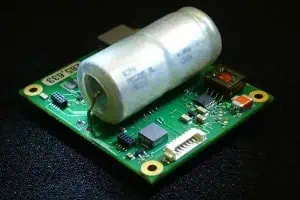
OEM Pulsed & CW Laser Diode Driver by Analog Modules.
In unmanned systems, the continuous wave laser diode driver must coexist with a dense array of electronics. In a tight UAV fuselage or a pressure-rated UUV housing, EMI is a constant threat. Leading designs utilize:
Digital Interfaces: SPI, I2C, or CAN bus for telemetry and remote setpoint adjustment.
Galvanic Isolation: To prevent ground loops between the high-power laser system and sensitive flight controllers.
Physical Shielding: To protect the driver from the platform’s high-frequency radios and motors.
Thermal Management and Protection
A CW laser diode is highly sensitive to heat. As the junction temperature rises, its threshold current increases and its wavelength shifts. To prevent thermal runaway, professional drivers integrate:
TEC Controllers: Built-in thermoelectric cooler controllers to actively stabilize the diode temperature.
Interlock Loops: Safety circuits that shut down the laser if a housing is opened or a cooling failure is detected.
Shorting Relays: A critical safety feature that keeps the laser diode leads shorted when the driver is powered down, protecting the sensitive semiconductor from ESD or turn-on transients.
Applications of CW Laser Diode Drivers Across Unmanned Systems
UAV, UGV, and UUV Payload Integration
These drivers are foundational components in LiDAR systems used for terrain mapping, obstacle avoidance, and navigation. Output stability directly affects ranging accuracy and point cloud consistency. In optical communication payloads, CW lasers enable high bandwidth and low probability of intercept data links. Driver noise, linearity, and modulation fidelity directly influence bit error rates and link robustness.
Gimbals, Stabilized Optics, and ISR Systems
Within stabilized gimbals and ISR turrets, drivers must operate reliably under continuous motion, vibration, and temperature variation. Accurate synchronization with imaging sensors is essential, particularly in gated imaging or combined EO and laser systems. Environmental robustness is a defining requirement; drivers must tolerate shock and vibration without introducing optical artifacts.
Industrial and Scientific Payloads
Missions involving infrastructure inspection, environmental monitoring, and precision metrology emphasize long-duration stability and measurement traceability. Low drift and predictable thermal behavior ensure that data collected over a multi-hour flight remains consistent and calibrated.
Emerging Trends in CW Laser Driver Technology
The industry is shifting toward higher efficiency designs that reduce thermal load while supporting increasing optical power levels. Advances in power semiconductor technology and control ICs are enabling quieter and more compact switching architectures.
Digital control and autonomous behavior are becoming standard expectations. CW laser drivers are evolving into intelligent subsystems capable of self-calibration, fault prediction, and adaptive performance optimization. Furthermore, drivers are taking on a growing role in directed energy related subsystems as unmanned platforms are tasked with increasingly complex and contested missions.
Analog Modules Inc. (AMI) examines the operating principles, efficiency limitations, and reliability challenges associated with linear laser diode driver designs for high-current pulse applications, as well as control methods developed to improve overall performance
Analog Modules Inc highlights the development and technical challenges of high current laser diode drivers for military systems, examining linear driver limitations, capacitor selection, and advances in intelligent switching architectures
Analog Modules’ new OEM driver delivers up to 50 Amps of programmable current for continuous wave and pulsed laser operation, combining high efficiency, compact form factor, and integrated protection features
Analog Modules, Inc. offers a variety of choices for developers of small-to-mid-sized UxVs, system integrators, and gimbal and payload OEMs
Jan 28, 2026
Advancing Unmanned Systems Through Strategic Collaboration
UST works with major OEMs to foster collaboration and increase engagement with SMEs, to accelerate innovation and drive unmanned systems capabilities forward.