Showcase your capabilities
If you design, build or supply Laser Power Supplies, create a profile to showcase your capabilities and connect with visitors who have an active requirement for your solutions.




Laser power supplies provide regulated electrical power and precision current control for laser-based subsystems integrated into UAVs, UGVs, and unmanned maritime platforms. Designed for LiDAR, target designation, DIRCM, laser communications, and directed energy payloads, these systems convert standard vehicle bus inputs such as 28 VDC, 48 VDC, or 270 VDC into stable, low-noise outputs tailored to pulsed and continuous wave architectures.
This page showcases laser power supply manufacturers, offering high-efficiency DC-DC conversion, fast pulse generation, and precision diode driver control.
Read the Technology Overview
Laser Electronics & Sensor Modules for UAVs, Unmanned Platforms & Counter-UAS Systems

If you design, build or supply Laser Power Supplies, create a profile to showcase your capabilities and connect with visitors who have an active requirement for your solutions.

Laser power supplies form the core electrical architecture for laser-based subsystems integrated into Unmanned Aerial Vehicles (UAVs), Unmanned Ground Vehicles (UGVs), and maritime platforms. Whether supporting a compact LiDAR payload for a tactical drone, a laser designator for a unmanned combat vehicle, or a directed energy weapon subsystem, the power supply directly influences output stability, timing accuracy, thermal behavior, and overall system reliability.
In the demanding environments typical of unmanned operations, these subsystems must function autonomously, tolerate vibration and thermal cycling, and integrate with distributed onboard electronics. Beyond basic energy delivery, a modern laser power supply must regulate and shape current with high precision, as electrical stability affects beam quality, range accuracy, and the operational lifespan of laser emitters.
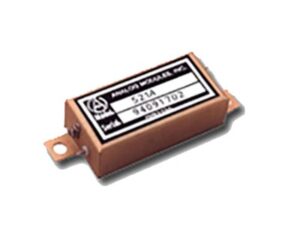
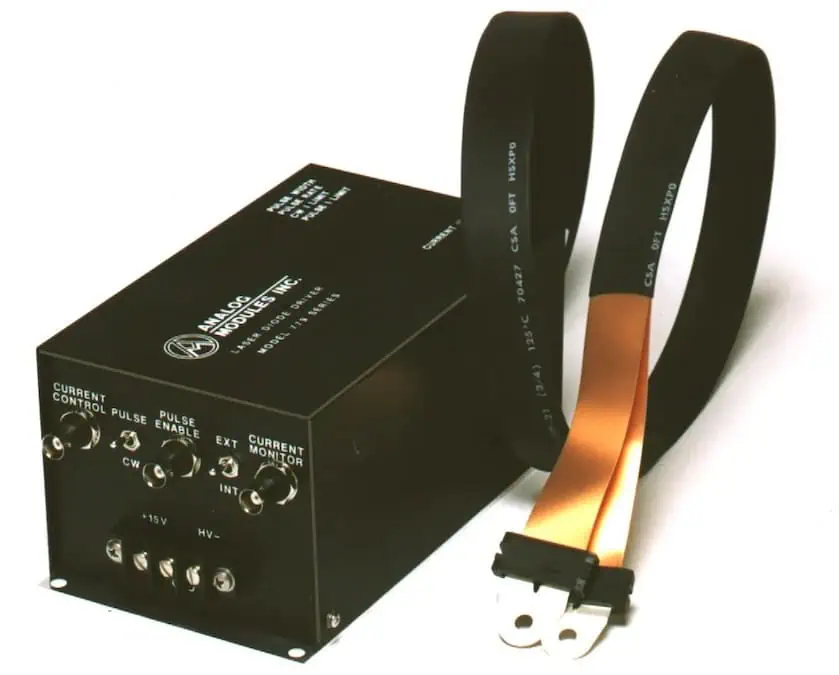
High-Voltage Bias Supplies from Analog Modules Inc.
A laser power supply converts platform electrical input into the specific voltage and current profiles required by a given laser architecture. In unmanned systems, this commonly involves high-efficiency DC-DC conversion from standard vehicle buses. While 28 VDC and 270 VDC remain established aerospace standards, many mid-sized tactical systems are adopting 48 VDC architectures to balance safety, integration simplicity, and power density.
High-frequency switched-mode designs are typically employed to maximize efficiency while minimizing the SWaP-C footprint. Tight regulation loops are required to maintain output stability despite input voltage variation or dynamic load conditions during mission operation. Effective ripple suppression is also critical, as excessive electrical noise can degrade optical stability and introduce interference into sensitive avionics or sensor systems.
For pulsed laser systems, the supply must generate fast rise-time drive signals with high repeatability. Consistency in pulse energy and timing is essential for LiDAR and rangefinding applications, where electrical timing jitter can translate into range uncertainty and reduced point cloud fidelity.
In solid-state architectures, coordination between the pump diode driver and Q-switch is required to synchronize excitation and cavity release timing. Where capacitor charging or pulse-forming networks are used, the system must manage elevated voltages with controlled discharge sequencing and precise timing, often at microsecond or sub-microsecond resolution depending on system class.
Within distributed unmanned architectures, high-voltage power supplies for laser modules operate as intelligent subsystems, managing regulation loops and protection logic autonomously. Digital interfaces such as CAN, Ethernet, RS-422, or MIL-STD-1553 enable configuration, command input, and real-time telemetry exchange with the flight or mission controller.
Built-in test and health monitoring functions are particularly important for beyond line of sight missions. By tracking voltage, current, and thermal parameters over time, these systems support condition-based maintenance strategies and improve operational assurance for long-endurance platforms.
A laser power supply must be tailored to the electrical and operational demands of each mission set, as different laser-based subsystems impose distinct requirements on stability, modulation, energy delivery, and thermal control:
Powering diode pumped solid-state and fiber lasers typically involves high-current pump diode drivers combined with protection circuitry and feedback control. These systems provide low-noise, constant-current outputs tailored to the optical gain medium.
In fiber laser architectures, the supply may manage multiple pump channels independently to balance gain distribution and maintain beam stability. High-power implementations often incorporate isolated gate drivers and advanced current control techniques to support multi-kilowatt electrical input levels while controlling ripple and transient behavior.
A laser diode driver is fundamentally a precision current source designed specifically for semiconductor laser operation. Unlike a general-purpose bench supply, it operates in current control mode with tightly limited overshoot and sub-percent stability to protect sensitive laser junctions.
Advanced implementations may include programmable current ramp profiles, automatic power control using photodiode feedback, and integrated thermoelectric cooler control for temperature stabilization. Variable current operation allows real-time output adjustment in adaptive sensing or communication systems without interrupting emission.
A pulsed laser power architecture typically incorporates energy storage elements such as capacitor banks or pulse-forming networks to deliver high-peak-power bursts. Key performance parameters include rise time, repetition rate stability, and pulse-to-pulse energy consistency.
In contrast, a CW laser power supply is optimized for long-duration regulation and thermal equilibrium. These designs emphasize steady-state current stability, thermal derating, and long-term reliability during sustained surveillance or communications operation.
Some modern designs support both pulsed and continuous wave operation within a configurable hardware platform. This flexibility is valuable in modular unmanned payload ecosystems, where a single host platform may alternate between sensing, designation, or communication roles across mission profiles.
Gallium Nitride and Silicon Carbide devices are increasingly used to improve switching efficiency and power density. Their ability to operate at higher switching frequencies allows reduction in magnetic component size while improving thermal performance, which is particularly relevant for SWaP-constrained unmanned platforms.
Recent designs incorporate advanced telemetry, fault logging, and software-defined configuration. By analyzing current and thermal trends over time, these systems can support condition-based maintenance and early detection of component degradation. Modular and scalable power stages are also becoming more common to accommodate the rapid energy discharge profiles associated with higher power laser payloads.


 Searching Companies & Products