



Showcase your capabilities
If you design, build or supply Battery Chargers, create a profile to showcase your capabilities and connect with visitors who have an active requirement for your solutions.




Battery chargers are advanced power management systems that safely and efficiently replenish onboard energy storage for UAVs, UGVs, and robotic platforms. Designed for professional and industrial use, these solutions range from portable field chargers and onboard integrated units to high-current chargers and multi-bay charging stations.
This category showcases suppliers of drone battery chargers and recharging solutions for unmanned systems, supporting LiPo, Li-ion, LiFePO₄, and NiMH chemistries.
Read the Technology Overview
Advanced UAV & Unmanned Systems for Challenging Missions in Government, Defence & Commercial Applications

If you design, build or supply Battery Chargers, create a profile to showcase your capabilities and connect with visitors who have an active requirement for your solutions.

Battery chargers provide the controlled electrical interface between external power sources and onboard energy storage, directly influencing mission tempo, sortie rate, and operational resilience. For professional UAV, UGV, and robotic platforms, the charger is not a peripheral accessory but a core subsystem that determines how quickly energy can be restored, how safely batteries can be handled, and how long expensive battery assets remain serviceable over their lifecycle.
In high-stakes operational environments, charger selection is mission-critical. An under-specified or poorly matched charger often becomes the primary bottleneck in field operations, grounding platforms due to sluggish recharge times, thermal faults, or premature battery degradation. Conversely, a well-engineered charging solution enables rapid turnaround and predictable performance across diverse environmental conditions.
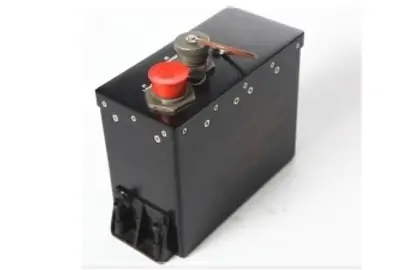
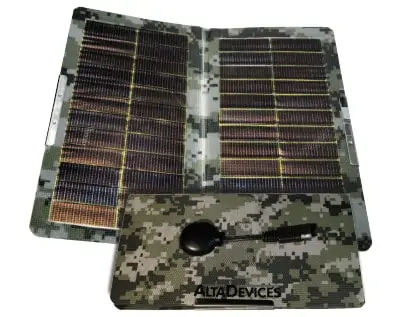
Mini drone battery chargers are often the lifeline of expeditionary or first-responder units. These compact units are designed for extreme SWaP (Size, Weight, and Power) efficiency, typically running off DC inputs like vehicle power or portable solar arrays. Despite their small footprint, professional-grade portable chargers maintain high accuracy in cell balancing and offer ruggedized housings for field durability.

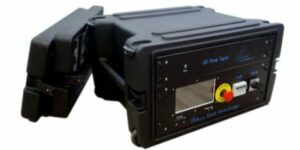
PowerCharger Deep-Sea Battery Charger by SubCtech
An onboard battery charger or integrated charger is physically built into the airframe or chassis. This configuration is critical for autonomous drone-in-a-box solutions, allowing the platform to land on a contact pad and begin replenishment without human intervention. These systems require sophisticated electromagnetic interference (EMI) shielding to ensure the high-power charging electronics do not disrupt sensitive flight controllers or GNSS receivers.
For operators managing diverse fleets, a universal battery charger or multi-chemistry battery charger is a logistical necessity. These units provide the flexibility to service batteries with differing chemistries from a single interface. The best industrial models utilize battery identification (via RFID or SMBus) to automatically apply the correct charging profile, mitigating the risk of human error in high-pressure environments.
A smart battery charger does far more than just move electrons, serving as a complete diagnostic hub. By communicating via protocols like CAN-bus (UAVCAN/Cyphal) or Mavlink, these chargers pull data from the Battery Management System (BMS). This allows operators to track State of Health (SoH), cycle counts, and internal resistance, enabling a shift from reactive to predictive maintenance.
To minimize downtime, high-current battery chargers push the boundaries of C-rates. These ultra-fast battery chargers often feature active thermal management, such as interfacing with cooled battery cradles, to prevent the thermal runaway that can occur when pushing high levels of current into high-capacity packs.
Drone battery charging stations represent the transition to infrastructure-scale power management. These units are often rack-mounted or containerized, capable of managing dozens of batteries simultaneously. They incorporate sophisticated load-balancing algorithms to prioritize batteries based on mission urgency while ensuring the local power grid (or generator) is not overloaded.
In expeditionary deployments, battery chargers must operate reliably with limited infrastructure. Portable drone chargers powered from vehicle DC systems, generators, or solar arrays support sustained UAV and UGV operations in remote locations. Accuracy in cell balancing and robust thermal protection are critical in these settings, where replacement batteries may be scarce and failure can halt operations entirely.
Search and rescue, disaster response, and public safety missions place a premium on rapid turnaround. High-current chargers and compact multi-bay charging stations allow responders to cycle batteries continuously during time-critical operations. Predictable recharge times and clear battery health diagnostics help teams maintain airborne or mobile assets without guesswork during extended incidents.
Military drone platforms rely on chargers that support mixed fleets, multiple battery chemistries, and strict safety controls. Universal and smart battery chargers simplify logistics by reducing the number of charging assets required in forward operating bases. Integration with BMS enables commanders to assess battery condition across the fleet and plan missions around verified energy availability rather than nominal capacity.
Persistent surveillance and inspection programs depend on integrated and onboard charging solutions. In these use cases, the drone charger is part of a closed-loop system that includes a docking station, landing guidance, and automated power management. Reliable electrical contact, EMI control, and software-driven charge profiles are essential to ensure consistent autonomous turnaround without human intervention.
Energy-intensive payloads such as LiDAR, high-resolution imaging systems, and multispectral sensors accelerate battery depletion. High-current and smart chargers support fast cycling between sorties while preserving battery lifespan. Detailed charge data allows operators to retire batteries before performance degradation affects flight stability or sensor operation.

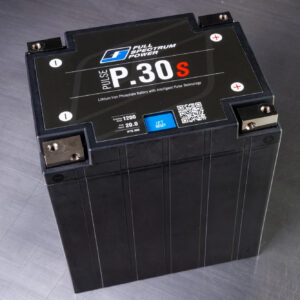
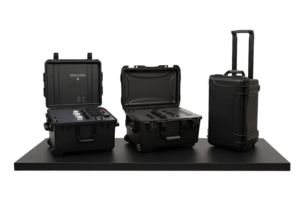
Full Spectrum Power Batteries & Drone Battery Chargers by AvioRace
Organizations operating large fleets benefit from centralized drone charging stations capable of handling dozens of batteries simultaneously. Load balancing and scheduling functions prevent infrastructure overload while ensuring batteries are ready for scheduled sorties. Data logging supports usage tracking, helping distinguish training wear from operational consumption.
Modern unmanned systems utilize a variety of rechargeable battery chargers tailored to specific mission profiles. Understanding the nuances of these chemistries is vital for maintaining safety and platform longevity.
Lithium Polymer (LiPo) batteries are the workhorse of high-power UAV applications due to their exceptional discharge rates. However, many modern professional platforms have transitioned to High-Voltage Lithium Polymer (LiHV) cells. Specialized LiPo battery chargers for professional drones must support precise cell balancing and, crucially, the higher termination voltages (up to 4.45V per cell) required by LiHV to unlock maximum energy density.
Lithium-ion (Li-ion) battery chargers are standard for endurance-focused ISR platforms. Sectors are now seeing the active deployment of high-capacity Silicon Anode cells, which require sophisticated charging algorithms to manage their unique expansion and thermal characteristics during fast-charge cycles.
Lithium Iron Phosphate (LiFePO₄) charging units are prioritized for UGVs and maritime systems where thermal stability and cycle life are more critical than energy density. Professional chargers must accommodate a lower nominal voltage (3.2V) and utilize high-resolution sensing to navigate the chemistry’s characteristically flat charge curve. This ensures an accurate State of Charge (SoC) without overstressing cells, supporting platforms that require thousands of reliable charge cycles.
While less common in modern aviation, Nickel-Metal Hydride (NiMH) battery chargers remain essential for legacy systems and specific ground robotics. Unlike voltage-terminated lithium systems, these chargers employ complex algorithms to detect “negative delta-V” and rapid temperature shifts to identify a full charge. Industrial-grade units include redundant thermal cut-offs and safety timers to prevent cell venting, ensuring older fleet assets are safely managed.
Autonomous charging stations and robotic docking systems are transitioning from experimental concepts into operational deployments, supporting persistent unmanned operations with minimal human oversight. Their effectiveness depends on precise mechanical alignment, robust electrical interfaces, and intelligent charge management, while higher-voltage battery architectures are gaining traction in larger UAVs and hybrid-electric platforms to reduce current demands and improve power efficiency.
Advances in battery chemistry, including solid-state cells and enhanced lithium formulations, are expected to further shape drone charger design. As a result, future charging systems will place greater emphasis on software-defined control, data integration, and adaptability, allowing charging infrastructure to evolve in step with increasingly capable unmanned platforms.


 Searching Companies & Products


 Subscribe to the Weekly eBrief
The latest engineering and technical developments straight to your inbox - join thousands of engineers who receive it.
Subscribe to the Weekly eBrief
The latest engineering and technical developments straight to your inbox - join thousands of engineers who receive it.