

CHC Navigation (CHCNAV) discusses how network RTK technology is redefining real-time positioning accuracy across surveying, agriculture, construction, and autonomous systems.
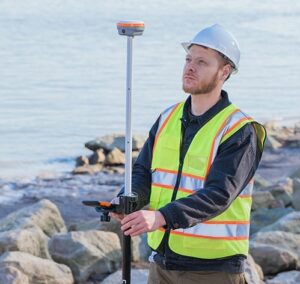 Through its Satellite-based Wide Area Augmentation Service (SWAS), the company demonstrates how network-based corrections extend RTK precision to a global scale while improving reliability, flexibility, and cost efficiency.
From Single-Base to Network RTK
Traditional single-base RTK systems rely on a local GNSS base station to transmit corrections to a rover. While effective over short distances, accuracy drops as the rover moves farther from the base. Network RTK overcomes this limitation by using multiple reference stations or satellite augmentation to model errors regionally. This approach delivers faster convergence, wider coverage, and improved reliability in all environments.
Key Advantages
1. Centimeter-Level Precision
CHC Navigation’s SWAS provides sub-3 cm horizontal and sub-6 cm vertical accuracy, with initialization times under 10 seconds. Such performance ensures precise results for high-stakes applications, from construction layout to precision agriculture.
2. Global Coverage and Flexible Access
Network RTK extends beyond the 10–20 km range of single-base setups. SWAS delivers corrections via L-Band satellite broadcasts for offline areas and NTRIP internet links for connected regions, ensuring uninterrupted accuracy across varied terrains.
3. Reliable Uptime and Service Continuity
SWAS maintains 99.99% uptime, supported by Tier-4 data centers, load balancing, and failover systems. This reliability ensures continuous operation for surveying, drone mapping, and other time-sensitive tasks.
4. Faster Fix Times and Robust Performance
Enhanced ambiguity resolution enables rapid positioning fixes, allowing users to achieve centimeter-level accuracy in seconds, critical for dynamic operations such as field work or UAV deployment.
5. Cost Efficiency with Optimized Data Usage
By eliminating local base stations, network RTK reduces equipment and maintenance costs. CHC Navigation’s Differential Data Compact Transmission Protocol (DCTP) also cuts bandwidth use by over 40 percent, and flexible billing models help control operational expenses.
6. Seamless Compatibility
SWAS supports RTCM 3.X and NTRIP 1.0/2.0, ensuring interoperability with most GNSS receivers. APIs and SDKs allow integration into GIS, robotics, and autonomous navigation systems.
7. Advanced Environmental Modelling
Cloud-based ionospheric and tropospheric modelling minimizes signal distortion, maintaining accuracy even in complex terrain or changing weather conditions.
Applications
- Surveying and Mapping: Enables wide-area data collection without local infrastructure.
- Precision Agriculture: Improves yield through accurate machine guidance.
- Construction and Engineering: Ensures precise layout and machine control.
- Autonomous Systems: Provides reliable navigation data for UAVs and robotics.
- GIS and Infrastructure: Enhances mapping and asset management accuracy.
By advancing network RTK technology, CHC Navigation is delivering precise, reliable positioning on a global scale.
The SWAS service combines satellite and internet correction delivery with robust uptime, data efficiency, and seamless device compatibility. For professionals who depend on centimeter-level accuracy, network RTK provides the consistency and flexibility essential for modern geospatial operations.