Drone solar panel inspection services provide fast, non-intrusive evaluation of commercial and utility-scale PV assets using thermal and high-resolution optical imaging from UAV platforms. These surveys identify hotspots, PID effects, module defects, soiling, and structural issues under real operating conditions.
This category showcases providers of solar panel drone inspection services that deliver consistent, repeatable results along with audit-ready outputs compatible with CMMS and SCADA systems.
If you design, build or supply Drone Solar Panel Inspection Services, create a profile to showcase your capabilities and connect with visitors who have an active requirement for your solutions.
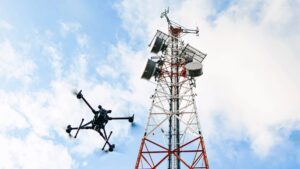
Drone services for aerial data collection & inspection operations
Drone services for aerial data collection & inspection operations
... comprehensive droneservices for commercial and industrial projects requiring aerial imaging,... ...space delivers drone-based solutions for construction and engineering, defense, infrastructure,...
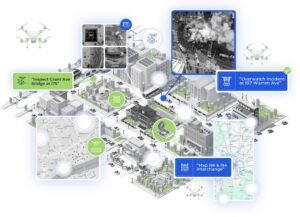
AI-enabled aerial intelligence service for connected urban and regional operations
AI-enabled aerial intelligence service for connected urban and regional operations
...le Drones as a Service (DaaS) platform tailored for smart-city and regional networks. The AI-enabled... ...d right-of-way inspection; flood and storm assessment; traffic monitoring....
Introduction to Drone Solar Panel Inspection Services
Drone solar panel inspection services have fundamentally transformed the approach to diagnostics for both commercial rooftop installations and utility-scale photovoltaic (PV) solar farms. Leveraging Unmanned Aerial Vehicle (UAV) platforms equipped with advanced thermal (infrared) and high-resolution optical payloads, operators can efficiently survey thousands of modules per hour. This method allows for the non-intrusive identification of failures and delivers precise, georeferenced data directly to maintenance teams. Importantly, UAV inspections offer a highly repeatable and consistent assessment process with significantly higher fault-detection sensitivity than traditional walk-through or vehicle-mounted systems.
Why Solar Farm Operators Are Turning to UAVs
The sheer scale of modern PV plants, often spanning hundreds of acres, makes manual inspection intensely labour-intensive and slow. Aerial inspection UAVs dramatically cut down on project time, substantially improve the detection rates for thermal anomalies, and provide a digital record critical for long-term trend analysis. System operators benefit from rapid anomaly localization, accurate quantified thermal measurements, and a streamlined workflow that perfectly aligns with modern condition-based maintenance (CBM) practices.
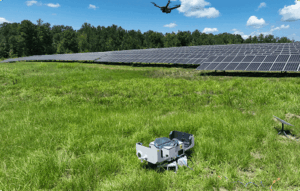
Drone Aerial Imaging Services for Solar Inspection by Blue Nose Aerial Imaging
Key Advantages of UAV Solar Panel Inspection
Employing drones for solar panel inspection provides significant operational benefits for utilities, asset owners, and inspection service providers.
Cost Savings & Safer Inspections
Manual electrical testing demands significant labour, physical access to every string, and frequently requires system shutdowns. High irradiance, which is necessary for reliable thermal imaging, presents significant heat stress risks for human personnel. Furthermore, uneven terrain, wildlife, and extensive cabling infrastructure greatly complicate manual assessment efforts.
Drone solar panel inspections cover entire arrays without interrupting energy production, drastically reducing man-hours and eliminating the requirement for complex elevated work platforms.
Yield Improvement Through Rapid Fault Detection
High-fidelity thermal imaging payloads rapidly identifies underperforming or damaged modules. This early remediation minimizes energy losses and ensures the system sustains its expected yield profiles throughout its operational life.
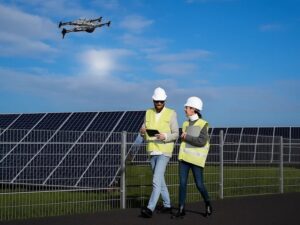
Solar Farm Inspection Services by Drohnen Expertise Solutions GmbH
Minimizing Downtime and Energy Loss
Since UAVs operate while the system is generating power, inspections occur during normal load conditions. Anomalies are detected and geolocated in real-time, allowing maintenance teams to receive exact asset coordinates for swift intervention and reducing downtime.
Scale and Accessibility
Modern utility-scale solar farms are characterized by dense layouts and vast footprints. Ground-based inspection struggles to maintain consistent vantage points across the entire array and cannot reliably detect fine thermal gradients at the necessary scale.
UAV systems scale seamlessly. Larger farms simply necessitate adjusting flight plans or deploying extended-endurance platforms. Inspection throughput increases linearly with minimal impact on staffing levels, making the use of drones for solar farms the preferred method.
Data and Compliance Requirements
Owners and asset managers typically demand highly detailed and actionable data, including:
Fault classification aligned with recognized standards, specifically IEC TS 62446-3.
Radiometrically accurate thermal data that quantifies temperatures.
Precise geolocation of all identified anomalies.
Seamless compatibility with CMMS (Computerized Maintenance Management Systems) or SCADA systems.
Comprehensive documentation suitable for warranty claims and performance guarantees.
Drone solar panel inspection services deliver consistency, repeatability, and audit-ready artifacts to meet the operational demands of solar farm operators.
Types of Solar Panel Defects Identified by Drones
Solar panel inspection drones serve as a vital tool for detecting a wide array of defects.
Hotspots
These are localized heating areas typically caused by cell mismatch, soldering defects, or bypass diode failures. UAV thermal data highlights these with extremely high clarity.
Cell/Module Failures
Strings or individual modules exhibiting significant temperature deviations are rapidly identified, allowing the affected module to be pinpointed using the synchronized georeferenced imaging.
PID (Potential Induced Degradation)
While PID results in reduced power output and thus higher operating temperatures, the thermal signature often appears as non-uniform heating or a pattern of subtle hot spots, particularly visible at the string level under peak irradiance conditions. Early detection is crucial for mitigation.
Delamination and Cracks
High-resolution optical imaging is used to capture surface flaws such as reflective distortions, snail trails, or fine surface cracking that may not yet have generated a measurable thermal signature.
Soiling, Vegetation Shading, and Contamination
UAV RGB imaging quickly highlights significant soiling patterns, vegetation encroachment, or the accumulation of foreign objects that cast shadows and reduce output.
Tracker and Structural Issues
For utility-scale systems utilizing single-axis trackers, drone inspection of solar panels is invaluable for identifying alignment errors, actuator failures, or subtle structural deformation across a large array.
UAV Payloads for Solar Inspection
Thermal Inspection Payloads
Thermal cameras for drones are the primary diagnostic tool in PV inspections. They provide the necessary temperature-based anomaly detection capability while the system is actively generating power (under load).
Within these cameras, radiometric capability is non-negotiable. It ensures the camera captures and records a calibrated temperature value for every pixel. This feature is essential for threshold-based fault classification, allows for accurate comparison over time, and is mandatory for warranty-compliant reporting.
Resolution, Accuracy & Spectral Bands Relevant to PV Diagnostics
The vast majority of PV inspections rely on the LWIR (Long-Wave Infrared) range, specifically 8–14 µm. This band effectively captures the module temperature behavior caused by non-radiative energy dissipation under typical solar loading conditions.
For the professional engineering audience, specific performance metrics are critical:
Resolution: A minimum of 640 × 512 pixels is required for efficient, high-fidelity utility-scale farm inspection.
Thermal Sensitivity (NETD): A value below 40 mK (Noise Equivalent Temperature Difference) is generally preferred to reliably detect subtle temperature anomalies.
Accuracy: ±2°C or better, maintained through regular calibration.
Frame Rate: A minimum of 30 Hz is necessary to avoid motion blur and image distortion during rapid, high-throughput flights.
RGB and High-Resolution Visual Payloads
Optical imagery provides essential contextual data, allows for surface defect visibility (e.g., glass breakage), and confirms physical alignment. High-resolution RGB data is vital for creating digital twins of the array and for conducting detailed structural assessments.
Hybrid sensor loadouts (thermal + RGB) are industry standard. They synchronize the thermal and visual frames automatically, which is critical for precise anomaly localization and dramatically accelerates the post-processing and reporting workflow.
Integration With Solar Farm Operations & Maintenance
Inspection outputs are the direct input for effective maintenance planning. Identified anomalies are rigorously categorized by severity, accurately mapped to specific module coordinates, and associated with the most likely failure mechanism (e.g., cell fault, diode failure, soiling). This detailed data enables prioritized dispatch and highly efficient component replacement.
UAV solar panel inspection data is increasingly integrated with enterprise maintenance software:
Computerized Maintenance Management Systems (CMMS): This is where work orders are generated and tracked based on the detected faults.
SCADA (Supervisory Control and Data Acquisition) event logs: Correlating thermal anomalies with real-time electrical performance data improves the accuracy of fault confirmation and root-cause analysis.
Inverter-level monitoring platforms: Integration ensures thermal issues are confirmed by power output deviations.
Emerging Technology in UAV Solar Farm Inspections
Persistent Monitoring
Drone-in-a-box systems represent the next evolution, enabling scheduled, automated inspections without requiring an on-site operator. This technology supports continuous monitoring and detailed trend analysis across different seasons and environmental conditions.
Autonomous Docking Stations
These stations provide secure, weatherproof housing, autonomous charging, and remote-trigger capability. They enable completely automated recurring missions that can be scheduled to align perfectly with proactive O&M cycles.
AI-Driven Predictive Maintenance
The application of AI drone solar panel inspection software is rapidly maturing. Machine learning models analyze patterns in fault data over time, predicting future module degradation or systemic failure risks before they occur. This is the key transition for solar farms, moving them from reactive to truly predictive maintenance strategies, significantly improving output stability and extending the overall asset life.
Drone as a Service by ZenaDrone outlines how drone-based inspection improves safety, reduces downtime, and enhances monitoring across large-scale renewable energy infrastructure
Drone-as-a-Service by ZenaDrone outlines how drone data analytics transforms aerial data into actionable insights, enabling predictive maintenance, improved safety, and greater operational efficiency across renewable energy assets
Drone as a Service's end-to-end offerings are highly scalable and can be tailored to suit a wide range of project requirements
Mar 25, 2026
Advancing Unmanned Systems Through Strategic Collaboration
UST works with major OEMs to foster collaboration and increase engagement with SMEs, to accelerate innovation and drive unmanned systems capabilities forward.