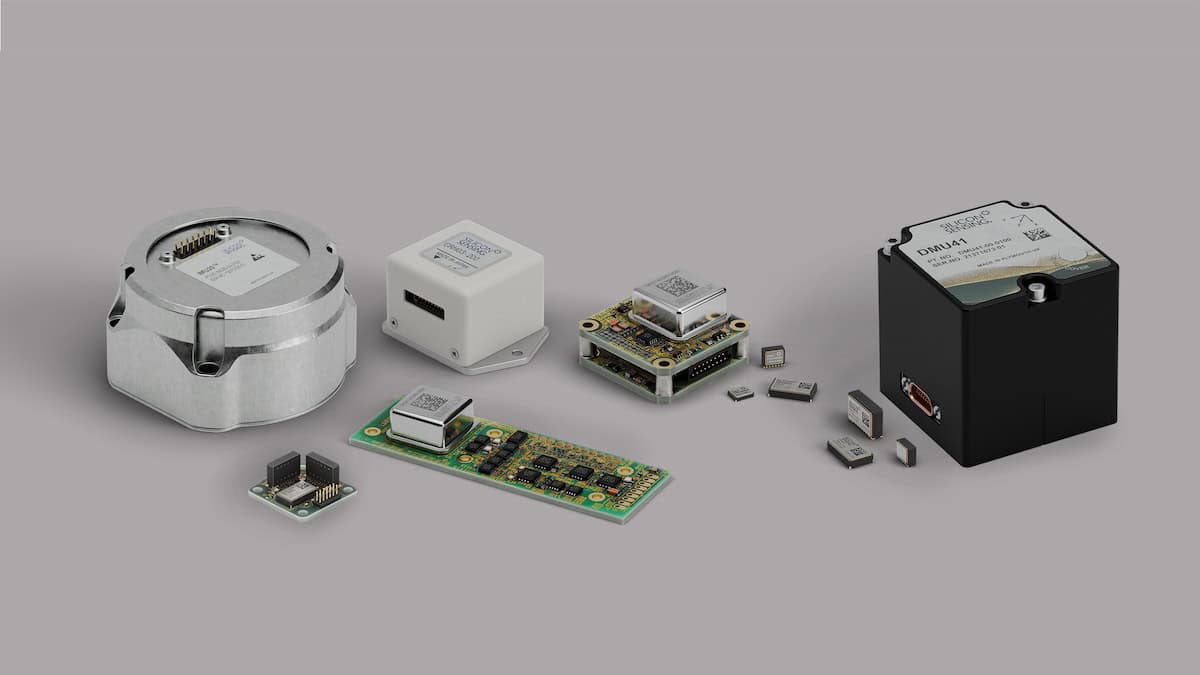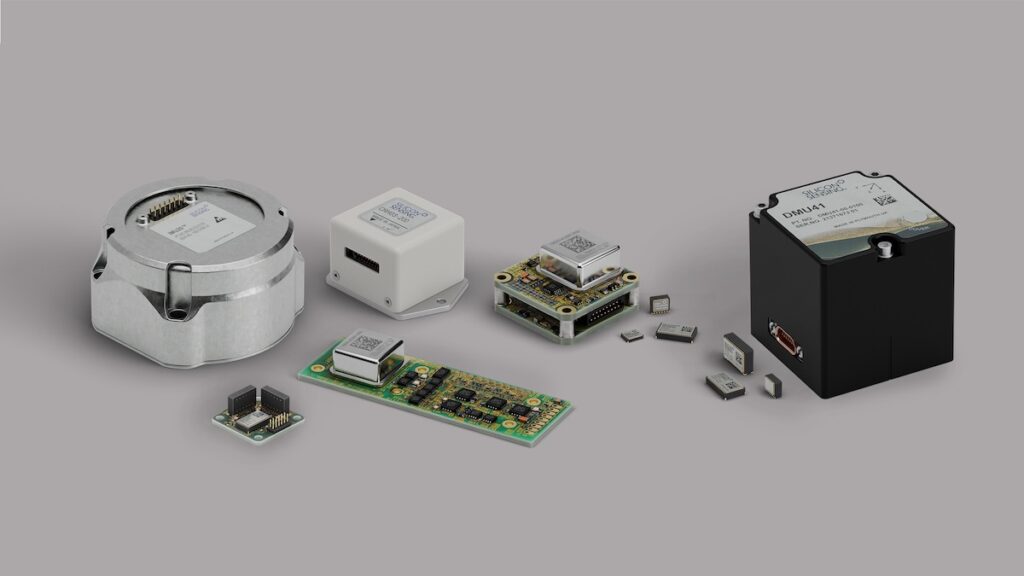




Silicon Sensing took part in Geo Business London, held 4–5 June, where the company presented its DMU41, CRH03, and DMU11 compact inertial sensors, designed for high-accuracy motion sensing in geospatial systems.
Silicon Sensing joined more than 130 exhibitors, emphasizing how its high-performance sensors are supporting a wide range of geospatial initiatives. These compact systems combine minimal size, weight, and power needs with consistent, long-term performance, delivering precise motion tracking even on space-constrained platforms.
DMU41
The DMU41 is a 9 degrees of freedom (DoF) inertial measurement unit (IMU) that achieves performance levels comparable to much larger and heavier fibre optic gyro-based IMUs. With dimensions of 50 x 50 x 50mm, it performs reliably across a wide temperature range, featuring extremely low noise, outstanding bias instability, and superior angle random walk.
Specifications:
- Temperature range: -40°C to +85°C
- Power usage: 1.8W
- Bias Instability: 0.1°/hr, 0.015mg
- Random Walk: Angular – 0.02°/√hr, Linear – 0.05m/s/√hr
CRH03
The CRH03 is a single-axis gyroscope delivering fiber optic gyro-equivalent accuracy. It resists external vibration, maintains excellent bias stability, and offers five selectable rate ranges—including a 10°/s option. It can be provided as either an OEM component or a fully packaged solution.
Specifications:
- Temperature range: -40°C to +85°C
- Bias instability: 0.03° to 0.1°/hr
- Angular random walk: from 0.005°/√hr
- Rate ranges: ±10°/s to 400°/s
DMU11 IMU
Alongside newer models, Silicon Sensing continues to supply proven systems like the DMU11. This 6 DoF IMU is a compact, budget-conscious option suitable for both small-scale and large-scale deployments. It provides low-noise performance and maintains high stability in bias and random walk.
Specifications:
- Temperature range: -40°C to +85°C
- Random Walk: Angular – 0.40°/√hr, Linear – <0.05m/s/√hr
- Bias Instability: <10°/hr, <0.05mg
- Noise: Gyro – 0.1°/s rms, Accelerometer – 1mg rms
With over 4,000 attendees, the event provided opportunities for meaningful dialogue with current users and prospects, demonstrating the increasing relevance of inertial sensing in geospatial projects.
Darioosh Naderi, Global Strategy Lead, commented, “This was our first time exhibiting at this event and we were hugely impressed with the quality of the discussions we had. Our team was presented with an extraordinary range of opportunities which were a fit for our inertial technology. We look forward to returning next year.”