
Knight Optical explains how precision prisms manipulate light to meet the demanding requirements of UAV and UGV systems.
By controlling refraction and total internal reflection, these components enable compact, stable, and accurate optical assemblies for applications ranging from hyperspectral imaging to laser rangefinding. This guide explores the key prism types, their functions, and how to select the right solution for unmanned system payloads.
Precision Optics for Unmanned Systems
Prisms perform two critical light manipulation functions, refraction and total internal reflection (TIR). Produced from precision optical materials such as N-BK7, UV-fused silica, Zinc Selenide (ZnSe), and Germanium (Ge), each prism’s geometry and substrate determine how it alters light to achieve specific outcomes.
In refraction, light bends as it passes through the prism due to a change in optical density between air and the prism material.
The amount of bending depends on both the prism’s shape and its refractive index. Different wavelengths refract by varying amounts, producing spectral dispersion, a principle exploited in hyperspectral imaging and spectroscopic instruments carried by UAVs.
Conversely, when light inside the prism encounters an internal surface at an angle greater than the material’s critical angle, it reflects entirely within the prism. This TIR effect enables the redirection of beams and image inversion without the need for mirror coatings, providing a stable and efficient optical path for compact UAV gimbal systems and UGV-mounted sensors.
Dispersive and Reflecting Prism Applications
The two main optical mechanisms, dispersion and reflection, define how prisms function in unmanned system payloads.
Dispersive prisms split light into individual spectral bands, supporting imaging and sensing systems that rely on wavelength differentiation. This separation of light allows UAVs to perform agricultural surveys, environmental monitoring, and target identification, where precise spectral information is vital.
Reflecting prisms, meanwhile, use total internal reflection to steer beams and reorient images, critical for maintaining alignment in space-limited optical setups and ensuring lightweight, stable imaging within compact gimbal assemblies.
Dispersive Prisms for Spectral Analysis
Knight Optical’s range of dispersive prisms includes:
- Equilateral prisms, with three equal 60° angles and a high refractive index substrate, ideal for maximizing spectral separation in UAV-mounted hyperspectral or multispectral cameras.
- Pellin–Broca prisms, which provide a constant 90° beam deviation and can be rotated to isolate specific wavelengths, valuable for airborne or vehicle-based spectrometers requiring precise wavelength selection.
- Wedge prisms, which create controlled beam deviation with minimal chromatic dispersion. When paired, they allow fine steering of LiDAR or laser targeting beams without affecting wavelength composition.
Reflecting Prisms for Compact Optical Paths
In UAV gimbals and UGV sensor housings, space and stability are key considerations. Reflecting prisms offer an efficient method of controlling optical paths within limited form factors. Knight Optical’s portfolio includes:
 Porro prisms, used in pairs to invert and offset light beams in imaging assemblies.
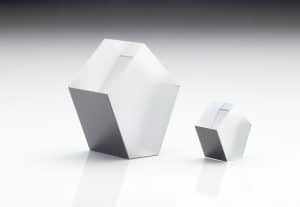
- Penta prisms, which maintain a fixed 90° beam deviation regardless of incident angle, ensuring consistent alignment in laser rangefinding and surveying applications.
- Dove prisms, which provide image rotation in compact optical systems, suited for stabilization and alignment in airborne platforms.
- Rhomboid prisms, which laterally shift beams without altering orientation, ideal for sensor integration where physical displacement is required.
Supporting Accuracy in Harsh Environments
Unmanned platforms often operate in conditions where vibration, motion, and environmental exposure challenge optical alignment. Knight Optical’s prisms are produced and verified with angular accuracy to within three arcseconds, minimizing potential optical distortion and ensuring dependable system performance.
For optical engineers developing UAV and UGV payloads, selecting the appropriate prism type—based on wavelength range, environmental constraints, and optical path design—is essential. Knight Optical’s technical sales team works directly with designers to define optimal material and geometry choices, providing both custom-engineered and off-the-shelf solutions to meet operational needs.
Enabling the Future of Unmanned Optics
From airborne hyperspectral imaging to ground-based vision and targeting systems, optical prisms remain fundamental to modern unmanned technology. Through precision fabrication and rigorous testing, Knight Optical delivers the high-quality optics required to maintain stability, accuracy, and performance in today’s UAV and UGV platforms.