
Advanced Navigation, a developer of Inertial Navigation Systems (INS) for commercial and defense applications, discusses recent flight demonstrations showcasing resilient GPS-denied navigation and high-accuracy positioning using two assured navigation architectures with intelligent sensor fusion. Read more >>
As navigation threats continue to grow, operating in GPS-contested or denied environments has become a major challenge for aviation. When GNSS signals are degraded, jammed, or unreliable, aircraft cannot accurately determine their position, putting missions, assets, and lives at risk.
Advanced Navigation conducted real-flight trials showing the fusion of inertial navigation with complementary aiding technologies through intelligent software can deliver precise, reliable navigation when signals disappear or are subjected to severe Electromagnetic Warfare (EW) conditions.
The company’s architecture uses intelligent software to fuse data from multiple sensors in real time, adapting to signal degradation, vibration, and atmospheric conditions. Powered by its AdNav Intelligence, the filter blends advanced state estimation with AI and machine learning to maintain reliable navigation in GPS-denied environments across crewed and uncrewed platforms.
 This demonstration paired a Boreas D90 Fibre Optic Gyroscope (FOG) INS with a Laser Velocity Sensor (LVS), and a Certus Evo MEMS (Micro-Electro-Mechanical Systems) INS with an Air Data Unit (ADU), validating performance across a range of size, weight, power, and cost (SWaP-C) requirements, and flight profiles.
The flight trials, conducted aboard a Mooney 201 (M20J) aircraft operating at altitudes between 400 and 500 meters, departed from Jandakot Airport in Western Australia. Data was collected across expansive farmland and dense forest throughout the South West region, with GNSS denied after system initialization.
Certus Evo & ADU Configuration
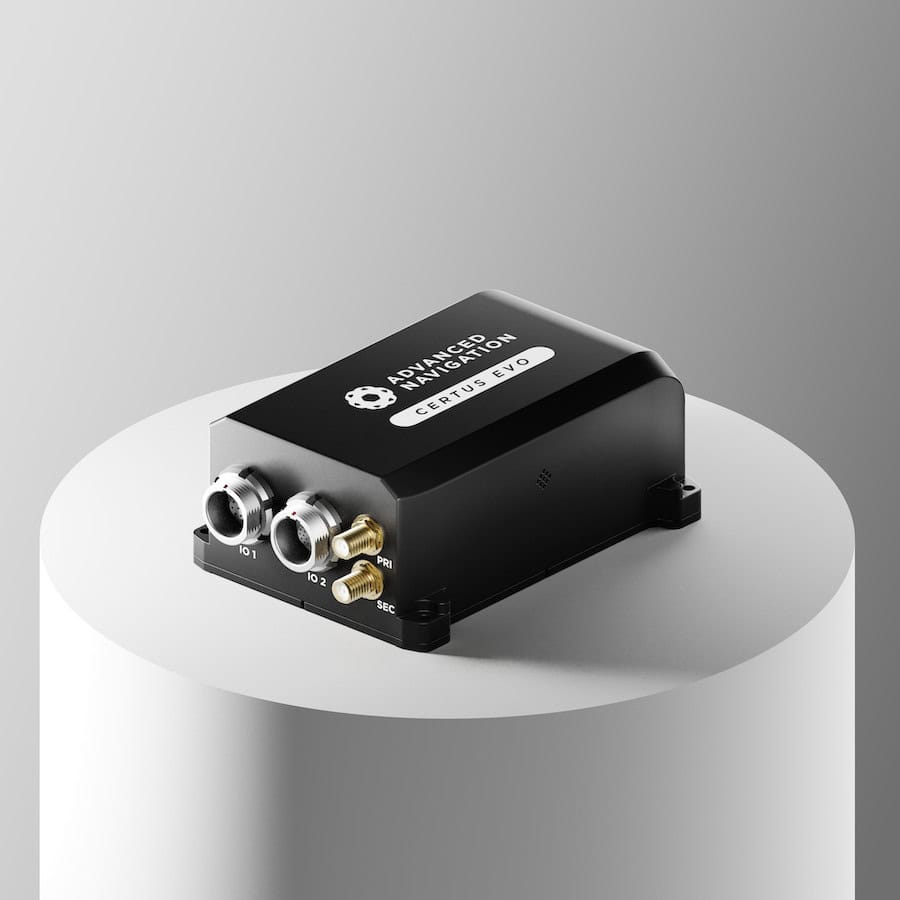
Certus Evo MEMS INS provides accurate position, velocity, acceleration, and orientation. It features low SWaP-C and FOG-like performance, as well as internal data logging, multiple interfaces, and Electronic Protection (EP) against EW.
The ADU measures pitot airspeed and barometric altitude using high-accuracy, temperature-calibrated sensors and outputs data over RS232, operating either standalone or paired with an INS to improve navigation accuracy when GNSS is unavailable.
The Certus Evo and ADU configuration, designed for small uncrewed aircraft, used atmospheric data to maintain positioning and velocity, achieving 8.8 meters of error over 5 km and 118 meters over 35 km without GNSS.
This solution targets Uncrewed Aerial Systems (UAS), Vertical Take Off and Landing (VTOL) platforms, High-Altitude Pseudo-Satellites (HAPS), and long-endurance Intelligence, Surveillance, and Reconnaissance (ISR) missions that require low-power, lightweight navigation systems capable of precision over ranges of approximately 50 km.
Boreas D90 & LVS Configuration
The Boreas D90 rugged FOG INS determines heading without GNSS or a magnetometer by sensing the Earth’s rotation, enabling accurate north-seeking in both static and dynamic conditions, even at high latitudes. Built to withstand EW, it includes EP against GNSS jamming and spoofing and offers multiple interfaces and protocol support for integration.
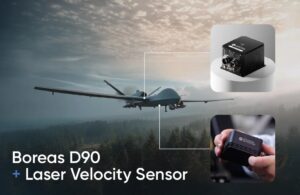 The LVS provides precise 3D velocity measurements using laser Doppler velocimetry, delivering high accuracy and long-term stability on ground or airborne platforms when a clear line of sight to a stationary surface is available.
For longer-range and high-dynamic flight operations, the Boreas D90 FOG INS was paired with the Laser Velocity Sensor. This configuration achieved 29 meters of error over 100 km without GNSS, offering an order-of-magnitude improvement over conventional velocity-aiding techniques.
It is suited for UAS, VTOL, HAPS, Medium Altitude Long Endurance (MALE), HALE, and ISR platforms operating in heavily contested environments where strategic-grade accuracy and long-term stability are essential.
Implications for GPS-Denied Operations
The results highlight the advantages of software-defined navigation for Assured Positioning, Navigation, and Timing (A-PNT), including robust performance during jamming and spoofing, reduced dependence on external signals and scalable configurations across diverse aircraft.
Advanced Navigation’s intelligent sensor fusion approach demonstrates a clear path toward resilient, assured navigation in denied, disrupted, or deceptive environments.