
Showcase your capabilities
If you design, build or supply FPV Drone Cameras, create a profile to showcase your capabilities and connect with visitors who have an active requirement for your solutions.




FPV drone cameras provide the live video feed used to pilot UAVs where responsive visual feedback and reliable scene interpretation are critical. Systems range from analog and digital FPV cameras to low-light, thermal, and multi-sensor configurations.
This technical guide covers FPV drone cameras for racing, inspection, situational awareness, reconnaissance support, and aerial imaging.
Read the Technology Overview
If you design, build or supply FPV Drone Cameras, create a profile to showcase your capabilities and connect with visitors who have an active requirement for your solutions.

FPV drone cameras provide the live visual perspective used to pilot unmanned aircraft when precise onboard viewing is required. Unlike a general imaging payload, an FPV drone camera is selected primarily for a responsive and usable video feed, so latency, field of view, dynamic range, size, and video-link compatibility can matter as much as resolution.
An FPV camera for drone integration may be an analog board camera, an HD digital unit, a low-light sensor, or part of a multi-sensor payload. The camera is only one element of the system. The transmitter, receiver, antennas, display, power supply, and flight-controller interfaces collectively determine how effectively the pilot can interpret and react to the scene.
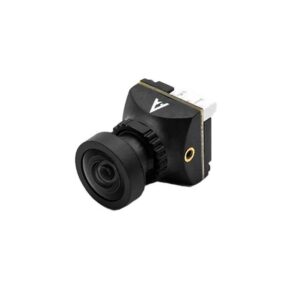
An analog FPV camera outputs a conventional composite analog video signal for transmission by a compatible video transmitter, or VTX. These cameras remain useful where low delay, simple integration, low mass, and predictable signal degradation are priorities. A micro FPV camera or FPV board camera can suit compact multirotors. Legacy designs may use CCD sensors, while CMOS FPV camera architectures are now widely used in compact systems. Compatibility can also depend on video standard, aspect ratio, and the capabilities of the connected display system.
A digital FPV camera feeds image data into a digital video link, supporting higher-resolution pilot imagery and more sophisticated on-screen information. HD FPV cameras may operate at 720p, 1080p, or other formats, while some systems combine an FPV flight camera with higher-resolution onboard recording. A 4K FPV camera does not automatically provide a 4K low-latency pilot feed because transmission bandwidth and processing delay remain system-level constraints. Digital links can also carry telemetry and OSD data with video, although cameras, transmitters, receivers, and displays generally need to belong to compatible digital ecosystems.
A low light FPV camera is designed to preserve usable scene detail when illumination falls below the level suited to a conventional daylight camera. Performance depends on sensor sensitivity, lens aperture, exposure time, gain control, image processing, and noise behavior. A night vision FPV camera may use enhanced visible-light sensitivity or near-infrared illumination, while an IR FPV camera should be distinguished from a true thermal imager. The priority is usable contrast and motion detail rather than brightness alone, since excessive exposure time or gain can reduce motion clarity.
A thermal FPV camera detects thermal infrared radiation rather than visible light, allowing operators to observe temperature contrast in darkness and other visually challenging conditions. Multispectral cameras capture information in multiple defined wavelength bands, while multi-sensor systems may combine thermal and visible cameras to provide complementary information. Thermal resolution, spectral band, field of view, frame rate, sensitivity, and processing should therefore be assessed separately from visible-camera specifications.
Dual-sensor and multi-camera installations give a UAV more than one visual perspective or imaging modality. A platform may combine forward and downward FPV cameras, visible and thermal sensors, or a fixed low-latency FPV UAV camera with a stabilized imaging payload. Switching between views can support navigation, inspection, and observation without forcing one camera to satisfy every requirement. Integration must account for added mass, power draw, video channels, processing capacity, switching behavior, and operator workload.
An FPV racing drone camera prioritizes fast visual response, clear motion rendering, and a field of view suited to rapid attitude changes. Low latency is especially important because delay between aircraft movement and displayed video reduces the pilot’s ability to make precise corrections. A wide angle FPV camera can improve peripheral awareness, although excessive optical distortion can make distance and obstacle judgment less intuitive.
Inspection aircraft use FPV cameras to help pilots position the vehicle around structures, equipment, confined spaces, or other points of interest. A compact drone camera may serve as the dedicated navigation view while a separate high-resolution or stabilized payload collects inspection data. For close work, dynamic range, low-light performance, lens geometry, exposure response, and physical protection may be more valuable than maximum recording resolution.
FPV cameras for drones used in search or situational-awareness missions may need to function across daylight, shadow, dusk, and low-contrast conditions. Low-light visible imaging supports natural scene interpretation, while thermal imagery adds information based on temperature differences. Multi-sensor configurations can therefore help operators alternate between contextual visible imagery and thermal detection cues.
For mapping or reconnaissance, the drone FPV camera normally supports piloting and route awareness rather than replacing a calibrated survey or intelligence sensor. A forward-facing FPV camera can aid terrain awareness and aircraft orientation, while mission payloads collect the higher-resolution, georeferenced, spectral, or stabilized imagery required for analysis. Separating navigation and payload functions allows each camera to be optimized for its specific task.
First-person aerial imaging requires a responsive pilot view for framing dynamic flight paths, but the navigation feed and recording camera do not have to be identical. Some aircraft pair a lightweight drone camera for piloting with a higher-resolution recorder or use an FPV camera with gimbal stabilization where the application permits. This arrangement lets the flight camera prioritize responsive control while the recording payload emphasizes image quality and stabilization.
The main specifications should be evaluated as part of the complete FPV camera and VTX chain rather than in isolation.
| Specification | Technical Significance |
| Sensor type and size | CMOS sensors are common in compact FPV designs; sensor area, pixel characteristics, and readout behavior affect sensitivity, noise, dynamic range, motion rendering, and package size. |
| Resolution | Higher resolution can reveal more detail, but 1080p or 4K specifications do not by themselves indicate pilot-feed latency or transmitted resolution. |
| Frame rate | Higher frame rates can improve motion rendering when the camera, transmission link, receiver, and display chain can support them. |
| Latency | End-to-end delay includes capture, image processing, encoding, transmission, decoding, and display, making low latency a system-level requirement. |
| Field of view | A wider view improves peripheral awareness, while a narrower view provides greater apparent detail and typically less geometric distortion. |
| Dynamic range | Strong dynamic range helps retain scene information when bright sky and deep shadow appear together and when illumination changes rapidly during flight. |
| Lens focal length | Focal length and sensor size determine viewing angle and influence perspective, distortion, and apparent obstacle scale. |
| Video format | Analog and digital formats require compatible transmitters, receivers, goggles, or monitors. Analog systems may also depend on supported video standards, while digital systems can require ecosystem-specific hardware. An FPV camera with OSD also requires compatible interfaces. |
| Weight and dimensions | A small FPV camera reduces payload burden, but mounting, connector access, input voltage, power consumption, thermal management, and lens protection still matter. |
These factors should be balanced against aircraft size, flight profile, operating environment, and the capabilities of the complete FPV drone camera and transmitter system.
Development is increasingly focused on improving usable visual information without imposing excessive latency, bandwidth, mass, or power demand.
For UAV designers and operators, the most useful developments are those that improve situational awareness while preserving predictable latency, reliable integration, and an appropriate size, weight, and power footprint.


 Searching Companies & Products



 Subscribe to the Weekly eBrief
The latest engineering and technical developments straight to your inbox - join thousands of engineers who receive it.
Subscribe to the Weekly eBrief
The latest engineering and technical developments straight to your inbox - join thousands of engineers who receive it.