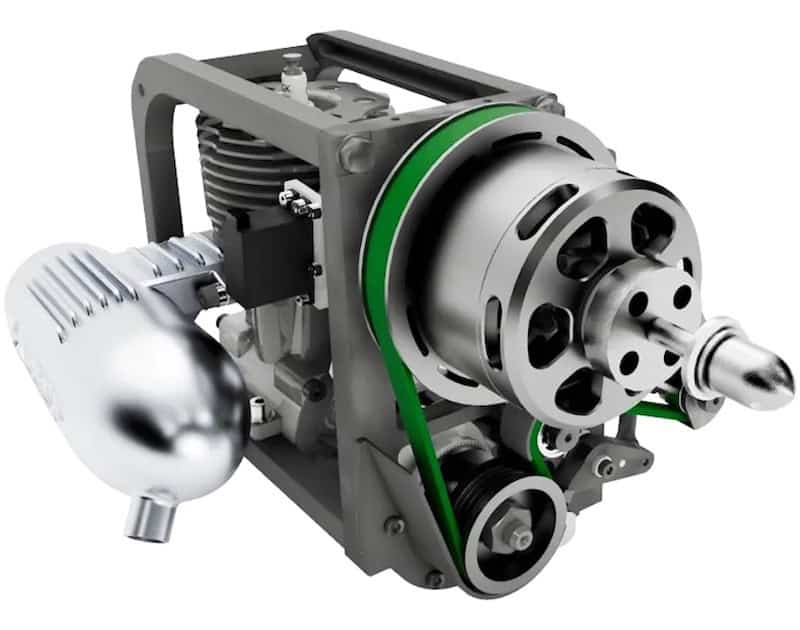
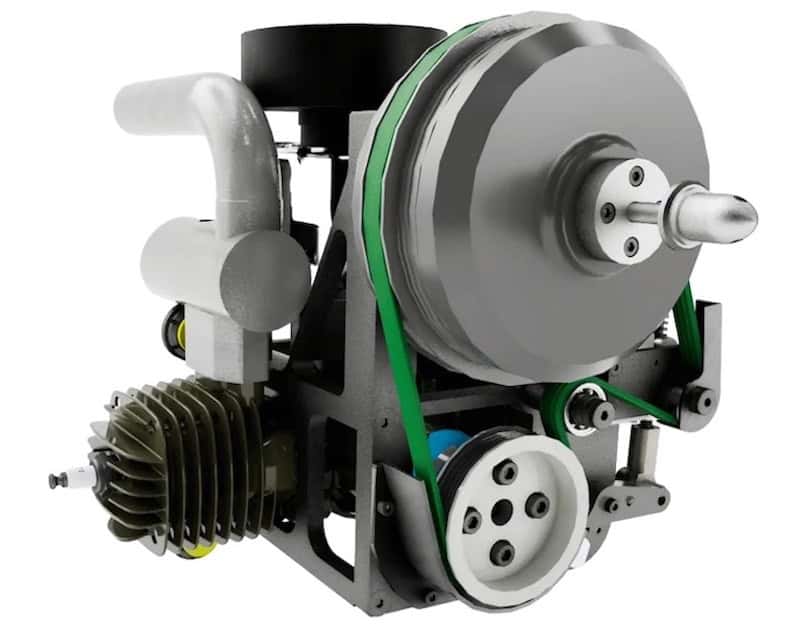
Lowental Hybrid discusses the core obstacles to true accessibility in tactical Unmanned Aerial Systems (UAS): launch and recovery, endurance and energy limitations, and the cognitive load created by modern sensors and data.
 Understanding these barriers clarifies why propulsion architecture is not a background design choice. It is the central determinant of who can actually use an Unmanned Aerial Vehicle (UAV) in the field.
UAS were once confined to organizations with trained operators and dedicated infrastructure. Advances in propulsion, flight control, and sensor miniaturization have expanded access, allowing small tactical units to deploy UAVs with minimal support. However, rising operational demands mean that many current systems no longer deliver sufficient value. Platforms that prioritize simplicity often lack endurance or payload capability, while higher-performance designs typically exceed the size and complexity that tactical users can accommodate.
Launch and Recovery Constraints
Small tactical teams operate without runways or specialized ground equipment. They require autonomous, repeatable launch and recovery with minimal training. Catapults and rails add logistical burden and address only takeoff, while Vertical Take Off Landing (VTOL) configurations simplify recovery at the cost of added mass, drag, and energy consumption.
More complex mechanisms reduce some inefficiencies but introduce integration and reliability risks. In practice, improved launch and recovery accessibility frequently results in reduced mission endurance unless propulsion efficiency offsets these penalties.
Endurance Within Group-2 Limits
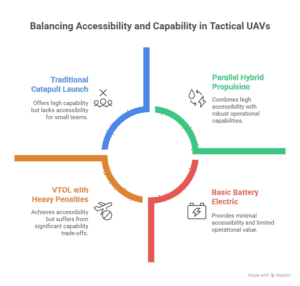 Endurance defines tactical utility, determining whether a UAV can reach the area of interest, remain on station, and return with actionable data. Group-2 fixed-wing platforms are favored for their efficiency, portability, and low signatures, yet their size tightly restricts energy options.
Fuel offers high energy density, but in small airframes the engine required to meet mission power demands consumes the mass and volume needed for fuel, limiting endurance gains. Electric systems use lightweight motors, but the batteries required for extended missions impose a persistent weight penalty. As a result, most Group-2 UAVs remain battery-powered and limited to short missions, often one to two hours, with further reductions when VTOL is included.
This constraint is structural and driven by propulsion physics rather than airframe design.
Managing Cognitive Load
Modern tactical UAVs carry multiple sensors and onboard processing systems that demand continuous electrical power and generate large volumes of data. A single operator cannot manage multiple data streams while making time-critical decisions. Accessibility therefore depends on onboard processing and sensor fusion that reduce cognitive burden without limiting capability. These requirements increase electrical demand, making propulsion architecture central to both flight performance and information usability.
Parallel Hybrid Propulsion as an Enabler
When launch and recovery, endurance, and cognitive load are considered together, a clear requirement emerges. Tactical users need automatic launch and recovery, long endurance within strict size limits, and sufficient electrical power to support modern sensors and onboard processing.
Meeting these needs in Group-2 UAVs requires a shift in propulsion architecture. Parallel hybrid propulsion combines an internal combustion engine and an electric motor on a single propeller, each operating where it is most efficient and with minimal added mass achieved through an engine optimized for cruise.
Electric power supports controlled, low-noise takeoff and landing without additional lift systems, while fuel-based propulsion sustains efficient cruise and extends endurance without increasing battery mass. Continuous electrical generation supports advanced sensors and onboard processing, and dual power sources provide redundancy and graceful failure modes that improve system resilience.
Redefining Accessibility
Tactical UAV accessibility is defined by how systems launch and recover, how long they remain effective, and how much cognitive effort they demand.
Parallel hybrid propulsion addresses all three without increasing airframe size or logistical burden. By balancing endurance, usability, and electrical capacity, it enables small tactical UAVs to deliver reliable operational value in unprepared environments with minimal support.