verifiedThis business has been claimed by Phoenix Flight Industries and verified by UST.Verified companies work with us to ensure we display the most up-to-date and comprehensive product information, articles and other material to help you choose the right solution for your requirements.
Hydrogen-Powered UAVs for Long-Endurance Industrial Inspection & Security Operations United States of America
Hydrogen-Powered UAVs for Long-Endurance Industrial Inspection & Security Operations
Phoenix Flight Industries designs and manufactures hydrogen-powered UAVs for long-endurance industrial inspection, utility infrastructure monitoring, oil and gas operations, and security applications. Combining advanced hydrogen fuel cell technology with robust multirotor platforms, the company’s aircraft deliver mission endurance far beyond the capabilities of conventional battery-powered drones, enabling operators to complete extended inspection and surveillance missions with fewer landings and reduced operational downtime.
Designed and manufactured in the USA, Phoenix Flight Industries’ NDAA-compliant UAV platforms integrate high-performance avionics, advanced imaging payloads, and modular hydrogen power systems to provide reliable, efficient aerial intelligence for enterprise and government operators. The company’s flagship Phoenix P1 UAV platform features interchangeable hydrogen tank configurations, allowing users to tailor flight endurance from one to six hours according to mission requirements while maintaining consistent platform performance.
Serving utility providers, energy companies, infrastructure contractors, public safety organisations, and security operators, Phoenix Flight Industries is helping accelerate the adoption of hydrogen-powered UAV technology for long-range, mission-critical aerial operations.
Find out how our hydrogen drones can unlock new levels of efficiency and cost-effectiveness, schedule a consultation today
Phoenix Flight Industries develops hydrogen fuel cell-powered UAV systems that deliver significantly longer flight times than conventional battery-powered platforms, enabling operators to inspect larger assets, cover greater distances, and complete more demanding missions with fewer interruptions.
The Phoenix P1 is powered by the IE SOAR 2.4 kW hybrid hydrogen fuel cell system and supports three modular hydrogen tank configurations, providing approximately 1–2, 3–4, or 5–6 hours of continuous flight depending on mission requirements. Field-swappable hydrogen tanks allow rapid turnaround between flights without specialised tools, helping maximise operational availability.
The platform combines long-endurance hydrogen propulsion with NDAA-compliant avionics, CubePilot Herelink Blue flight control, and advanced EO/IR payload options, providing a capable solution for infrastructure inspection, security monitoring, emergency response, and industrial surveying in challenging operational environments.
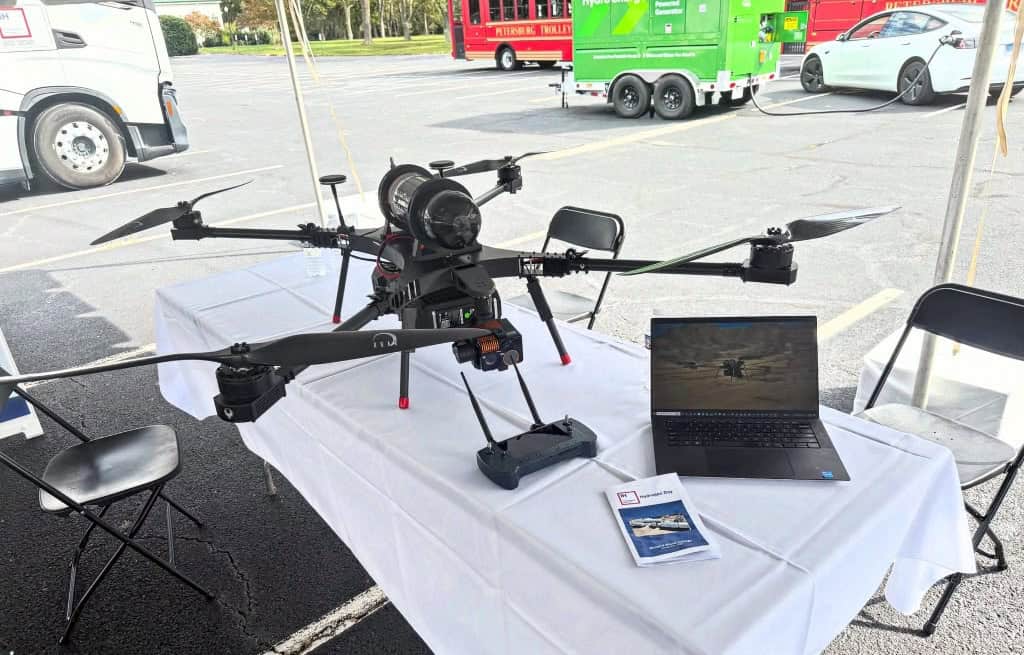
Phoenix P1 Hydrogen UAV
Advanced hydrogen-powered drone with market-leading flight time
The Phoenix P1 is a hydrogen-powered multirotor UAV engineered for long-endurance inspection, surveillance, and industrial data collection missions. Designed for operators that require significantly longer flight times than battery-powered drones can provide, the platform combines hydrogen fuel cell propulsion with modular fuel storage, enabling configurable endurance of approximately one to six hours depending on the selected hydrogen tank configuration.
Built around the IE SOAR 2.4 kW hybrid hydrogen fuel cell system, the Phoenix P1 offers the endurance and reliability required for utility inspection, oil and gas infrastructure monitoring, security patrols, emergency response, and other mission-critical operations. The aircraft is NDAA compliant throughout and features CubePilot Herelink Blue avionics, ensuring secure, dependable operation for enterprise and government users.
With a maximum take-off weight of 160 kg, communications range of up to 15 km line-of-sight, and operating altitude of up to 3,000 metres, the Phoenix P1 provides a versatile aerial platform capable of carrying advanced EO/IR payloads for demanding inspection and surveillance applications.
Key Features & Benefits
The Phoenix P1 has been designed to maximise operational efficiency while reducing the limitations associated with conventional battery-powered UAVs.
Key features include:
Hydrogen fuel cell propulsion for flight endurance of up to six hours
Three modular hydrogen tank configurations providing 1–2, 3–4, or 5–6 hours of flight
Field-swappable hydrogen tanks for rapid turnaround between missions
IE SOAR 2.4 kW hybrid fuel cell power system
NDAA-compliant aircraft architecture
CubePilot Herelink Blue flight control system
Maximum take-off weight of 160 kg
Communications range of up to 15 km (line of sight)
Operating altitude up to 3,000 metres
Wind resistance up to 12 m/s
High-performance thermal imaging with 640 × 512 resolution and 30× optical zoom
Hydrogen Power System
The Phoenix P1 utilises an advanced hybrid hydrogen fuel cell propulsion system that combines the high energy density of hydrogen with the responsiveness of battery-assisted power delivery. This approach enables substantially longer flight durations while maintaining stable aircraft performance throughout extended missions.
The modular hydrogen storage system allows operators to configure the aircraft for short-, medium-, or long-endurance operations using interchangeable composite pressure vessel tanks that can be swapped in the field without specialised equipment. This flexible architecture enables operators to optimise endurance according to payload requirements and mission objectives while reducing downtime between flights.
Compared with conventional battery-powered UAVs, hydrogen propulsion enables larger inspection areas to be covered in a single sortie, improving operational productivity and reducing the number of launches and recoveries required to complete long-distance inspection missions.

Inspection & Survey Applications
The Phoenix P1 has been developed for long-duration inspection and surveying missions where endurance, operational efficiency, and payload capability are critical.
Its extended flight time enables utility companies, infrastructure owners, and industrial operators to inspect transmission lines, substations, pipelines, renewable energy assets, and other large-scale infrastructure with fewer interruptions than battery-powered aircraft.
The platform supports advanced thermal and electro-optical payloads for identifying equipment defects, heat anomalies, structural damage, vegetation encroachment, and other maintenance issues, helping operators improve asset reliability while reducing inspection costs and minimising operational disruption.
Security & Surveillance Applications
For security and public safety missions, the Phoenix P1 delivers persistent aerial overwatch across large operational areas without the frequent battery changes associated with conventional multirotor UAVs.
Its long-endurance capability makes the aircraft well suited to perimeter security, critical infrastructure protection, border monitoring, emergency response, and incident management. High-resolution thermal imaging combined with powerful optical zoom enables operators to detect, identify, and monitor personnel, vehicles, and infrastructure from extended stand-off distances, providing enhanced situational awareness in both daylight and low-visibility conditions.
The platform’s hydrogen-powered endurance allows organisations to maintain continuous aerial coverage for significantly longer periods while reducing operational complexity.
Through established hydrogen supply partnerships, operators can access reliable hydrogen refilling services without investing in dedicated fuel production infrastructure, enabling straightforward integration of hydrogen-powered aircraft into existing inspection and surveillance workflows.
Combined with the Phoenix P1’s modular tank architecture and rapid field replacement capability, this approach helps minimise turnaround times while maximising aircraft availability during demanding operational schedules.
Applications
Phoenix Flight Industries’ hydrogen-powered UAV technology is designed to support a wide range of long-endurance commercial and government operations, including:
Utility transmission and distribution inspection
Power generation asset inspection
Oil and gas pipeline monitoring
Renewable energy inspection
Critical infrastructure inspection
Industrial asset surveying
Security and perimeter monitoring
Emergency response and disaster assessment
Environmental monitoring
Long-duration aerial surveillance
By combining hydrogen fuel cell propulsion with modular endurance configurations and enterprise-grade avionics, the Phoenix P1 enables operators to complete larger inspection and surveillance missions with fewer interruptions, improving operational efficiency while expanding the capabilities of unmanned aerial systems.
Advancing Unmanned Systems Through Strategic Collaboration
UST works with major OEMs to foster collaboration and increase engagement with SMEs, to accelerate innovation and drive unmanned systems capabilities forward.