Unmanned Surface Vehicles (USV)
Discover cutting-edge solutions from 8 leading global suppliers
The ROC + DOCK project has successfully demonstrated an integrated system to fully automate the operations of resident, zero-emission Uncrewed Surface Vessels (USVs) in ports and harbours.
The ROC + DOCK project, a collaboration between HydroSurv, South Devon College, and BMT, was funded through the Innovate UK Marine & Maritime Launchpad to overcome a key barrier to scalable uncrewed operations: the need for manual intervention for deployment, recovery, recharging, and retasking. By removing the need for human presence at the waterside, the integrated system enables true force-multiplication of resident USVs across geographically separated coastal sites.
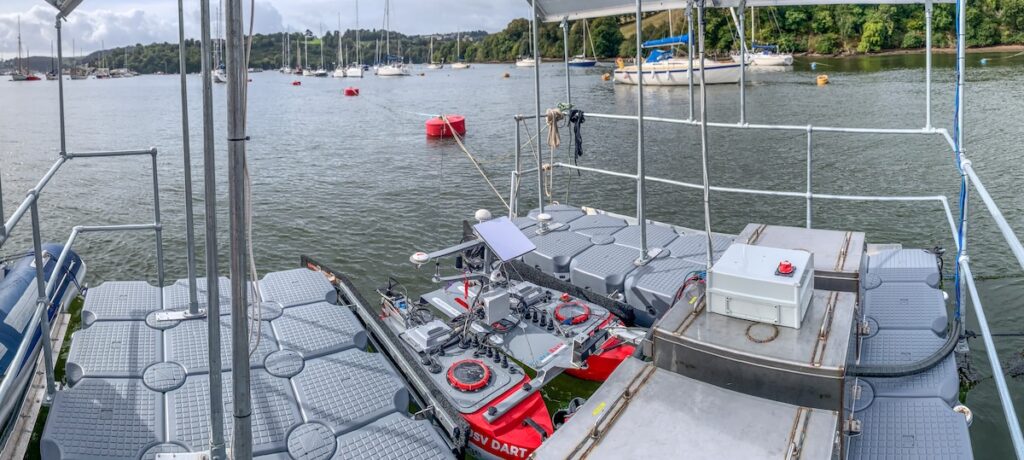
At the core of the initiative is a solar-powered docking and replenishment station, an immersive Remote Operations Centre (ROC) utilising BMT’s REMBRANDT vessel simulator, and upgrades to South Devon College’s existing training vessel, USV Dart.

The components together showcase an end-to-end workflow that could transform how short-range environmental monitoring, inspection, and surveillance missions are planned and executed from a single, centralised facility. During early September testing on the River Dart, the remotely monitored docking station, fitted with an automated mooring latch, enabled fully hands-off recovery and recharging of HydroSurv’s REAV-16 USV. Deep integration between HydroSurv’s vessel control software and the BMT REMBRANDT simulator allowed the USV to be launched, navigated, and tasked through a control interface traditionally used for crewed vessel training.
This capability represents a significant advance in Remote Operations Centre design, enabling operator training in a virtual environment that precisely replicates the vessel’s handling characteristics before transitioning to live control. This capability supports the modernisation of maritime training syllabuses and the technical evolution of uncrewed operations facilities, focusing on enhanced human factors and situational awareness.
The project culminated in a live demonstration day on September 16th at the South Devon College Marine Academy, Noss-on-Dart Marina, where the integrated system was shown to Innovate UK and invited stakeholders.
Chris Marshall said, “ROC + DOCK feels both highly successful and very promising. What stands out is the quality of collaboration between a commercial company and an academic institution not just as partners, but in a way that delivers real outcomes for both. South Devon College has taken its existing REMBRANDT system and, through this project, created a whole new line of activity for training and education in remote vessel operations. That’s unusual and valuable. It shows how technology can open opportunities, not take them away – making maritime operations safer, less physically demanding, and more accessible for the workforce of the future.”
By automating docking, charging, remote supervision, and simulator-based training, ROC + DOCK demonstrates a practical framework for force-multiplied maritime autonomy. A two-person team can now execute multiple missions from a single facility across dispersed coastal sites without the need for local on-water support.
David Hull, Founder & CEO of HydroSurv, added, “On-water data collection can achieve extraordinary productivity once vessels are set to work. The challenge lies in mobilising crew solely to launch, recover and replenish uncrewed vessels following short-duration voyages. ROC + DOCK addresses this challenge directly by enabling USVs to operate independently from a centralised hub, without the need to send a crew to the worksite. This approach not only reduces cost and decarbonises operations, but provides a blueprint for resident USV networks around the UK coastline.”
The project also tackles the acute skills and training challenge in emerging technologies such as Maritime Autonomous Surface Ship (MASS) operators. The REMBRANDT simulator and ROC facility create a progressive pathway, allowing operators to gain experience in a safe synthetic environment before progressing to live missions, ultimately preparing them for real-world operations in challenging environments. Through its REMBRANDT simulator and ROC facility, South Devon College now offers a progressive training pathway, from simulated exercises through to live remote missions, building operator confidence and competence in a safe, structured environment.
Paul Singer, Business and Qualification Development Coordinator, South Devon College Marine Academy, added, “Applied, hands-on learning is central to our ethos, and ROC + DOCK exemplifies how technology can be harnessed to reduce risk, improve accessibility, and prepare the workforce for the evolving demands of autonomy in maritime industries. It’s a proud moment for the College and a clear signal of where our maritime education and skills delivery is heading.”
The ROC + DOCK project has demonstrated that the centralised operation of small, zero-emission USVs is no longer a future vision but an emerging reality with the potential to reshape uncrewed marine data collection, inspection, and monitoring for years to come.