
Mejzlik Propellers, a developer of custom-designed carbon-fiber drone propellers, discusses the development of its second-generation 22-inch folding propeller designed to improve long-term durability and fatigue performance in forward-flight conditions. Read more >>
While foldable propellers offer clear advantages for compact, multirotor Unmanned Aerial Vehicle (UAV) design and handling, customer feedback indicated that commercially available foldable propellers did not consistently deliver the expected longevity, with some users reporting hub failures during operation.
The primary challenge identified was crossflow-induced fatigue. During forward flight, foldable propellers are exposed to a crossflow aerodynamic regime that introduces alternating forces at the blade root. Because the blade can rotate slightly within the foldable hub, these forces cause repeated micro-movements at the blade-to-hub interface, which accumulate wear over time and affect long-term stability.
Engineering Requirements & Design Focus
To address this, Mejzlik defined clear engineering requirements for a foldable propeller intended for continuous forward-flight use. Development focused on three key factors influencing hub longevity:
- Material pairing at the blade-to-hub interface.
- Internal hub geometry and load distribution.
- Clamping force securing the blade within the hub.
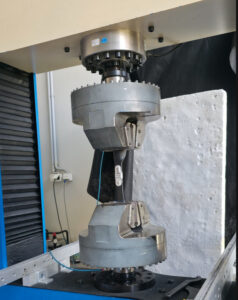
Testing & Evaluation
A dedicated crossflow test setup was developed to reproduce the alternating aerodynamic loads encountered during forward flight under controlled and repeatable conditions. A fixed-pitch 70×24 two-blade propeller was used to generate a consistent airflow, with the foldable propeller positioned perpendicular to the flow so the hub experienced characteristic crossflow loading. This allowed direct comparison of multiple hub configurations
Testing showed significant differences in wear behavior between hub designs, with the final second-generation hub architecture completing 100 hours of crossflow testing without meaningful degradation. While other commercial foldable propellers also survived the test, their observed wear levels were noticeably higher, highlighting the improved stability of Mejzlik’s design under crossflow loading.
Additional evaluations of the second-generation hub design included tip-deflection, overspin, and centrifugal load testing to further assess mechanical performance.
Design Refinements & Blade Improvements
Results from testing guided several design refinements. Material combinations at the blade bushing and hub pin were optimized, clamping force was carefully refined, and existing stress concentrations within the hub structure were eliminated. These changes improved fatigue margins and mechanical strength while maintaining full foldability. Destructive testing was also conducted to confirm structural integrity and effectiveness of these developments.
The blades were redesigned using prepreg materials and manufactured through a hot-press process, increasing stiffness, improving dimensional accuracy, and delivering a more precise leading edge. The updated hub architecture and manufacturing approach also resulted in a weight reduction compared to the previous generation.
Mejzlik’s final 22-inch foldable propeller configuration delivers improved long-term stability under crossflow loading, reduced wear at the blade root, higher mechanical strength, fail-safe hub behavior, and broad motor compatibility with symmetric puller and pusher installation.
The company is extending this second-generation hub architecture to additional foldable propeller sizes, beginning with 32-inch and 34-inch variants.