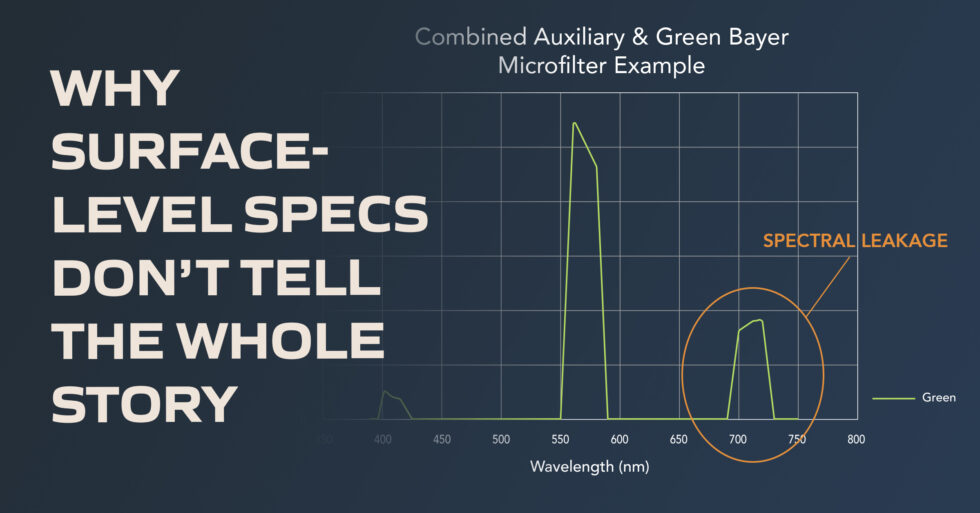
Sentera Sensors & Drones is highlighting the importance of looking beyond headline specifications when evaluating multispectral imaging systems, emphasizing that sensors with similar specifications can deliver significantly different performance in real-world applications.
While buyers often focus on metrics such as spectral band count, resolution, and cost, these figures do not reveal how data is captured, processed, and delivered. According to Sentera, the underlying sensor architecture plays a critical role in determining data quality, spectral precision, and radiometric accuracy.
Drawing on its experience developing both dedicated-channel and multi-channel multispectral systems, the company explains that factors such as filtering methods, spectral leakage, effective per-band resolution, and calibration processes can have a substantial impact on results. Dedicated-channel architectures use precise bandpass filters to isolate wavelengths, while multi-channel systems rely on microfilter arrays and auxiliary filtering methods that may introduce trade-offs between efficiency and accuracy.
To help users make informed purchasing decisions, Sentera recommends evaluating sensor architecture, calibration and alignment workflows, and true effective resolution rather than relying solely on advertised specifications.
The company explores these considerations in its white paper, Precision Filtering: Dedicated-Channel and Multi-Channel Systems, which examines filtering approaches, spectral precision, effective resolution, and the key questions users should ask when comparing multispectral sensor technologies.