Inertial Measurement Units (IMU)
Discover cutting-edge solutions from 17 leading global suppliers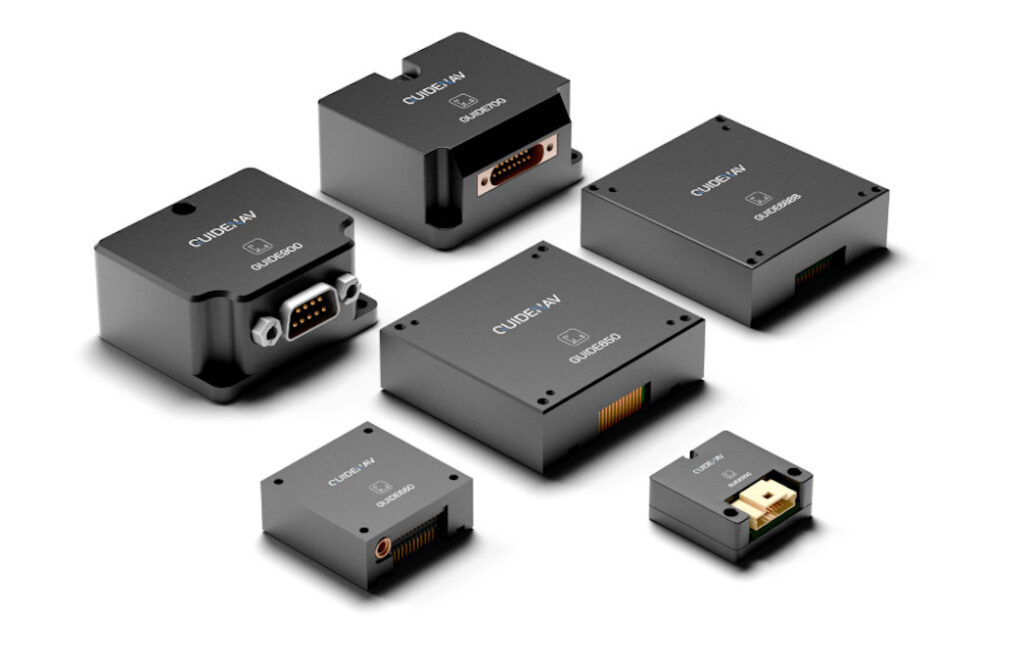
GuideNav, a developer of inertial sensing and navigation systems, discusses the features, benefits, and applications of 10-axis Micro-Electro-Mechanical Systems (MEMS) Inertial Measurement Units (IMUs) in modern unmanned platforms. Read more >>
As unmanned systems evolve, traditional 6-axis IMUs, composed of gyroscopes and accelerometers, are no longer sufficient for modern navigation and control needs. Today’s platforms require motion tracking, orientation, altitude, and environmental awareness.
This has led to the adoption of 10-axis MEMS IMUs, which integrate a magnetometer and barometric sensor with the conventional gyroscope and accelerometer, providing absolute heading and vertical positioning data.
A 10-axis MEMS IMU combines four sensor types in a single compact module:
- 3-axis gyroscopes for rotational motion
- 3-axis accelerometers for linear acceleration and tilt
- 3-axis magnetometers for absolute heading
- 1-axis barometric pressure sensor for altitude estimation
This combination delivers a richer, more complete representation of platform motion and spatial orientation, enabling improved control, navigation, and positioning in complex and GNSS-denied environments.
The gyroscope provides angular velocity along three axes, forming the foundation for real-time attitude estimation and stabilization. Key parameters include angular range, bias instability, noise performance, and bandwidth/output rate for responsive, jitter-free tracking.
Capturing dynamic acceleration and gravitational forces, the accelerometer senses motion, vibration, and tilt orientation, which is important for dead reckoning and GNSS-denied navigation. Performance depends on acceleration range, bias instability, noise floor, and response bandwidth.
A magnetometer provides a stable reference to Earth’s magnetic field, supporting long-term heading estimation, correcting drift, and enabling reliable direction awareness. This is useful in GPS-compromised environments. Key parameters include magnetic field range, resolution, and noise characteristics.
The barometric pressure sensor adds vertical awareness to a 10-axis MEMS IMU, translating air pressure into altitude information. This is essential for indoor Unmanned Aerial Vehicles (UAVs), Vertical Take-Off and Landing (VTOL) platforms, and robotic systems. Key parameters include pressure range, resolution, and measurement stability.
Advantages of 10-Axis IMUs
While 3-axis or 6-axis IMUs can measure basic motion and orientation, they may be insufficient in complex, GNSS-challenged environments.
10-axis systems provide a more complete understanding of motion and environment. The more comprehensive data enables absolute heading correction, vertical position awareness, improved dead reckoning in GPS-denied or indoor environments, and increased robustness against drift, vibration, and noise.
Applications
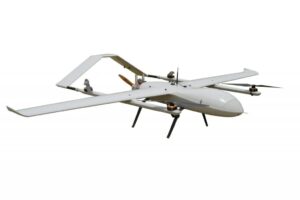 A 10-axis IMU enables UAVs to maintain altitude using barometric data, correct heading drift with a magnetometer, and retain control in GNSS outages or cluttered airspace. These capabilities are essential for autonomous flight, VTOL stabilization, and return-to-home functions under degraded navigation conditions.
In GPS-denied environments such as tunnels, basements, or other indoor facilities, ground robots and Unmanned Ground Vehicles (UGVs) rely on inertial sensing for navigation. A 10-axis IMU provides vertical awareness and heading correction, allowing robots to move across floors, ramps, or complex turns with improved positional accuracy even without mapping infrastructure.
Compact, high-shock systems like smart munitions gain from the full 10-axis sensor feedback. Gyroscopes provide orientation, accelerometers measure acceleration, magnetometers correct course, and barometers track altitude, enabling precise targeting, adaptive control, and stable guidance even during GNSS loss or countermeasures.
For stabilized optical systems, 10-axis IMUs use magnetometers for azimuth adjustment and barometers for tilt and elevation reference. This helps keep cameras or sensors locked on target with pixel-level precision, even on moving or unstable platforms.
In indoor navigation and smart mobility applications, 10-axis IMUs provide full orientation and 3D motion tracking. Barometers detect elevation changes between floors, while magnetometers supply orientation cues in steel-framed environments, supporting more accurate and reliable indoor navigation without beacons or GNSS.
GuideNav’s 10-Axis MEMS IMU
GuideNav integrates a tactical-grade 6-axis core with a magnetometer and barometer for full-state sensing in GNSS-denied and dynamic environments. Units are calibrated across temperature ranges and aligned for real-world deployment.
Customization options include output filtering, bandwidth tuning, interface adaptation, and structural adjustments. The company emphasizes engineering support, stable production with lifecycle continuity, and ITAR-free, export-friendly availability.