


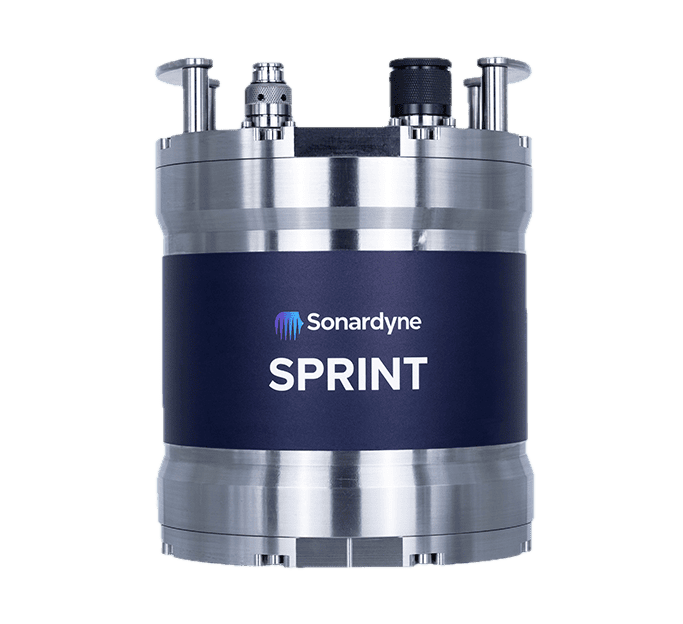
SPRINT is a high-precision subsea Inertial Navigation System (INS) engineered to deliver robust and efficient navigation for ROVs, towed platforms, and AUVs. By combining inertial and acoustic technologies, it enhances accuracy and reliability in demanding underwater environments. Using aiding inputs from USBL, LBL, DVL, and pressure sensors, SPRINT refines navigation data to improve position stability, vehicle control, and overall mission efficiency. The system supports instantaneous start-up without lengthy alignment and integrates seamlessly with existing subsea positioning hardware, extending the performance limits of USBL and optimizing LBL array efficiency.
Available in three configurations, SPRINT 300 provides a cost-effective solution for ROV and survey operations; SPRINT 500 delivers enhanced precision for multibeam surveys with automatic environmental compensation; and SPRINT 700 offers the highest-grade performance for advanced subsea metrology and mobile mapping. Constructed from titanium for long-term durability, each model offers concurrent AHRS and INS capability, onboard data storage, and battery-backed resilience.
Specifications:
| SPRINT 300 | SPRINT 500 | SPRINT 700 | |
| Heading | 0.05° secant latitude | 0.04° secant latitude | 0.02° secant latitude |
| INS Initialisation | Instantaneous | Instantaneous | Instantaneous |
| Roll and Pitch | 0.01° | 0.01° | 0.01° |
| INS Aiding Supported | USBL, Depth, DVL, Zero Velocity, Manual Position, LBL, GNSS | USBL, Depth, DVL, Zero Velocity, Manual Position, LBL, GNSS | USBL, Depth, DVL, Zero Velocity, Manual Position, LBL, GNSS |
| USBL/LBL Aided | 3x precision improvement | 3.5x precision improvement | 4.5x precision improvement |
| USBL/LBL and DVL Aided | 3 to 7 x precision improvement | 4 to 10 x precision improvement | 6 to 13 x precision improvement |
| LBL/DVL Aided | 3 cm confined area, 20 cm wide area (dynamic) | 3 cm confined area, 20 cm wide area (dynamic) | 3 cm confined area, 20 cm wide area (dynamic) |
| DVL Aided (Typical Survey) | 0.05% | 0.03% | 0.02% |
| Distance from Origin | 0.15% | 0.10% | 0.08% |
| DVL Aiding Loss/Drift | 1.2 m over 1 minute, 5 m over 2 minutes |
0.8 m over 1 minute, 3.2 m over 2 minutes |
<0.5 m over 1 minute, 2 m over 2 minutes |
| Station Keeping | <1 m over 24 hours (Syrinx DVL) | <1 m over 24 hours (Syrinx DVL) | <1 m over 24 hours (Syrinx DVL) |
| Power Requirement | 20–50 V dc, 15 W nominal (35 W maximum) | 20–50 V dc, 15 W nominal (35 W maximum) | 20–50 V dc, 15 W nominal (35 W maximum) |
| Power Pass Through | 3x for external aiding sensors (up to 3 A per sensor) | 3x for external aiding sensors (up to 3 A per sensor) | 3x for external aiding sensors (up to 3 A per sensor) |
| Internal Battery Backup | Li-ion/5 minutes | Li-ion/5 minutes | Li-ion/5 minutes |
| Data Storage | 8 GB internal memory | 8 GB internal memory | 8 GB internal memory |
| Serial Ports/Protocol | 4x RS232 or RS485 | 4x RS232 or RS485 | 4x RS232 or RS485 |
| Other Ports | Ethernet, 4x Triggers | Ethernet, 4x Triggers | Ethernet, 4x Triggers |
| Output Rate | Up to 100 Hz | Up to 100 Hz | Up to 100 Hz |
| Connector Options | 4x Seacon/Seanet 1x Seacon/Seanet |
4x Seacon/Seanet 1x Seacon/Seanet |
4x Seacon/Seanet 1x Seacon/Seanet |
| Mechanical Construction | Titanium | Titanium | Titanium |
| Dimensions 4,000 m (Seacon): 6,000 m (Seacon): 4,000 m (Seanet): |
205 x 260 mm 205 x 280 mm 205 x 250 mm |
205 x 260 mm 205 x 280 mm 205 x 250 mm |
205 x 260 mm 205 x 280 mm 205 x 250 mm |
| Weight in Air/Water 4,000m: 6,000m: |
18.5/11.5 kg 22/14 kg |
18.5/11.5 kg 22/14 kg |
18.5/11.5 kg 22/14 kg |
| Depth Rating | 4,000/6,000 m | 4,000/6,000 m | 4,000/6,000 m |
| Operating Temperature | -20 to +55°C | -20 to +55°C | -20 to +55°C |
| Storage Temperature | -20 to +60°C | -20 to +60°C | -20 to +60°C |
| Shock Rating | 22 g, 11 ms half sine | 22 g, 11 ms half sine | 22 g, 11 ms half sine |