Volatus has received a Special Flight Operations Certificate (SFOC) from Transport Canada, permitting the company to conduct more complex Beyond Visual Line of Sight (BVLOS) operations.
The certification authorizes the use of MatrixSpace’s next-generation radar, integrated with Kongsberg Geospatial’s IRIS Terminal platform.
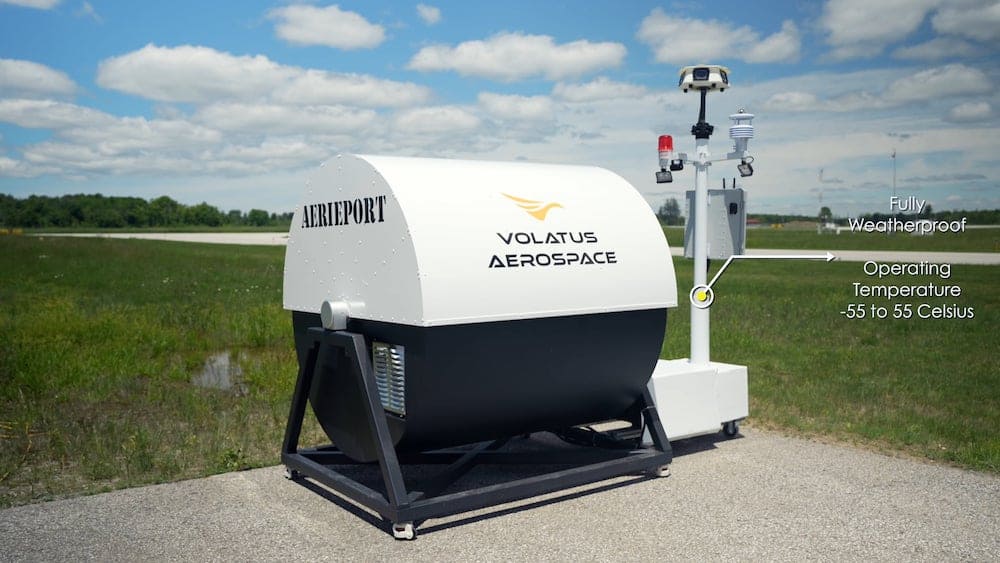
This approval enables Volatus to combine its operational expertise with these advanced technologies, delivering a scalable, safe, and commercially viable drone-in-a-box ecosystem. This positions the company to enhance its competitive standing and expand its market opportunities.
MatrixSpace’s technology, unlike traditional ground-based radar systems, is compact, low-power, and able to detect smaller non-cooperative traffic such as other drones.
When integrated with Kongsberg’s proven airspace awareness and traffic management software, and supported by Volatus’ remote Operations Control Center (OCC), these capabilities make it practical to scale BVLOS operations into applications such as automated drone-in-a-box networks, distributed wide-area monitoring, and autonomous services where continuous, reliable detect-and-avoid is critical.
Volatus already holds nationwide SFOCs permitting BVLOS operations in low-risk airspace, atypical airspace, high altitude, and nighttime missions at an advanced regulatory risk level recognized by Transport Canada. Building on this foundation, the integration will expand automated drone-in-a-box services for infrastructure security, utilities, and industrial monitoring, as well as wide-area inspection and surveillance at higher altitudes, such as forestry, wildfire monitoring, and environmental oversight.
Glen Lynch, CEO of Volatus Aerospace, stated, “This SFOC builds upon milestones such as Volatus’ approved BVLOS medical delivery operations at Halton Healthcare. With our partners, we are expanding these capabilities by integrating a lightweight and scalable detect and avoid system. This combination makes it practical to move from specialized projects into wide-scale deployments like drone-in-a-box networks, giving customers safe, reliable, and scalable autonomous services.”
Kongsberg Geospatial provides the IRIS Terminal platform, which integrates radar, telemetry, and other sensor feeds into a single real-time airspace awareness display for safe BVLOS operations. Beyond the technology, Kongsberg brings decades of defense and aerospace experience, opening access to global security and government markets where regulatory trust and mission assurance are critical.
Jordan Freed, President and Managing Director, Kongsberg Geospatial, added, “We’re pleased to support Volatus with our IRIS Terminal platform as they expand advanced BVLOS operations. By integrating real-time airspace awareness into their Operations Control Center, Volatus is demonstrating how safe and scalable drone services can be delivered for commercial customers.”
MatrixSpace delivers the next step forward in detect-and-avoid: a compact, low-power radar system that is smaller, more flexible, and lower cost than traditional installations. It can also detect smaller, non-cooperative traffic such as other drones, making it ideally suited for scalable, autonomous deployments like drone-in-a-box networks. MatrixSpace’s growing presence in homeland security and critical infrastructure monitoring creates new opportunities for Volatus to expand into high-value markets.
Greg Waters, Co-founder & CEO, MatrixSpace, commented, “This approval represents a major step toward scalable autonomous drone operations. Our compact radar technology is designed for exactly these kinds of applications, and Volatus is leading the way in bringing drone-in-a-box and automated services to the Canadian market.”
Together, these partnerships enable Volatus to act as the integrator of a proven ecosystem combining operational expertise with advanced airspace awareness and next-generation radar to deliver safe, scalable, and commercially viable drone services.
It strengthens Volatus’ competitive edge as one of the few Canadian operators authorized for advanced BVLOS operations, while expanding drone-in-a-box and autonomous applications with scalable detect-and-avoid systems. The move also opens higher-value missions and recurring revenue opportunities in logistics, enterprise monitoring, and automated drone services.