Discover World-Leading Unmanned and Autonomous Technologies
Discover cutting-edge solutions from leading global suppliers
Zephyr has released the latest update of its drone simulation and training platform
Version 1.10.7 introduces a new Search & Rescue (SAR) Mountain scenario, updates to existing SAR training modules, and an experimental Return to Home feature. The update also delivers a range of performance improvements and bug fixes aimed at enhancing training realism and stability.
New SAR Mountain Training Environment
The headline addition in v1.10.7 is SAR Mountain, a large-scale mountainous forest environment designed to support advanced search and rescue training. The scenario enables users to apply established SAR techniques across varied terrain, waterways, campsites, and elevated areas, reflecting the complexity of real-world operations.
The new environment includes a wide range of flyable modules, allowing trainees to practice different mission profiles and search strategies:
- Free Flight – Explore the mountain environment at your own pace
- Lost Hiker 01–03 – Search for missing hikers last seen near trails, waterfalls, and ponds
- Lost Climber / Lost Climbers – Locate one or more climbers reported missing on different mountain faces
- Lost Camper 01–03 – Conduct searches around campsites, rivers, valleys, and connecting lakes
- Lost Child 01–03 – Time-critical searches near parking areas, rivers, base camps, and the mountaintop
- Missing Person – Day – An open-ended daytime search with limited intelligence on subject movement
These scenarios are designed to reinforce methodical search patterns, situational awareness, and efficient coverage of large, challenging areas.
Expanded SAR Fundamentals Modules
Version 1.10.7 also updates the SAR Fundamentals scenario with new flyable modules that focus on core piloting and observation skills commonly used during SAR missions:
- Detailed Search 01 – Identify a lost subject within a populated area using descriptive cues
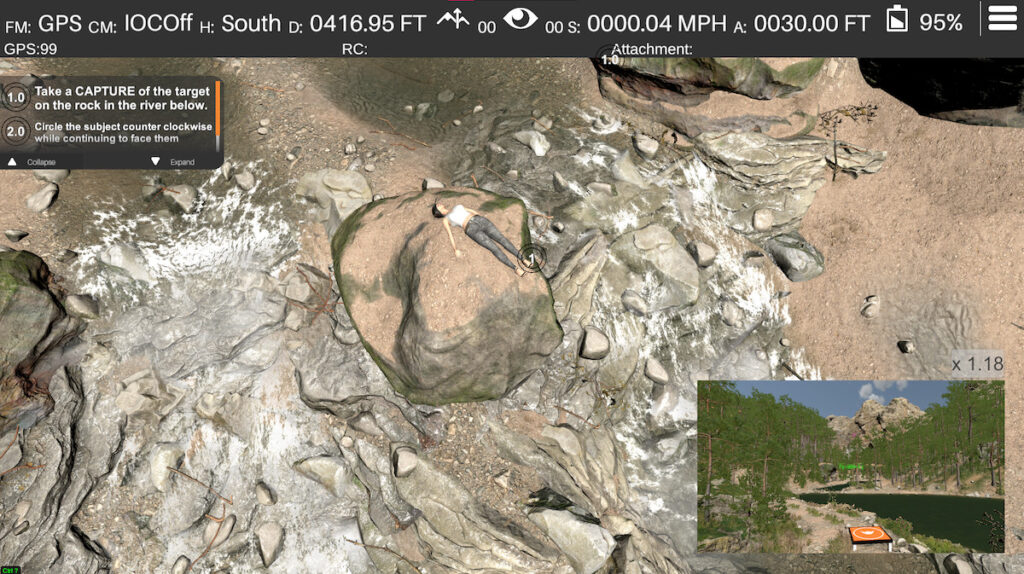
- Orbit Practice 01 – Maintain stable orbits around objects while keeping them in camera view
- Follow the Trail 01 – Fly trail-based routes while capturing imagery of targets below
- Glidescope 02 – Fly predefined routes while maintaining specified orientation
- Zoom Reveal 02 – Execute route-based flights with controlled camera direction
- Missing Camper – Search for a camper last heard from near the landing zone
These updates further align the SAR Fundamentals content with practical mission workflows and real-world piloting demands.
Experimental Return to Home Feature
The update introduces an experimental Return to Home (RTH) capability, allowing users to command the drone to autonomously return to and land near its home point. The system is designed to land within a few meters rather than performing a precision touchdown, reflecting realistic operational tolerances.
The feature can be activated by:
- Opening the map within a module
- Selecting Autonomous
- Choosing Return to Home
- Selecting Start Mission
Performance Improvements and Fixes
Alongside new content, v1.10.7 delivers several under-the-hood improvements. Notably, Zephyr has addressed an issue that caused drone wobble on systems running at lower frame rates, improving stability for a wider range of hardware configurations.
Additional fixes include:
- Improved DLC updating via the Little Arms Launcher
- Removal of unsupported screen resolutions from selectable options
Zephyr has also outlined known issues still under investigation, including a mini-map UI overlap problem, minor camera stabilisation behaviour during rapid pitch and roll changes, and reduced responsiveness when control inputs are pushed to extreme diagonals.
Read Zephyr’s v1.10.7 Patch Notes for further details.