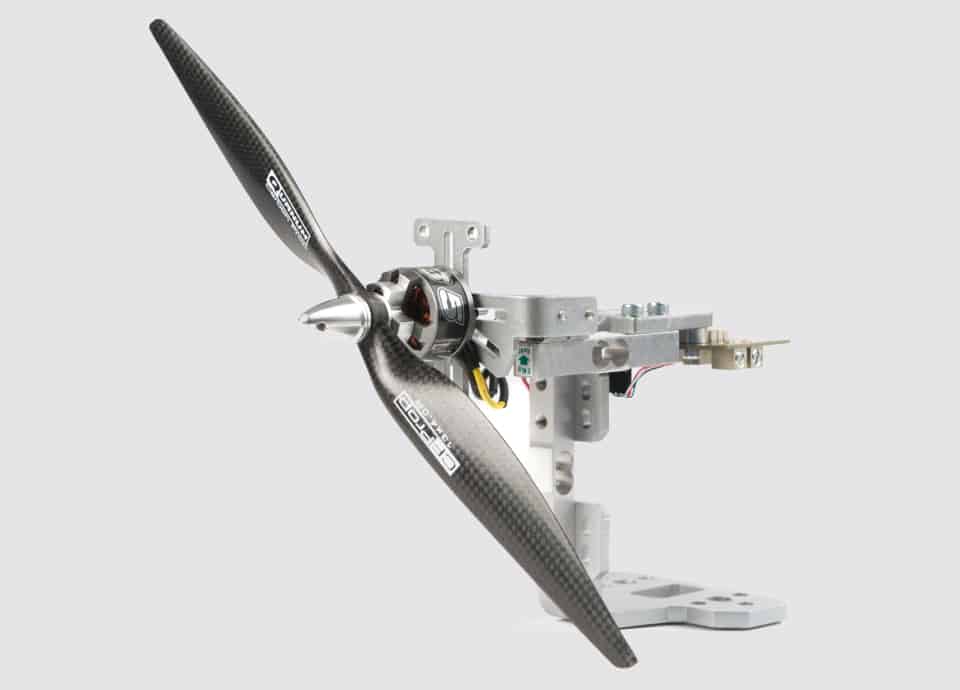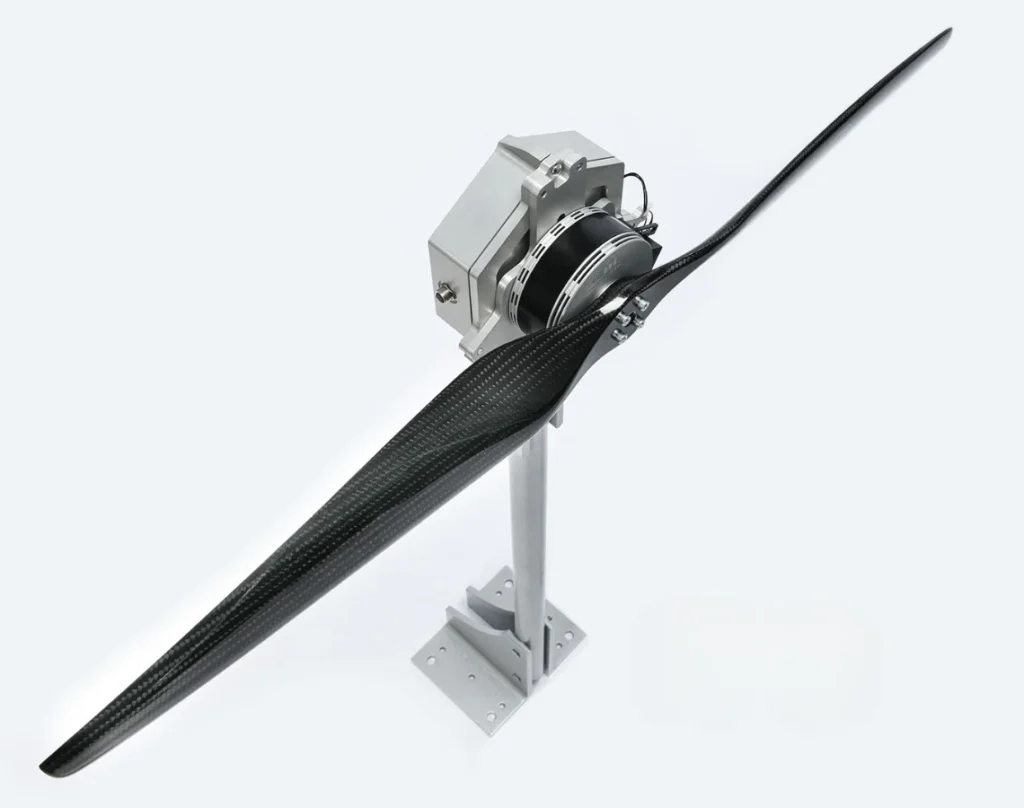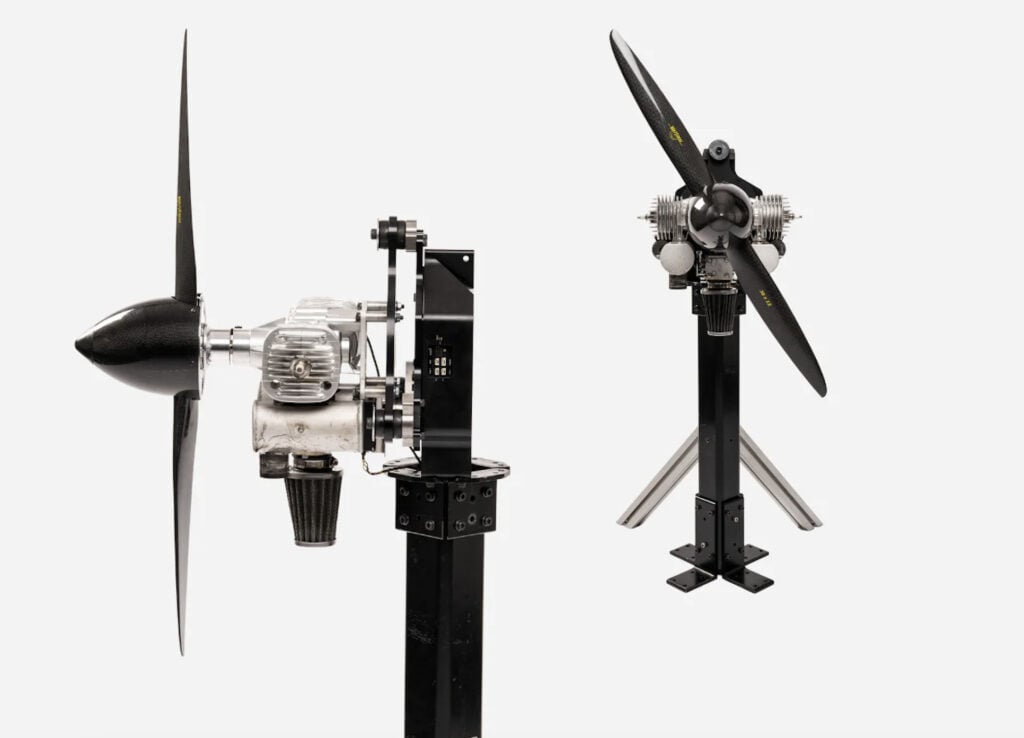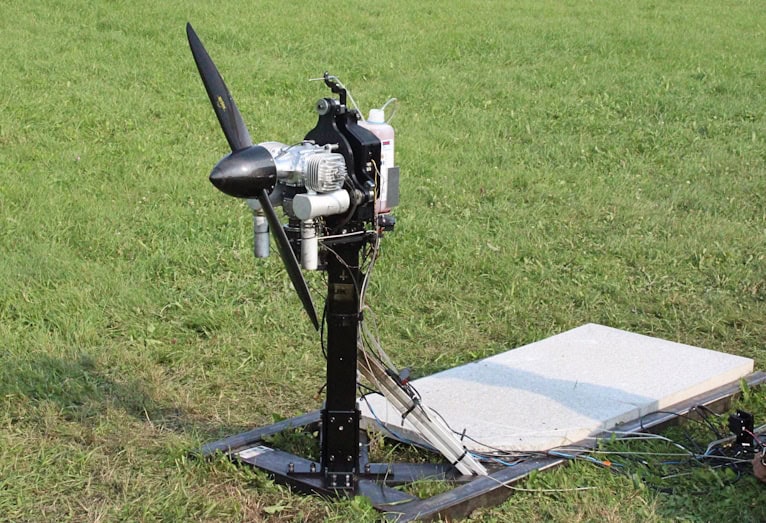

Tyto Robotics, a developer of test equipment for unmanned aerial vehicles (UAVs) and drones, conducted a study using a motor-propeller thrust stand rather than a traditional dynamometer to successfully test and map drone motor performance. Read more >>
Dynamometers are widely used to measure motor performance by applying controlled loads to characterize torque, RPM, and power.
This study explored the possibility of mapping motor performance without a traditional brake dynamometer, using a Flight Stand 15 thrust stand instead. Six propellers of different brands and sizes (11”, 16”, 18”, 22”, 26”, 30”) were installed on the motor and used as loads for the tests.
An automated step test with 10 throttle increments from 1150 to 2000 µs was performed with each propeller. Data was recorded using Flight Stand software and exported to CSV files. Motor maps were generated in Python via a Google Colab notebook, which can be adapted to other motor performance data, provided the same units and column titles are used or the code is modified accordingly.
Tyto Robotics showed it was possible to map drone motor power and efficiency using a thrust stand instead of a dynamometer.
Motor Power Consumption Map
A contour plot was generated showing rotation speed (RPM) on the x-axis and torque (Nm) on the y-axis, with modeled electrical power represented by colored sections. Measured data points were overlaid, with their color indicating the difference between the model’s predicted electrical power and the measured values. A third-order polynomial was applied to model electrical power consumption, with a maximum error of 0.8 W on 150 W, or approximately 0.5%.
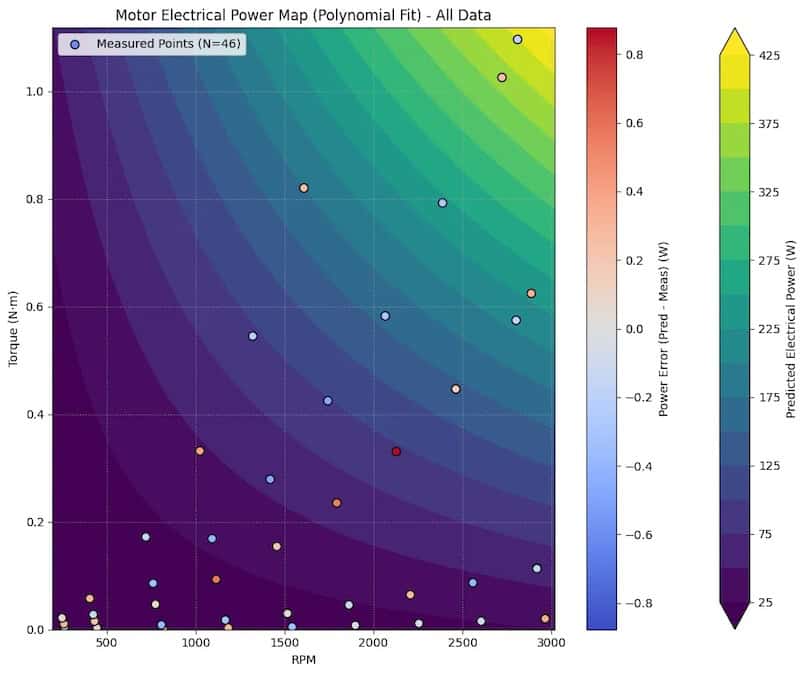
Map of motor power consumption.
Motor Efficiency Map
Motor efficiency was derived from the power map. Each colored section represented a 2% range of predicted motor efficiency. At very low efficiencies (<50%), measurement error reached up to 3 percentage points, as both power measured and torque were quite low in these ranges. At higher efficiencies typical for flight operations, the error was more negligible, below 1 percentage point for efficiencies between 74-86%.
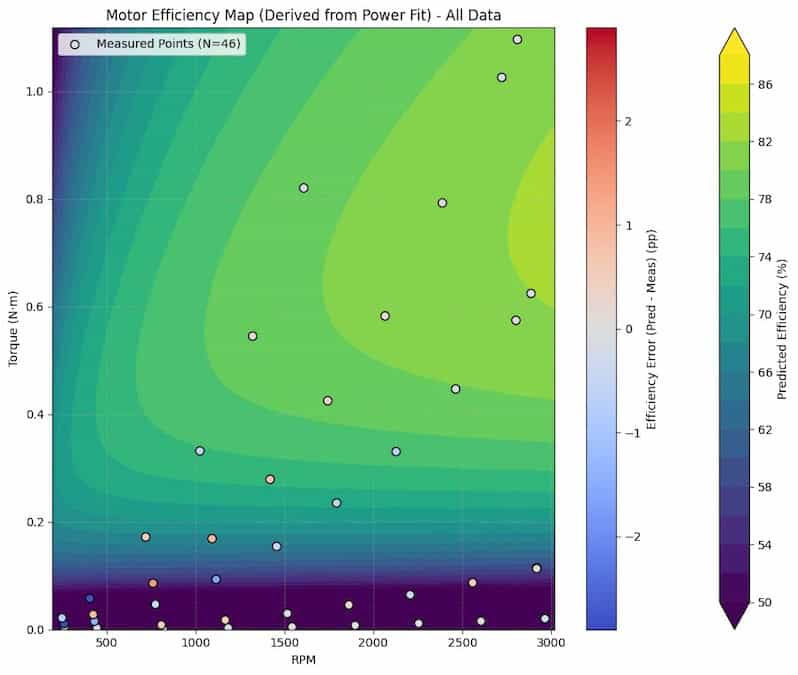
Map of motor efficiency.
Conclusion
Tyto Robotics’ study demonstrates it is possible to map drone motor performance without a traditional brake dynamometer. Using a Flight Stand thrust stand along with polynomial modeling, motor performance maps can accurately predict power consumption and efficiency for multiple configurations, including those not directly tested.
To find out more information, read ‘Drone Motor Mapping Without a Dynamometer’ here >>