
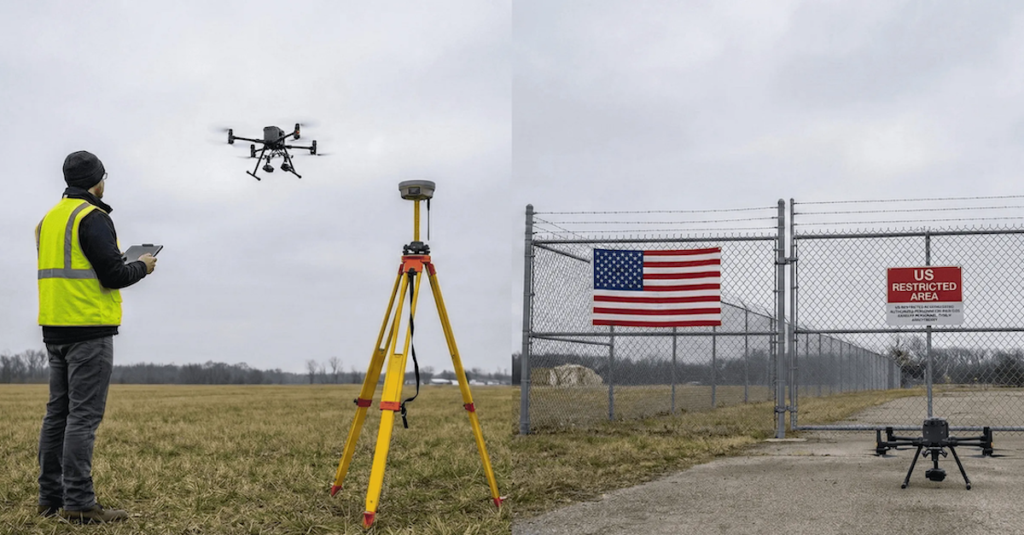
RTKdata discusses how recent U.S. regulatory developments are affecting RTK-enabled drone operations, particularly in relation to future procurement, compliance requirements, and maintaining consistent positioning workflows across platforms.
In December 2025, reporting indicated that the Federal Communications Commission moved to block the approvals required to import and sell new models of foreign-manufactured drones and certain critical components, including those from DJI and Autel. The same reporting states that previously authorized models and drones already purchased remain permitted for use.
The distinction lies in new devices. Existing fleets continue to operate, while the pathway for acquiring future platforms and components has become more constrained.
Federal Contract Requirements
Federal contract rules introduce an additional layer of restriction. FAR clause 52.240-1 defines “American Security Drone Act-covered foreign entities” and prohibits contractors from delivering covered systems. Beginning on or after December 22, 2025, the clause also prohibits operating restricted unmanned aircraft systems in contract performance, as well as using federal funds to procure or operate them.
These requirements apply to federally funded work, including infrastructure, emergency response, facility inspection, and research programs. Organizations working across private and federally connected projects may therefore need to operate separate fleets to remain compliant.
Policy Context
Reporting states that the FCC identified foreign-manufactured drones and certain critical components as posing “unacceptable risks.” It also notes that exemptions may be granted if the Department of Defense or the Department of Homeland Security determines that specific systems do not present such risks.
Impact on RTK Workflows
RTK is defined as a complete workflow that includes the aircraft, sensor payload, correction data, quality control procedures, and final deliverables. When hardware availability changes, this workflow is affected in several specific areas:
- Fleet continuity and standardization: Maintaining a consistent platform across teams may become more difficult
- Training and validation: Platform changes require retraining and re-validation of processing and accuracy checks
- Compliance-driven operations: Separate fleets may be required for private and federally funded work
- Correction workflow stability: A documented, standards-based correction process supports continuity across platforms
RTK for DJI and Existing Fleets
RTK drones from DJI remain widely used for mapping and surveying applications. Based on current reporting, these systems are not immediately restricted if already authorized and purchased. However, limitations affecting new models and certain components may influence future procurement planning.
Key considerations include maintaining existing equipment, planning and testing alternative platforms in advance, and ensuring accuracy is supported by control points, residuals, and documented settings.
NTRIP RTK as a Stable Element
NTRIP RTK remains a consistent part of the positioning workflow. It delivers RTCM correction data over a network connection and can be used across multiple compatible drone platforms.
Maintaining consistency involves using standards-based corrections, documenting coordinate reference systems and geoid models, and performing routine repeatability and accuracy checks.
Benefits and Operational Tradeoffs
The current regulatory environment presents both potential benefits and operational challenges.
Potential benefits:
- Reduced exposure to risk in sensitive applications if identified concerns are valid
- Increased emphasis on domestic manufacturing and supply chain resilience
- Clearer procurement boundaries for certain agencies
Operational challenges:
- Fewer high-performance, cost-effective platform options in the short term
- Additional requirements for retraining, retooling, and workflow validation
- The need to manage separate fleets for different project types
Operational Planning Considerations
For RTK drone operations, the following steps are identified:
- Assess which projects involve federal funding or contract requirements
- Inventory existing fleet components, including aircraft, controllers, batteries, and payloads
- Maintain reliable and accessible NTRIP RTK correction workflows
- Standardize quality assurance processes, including control points and reporting
- Evaluate alternative platforms while procurement timing remains flexible
The current shift reflects changes in the approval pathway for new drone platforms rather than restrictions on existing systems. While access to future hardware may be more limited, established RTK workflows can continue to operate when properly documented.
Maintaining consistent correction delivery through NTRIP RTK, along with structured quality control and validation practices, supports continued delivery of centimeter-level positioning results as platform availability and compliance requirements evolve.