RTKdata provides access to a global RTK corrections network with over 20,000 base stations spanning more than 140 countries.
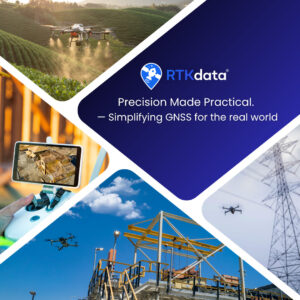 In this exclusive Q&A, UST spoke with Felix Förster, Co-Founder of RTKdata, to learn how they’re enabling centimeter-level accuracy across industries, the challenges of GNSS positioning, and how scalable, field-friendly corrections are shaping the next wave of autonomy.
Can you provide an overview of RTKdata.com and its core mission in advancing precision positioning for unmanned systems?
RTKdata helps unmanned platforms achieve dependable, high-precision GNSS without turning every job into a science project. In practice, that means fast onboarding, clear NTRIP parameters, and correction streams that drop straight into the hardware and flight stacks teams already use. From onboarding on our website to getting your first RTK fix can be done in a matter of minutes.
What challenges do unmanned systems operators face with GNSS positioning, and how does RTKdata.com address these pain points?
Out in the field, the usual challenges are multipath, weather, and being too far from a good correction source. We focus on two things that actually help: timely correction streams with sensible mount point options, and responsive support so operators pick the frame their device expects.
When a project needs iron-clad local reliability, we can, if needed, arrange a permanent, stationary RTK base station for longer-term work so the correction source sits exactly where the job happens. Lead time is often just a couple of days once power, internet, and site access are in place. What’s distinctive is how straightforward we make these deployments: pre-configured hardware, a clear commissioning checklist, and seamless use with the same standard NTRIP workflow customers already run, so teams get local certainty without redesigning their operation.
Can you walk us through a real-world use case where centimeter-level corrections directly improved performance?
Corridor mapping is where RTK pays off fast. With corrected positions, flight lines actually fly where you drew them, so you don’t over-pad sidelap “just in case” and you don’t refly gaps after a crosswind. That saves batteries, time on site, and a lot of nerves.
Photogrammetry also behaves better: less “doming,” quicker alignment, and a model that holds the same scale from start to finish. In LiDAR, a tighter GNSS trajectory results in cleaner strip alignment without constant boresight tweaking, speeding up QA and reducing the need for overlap. Most teams go from laying dozens of GCPs to dropping a few checkpoints for validation, less walking, fewer permission hassles, and lower field risk, especially along roads, rails, and pipelines.
Which industries or applications have you seen gain the most transformative benefits from high-precision corrections?
Two standouts are construction survey and long-corridor inspection. On construction sites, RTK turns layout into “set it once and build,” stakeouts land where the tape says, as-builts close cleanly, and much avoidable rework quietly disappears. On power lines, pipelines, and roads, corrected flight paths follow the plan instead of the wind, so you don’t over-pad sidelap or have to refly spans, and stitching holds together on the first pass.
What measures have you taken to make RTKdata.com scalable for large fleets or OEMs integrating corrections into their platforms?
We keep scaling simple rather than fancy. Corrections are delivered over standard NTRIP with a single, predictable set of fields, host, port, username, password, and mount point, so teams can copy the same template across all devices. Capacity is added simply by increasing concurrent streams on your account; crews don’t need to learn a new workflow. For OEMs and larger operators, we focus on the basics that matter in the field: clear connection settings, guidance on common mount point and frame choices, and responsive support during rollout. This way, you can pilot with a small set of vehicles and scale smoothly by adding streams as needed.
How do you see high-precision GNSS corrections shaping the next wave of autonomy?
They turn location from a best-guess into a control input. With centimeter-level corrections, the autopilot’s “confidence bubble” collapses, so planners stop padding routes by a meter “just in case” and start flying to exact coordinates, pads, docking rails, tight corridors, at operational speed. Latency stays low, so you don’t get the drift-then-snap EKF tantrums that waste batteries and spook operators; missions run clean, end-to-end. A blunt field outcome: a 1–2 m landing catch box becomes a 20–30 cm box, which means fewer go-arounds and faster turnarounds.
Just as important, corrections surface real health signals, age, residuals, fix state, so your stack can down-mode early (slow/hold/RTH) before a nuisance turns into an incident. Net effect: autonomy becomes predictable enough to write procedures around and auditable enough to scale without a human babysitter on every flight.
Are there any new areas that RTKdata.com is looking to move into, outside of your current range of products, in 2025 and beyond?
In the near term, we’re doubling down on the core experience: shaving minutes off onboarding, clearer mountpoint guidance by device, and offering pre-flight connection checks that show whether corrections, GGA, and fix state are healthy.
We’re also investing in fleet-friendly basics operators keep asking for: straightforward stream provisioning, stable credentials, and simple telemetry so teams can see uptime and correction age at a glance. Beyond drones, the biggest demand we’re seeing is in mobile robotics, yards and warehouses where repeatable docking and route replay are daily tasks. Our approach there is the same: standard NTRIP in, low latency, and templates that make “set it once and run” the default.
Thank you for your time, Felix. It has been a pleasure speaking with you, and we look forward to following the continued advancements and adoption of RTKdata’s world-leading GNSS RTK corrections and precision positioning solutions across drones, robotics, and autonomous vehicles.