


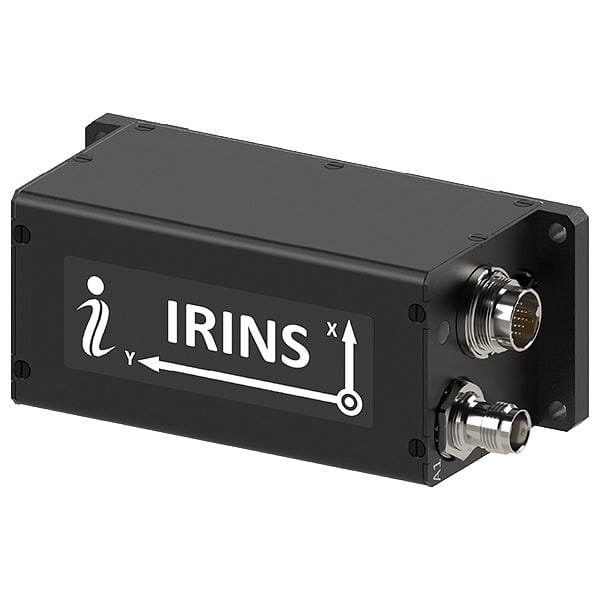
IRINS combines an INS and AHRS with an embedded Iridium STL-2600 LEO PNT receiver to maintain position, velocity, attitude, and time when traditional GNSS is unreliable or under attack. The tight coupling of inertial sensing, LEO-based timing/navigation, and anti-jam GNSS (with CRPA port) delivers resilient performance across land, air, and sea domains. The system meets IP67 and MIL-STD-810G environmental standards and minimizes drift through calibrated MEMS sensors and aiding inputs.
The compact platform achieves GNSS-denied performance of 80 m RMS position and 2 m/s velocity accuracy. Integrated barometer and magnetometer sensors, plus an optional onboard air-data computer within the AHRS, support continuous navigation in D3SOE conditions. Offered in enclosure, OEM, and deck-mount variants, IRINS supports RS-232/RS-422, CAN, and Ethernet interfaces, operates from 9–36 V DC with under 8 W consumption, and unifies assured PNT and navigation functionality.
Specifications:
| Dimensions: |
IRINS: 126.5 × 49.3 × 53.3 mm IRINS-OEM: 86 × 51 × 48 mm IRINS-DM: 160 × 141 × 61 mm |
| Weight: |
IRINS: 220 grams IRINS-OEM: 80 grams IRINS-DM: 1300 grams |
| GNSS-Denied Position Accuracy: | 80 m, RMS |
| GNSS-Denied Velocity Accuracy: | 2 m/s |
| Jamming and Spoofing Mitigation: | Yes |
| Input Voltage: | 9–36 V DC |
| Power Consumption: | <8 W |
| Interfaces: | RS-232, RS-422, CAN, Ethernet |





